



In a closed-door meeting on Capitol Hill, crypto industry leaders reviewed the latest text of the long-awaited crypto market structure bill, which focused on key proposals to address the stablecoin yield and rewards dispute.
Latest CLARITY Act Draft Says No To Stablecoin Yield
On Monday, the crypto industry got the first look at the latest version of the crypto market structure bill, known as the CLARITY Act, which addresses the main issue that has stalled the legislation over the past two months.

Industry sources shared details of the latest legislative text with the Journalist Eleanor Terret. According to an internal stakeholder email shared with Terret, the proposal would prohibit platforms from offering yield, directly or indirectly, for holding a stablecoin, or in a manner that resembles a bank deposit.
Notably, this restriction would broadly apply to digital asset service providers, including exchanges and brokers, as well as their affiliates. The proposal seeks to limit workarounds and prohibit any activity that is “economically or functionally equivalent” to interest, addressing concerns from the banking industry side.
It’s worth noting that the crypto market structure bill has been stalled since the Senate Banking Committee published its draft in mid-January. The text included several divisive policies, including significant restrictions for DeFi and the payment of interest on stablecoins.
The yield dispute became a major sticking point between the banking and crypto industries, leading to a prolonged negotiation period. The banking side has criticized the landmark stablecoin legislation, the GENIUS Act, for loopholes that could allegedly put the financial system at risk and distort market dynamics.
Ahead of the January draft, banks pressed lawmakers to include language in the CLARITY Act that bans yield on stablecoins from crypto exchanges, brokers, and related entities, rather than only issuers.
To address this issue, the Senate Banking Committee proposed that issuers offer rewards for specific actions, such as account openings and cashback, but prohibited interest payments to passive token holders. A month ago, the White House held a meeting to negotiate between the two sides.
As reported by Bitcoinist, Patrick Witt, executive director of the US President’s Council of Advisors on Digital Assets, reportedly brought a draft text that left earning yield on idle stablecoin balance “effectively off the table,” narrowing the debate to whether crypto firms could offer rewards linked to specific activities.
Terret’s report shared that the latest proposal would allow rewards based on user activity, including loyalty, promotional, or subscription programs, if they are not considered equivalent to interest from an economic or functional standpoint.
In addition, the latest version of the CLAIRTY Act would require the Securities and Exchange Commission (SEC), the Commodity Futures Trading Commission (CFTC), and the Treasury Department to collaborate to define acceptable rewards and establish anti-evasion regulations within a year.
Rewards Compromise Sees Mixed Reactions
The text has received mixed reactions from the crypto industry, with some calling the language more “restrictive.” One crypto industry leader who reviewed the text told Terret that the draft “is a ‘departure’ from what had been previously discussed with the White House.”
The unnamed source reportedly warned that the “economic equivalence” standard on stablecoin rewards is vague, risking a more restrictive interpretation by future regulators. Furthermore, they highlighted the potential challenges in structuring incentives due to limits on tying rewards to balances or transaction amounts. “Overall, this is a more narrow and restrictive approach toward crypto,” they stated.
On the contrary, another unnamed industry leader considers that the text is “largely in line with expectations.” They told Terret that the draft reflects a “balanced outcome” that preserves transaction-based incentives while making clear stablecoins cannot function like interest-bearing deposit accounts.
“This is the best possible result,” they reportedly affirmed, concluding that the text is “broader than the initial Tillis-Alsobrooks proposal, which would have been more restrictive on crypto.” Bank representatives will now review the draft at a similar meeting on Tuesday.
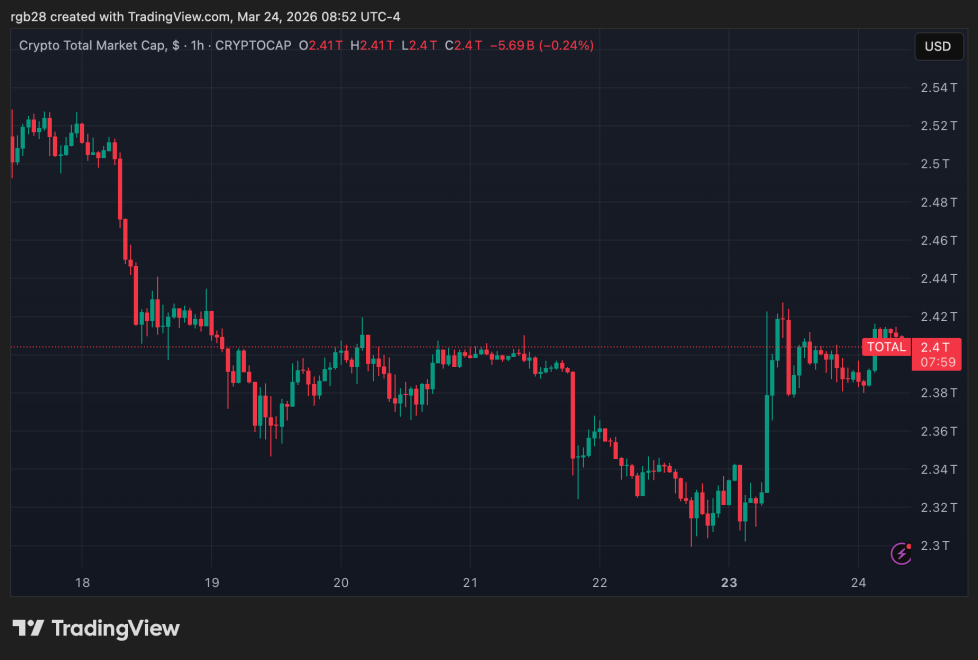
The total crypto market capitalization is at $2.4 trillion in the one-week chart. Source: TOTAL on TradingView
Featured Image from Unsplash.com, Chart from TradingView.com
Editorial Process for bitcoinist is centered on delivering thoroughly researched, accurate, and unbiased content. We uphold strict sourcing standards, and each page undergoes diligent review by our team of top technology experts and seasoned editors. This process ensures the integrity, relevance, and value of our content for our readers.


Be the first to comment