

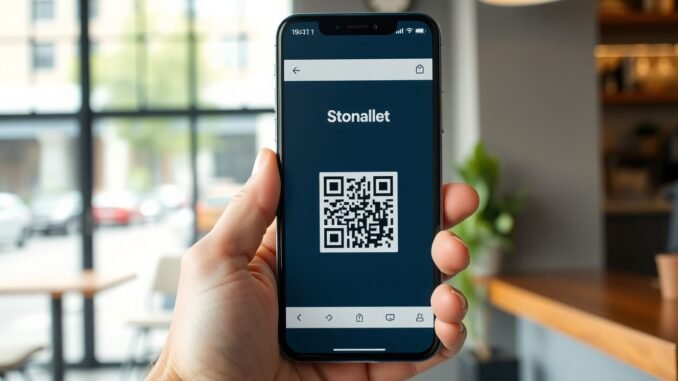

In a significant move for digital asset utility, the Stakestone-based Stone Wallet has officially launched its global QR payment service, enabling fee-free mobile transactions across ten initial regions as of April 2025. This development marks a pivotal step in bridging decentralized finance with everyday commerce, directly addressing user demand for simpler and more cost-effective crypto spending mechanisms. Consequently, the service bypasses the need for physical cards entirely, leveraging smartphone technology to facilitate seamless point-of-sale interactions.
Stone Wallet QR Payment Service Mechanics and Launch
The newly launched Stone Wallet QR payment service functions through a dedicated mobile application. Users simply open the app to generate a dynamic, one-time QR code at the point of sale. Merchants then scan this code to instantly receive payment in the user’s chosen digital asset. Importantly, the transaction settles on the underlying Stakestone (STO) omnichain infrastructure, which manages the cross-chain liquidity required for such operations. The initial launch encompasses ten diverse regions, including parts of Southeast Asia, Europe, and North America, indicating a strategic, phased global rollout.
Furthermore, the project’s team emphasized the zero-fee structure in their announcement. This policy starkly contrasts with traditional payment networks and even some competing crypto payment solutions, which typically charge merchants between 1% to 3% per transaction. The service’s architecture apparently absorbs network costs, presenting a compelling value proposition for both consumers and businesses. Industry analysts note that eliminating fees removes a major barrier to adoption, especially for micro-transactions where fees can disproportionately erode value.
The Role of Stakestone’s Omnichain Infrastructure
This payment service is not a standalone product but a direct application built atop the Stakestone protocol. Stakestone provides the essential omnichain liquidity infrastructure that makes such a seamless service possible. Essentially, it acts as a decentralized router, enabling assets from various blockchains—like Ethereum, Solana, or Polygon—to be used for a payment without the user manually bridging or swapping tokens beforehand. This backend complexity remains invisible to the end-user, who experiences a simple, unified payment interface.
Moreover, this infrastructure ensures security and finality. Transactions are not mere promises but settled on their native chains, leveraging Stakestone’s validation mechanisms. The choice to build on Stakestone, therefore, provides Stone Wallet with significant technical advantages, including reduced latency and enhanced reliability compared to building proprietary bridges. This foundational technology is critical for scaling the service to support more assets and higher transaction volumes in the future.
Expert Analysis on Market Impact and Trajectory
Financial technology experts point to several key implications of this launch. First, it represents a maturation of crypto payment solutions, moving beyond speculative trading into tangible utility. Second, the zero-fee model could pressure existing payment processors to reconsider their pricing strategies. However, experts also caution that widespread merchant adoption is the next critical hurdle; a payment method is only as useful as the number of places that accept it.
Data from recent industry reports shows a steady increase in merchant crypto acceptance, but penetration remains below 10% globally for physical retailers. The success of Stone Wallet’s service will likely depend on its partnership strategy and the ease of integration it offers to existing point-of-sale systems. The project’s roadmap, referenced in their communications, suggests plans for direct API integrations with major e-commerce platforms and physical terminal providers in subsequent phases.
Comparative Landscape of Crypto Payment Solutions
The digital payments space is increasingly competitive. To understand Stone Wallet’s position, a brief comparison is useful.
- Traditional Crypto Cards: Services like those from Crypto.com or Coinbase issue physical or virtual debit cards. They automatically convert crypto to fiat at the point of sale but often involve spread fees and foreign transaction fees.
- Pure QR Systems: Some blockchain networks have native QR systems (e.g., for stablecoins), but they are often chain-specific and lack the omnichain fluidity of the Stakestone solution.
- Mobile Wallet Tap-to-Pay: Apple Pay and Google Pay integrations for crypto are emerging, but they typically rely on the traditional card rails, inheriting their fee structures and settlement times.
Stone Wallet’s model differentiates itself by combining an omnichain backend with a dedicated, fee-free QR frontend. This approach potentially offers greater control over the user experience and cost structure. The following table summarizes key differentiators:
| Feature | Stone Wallet QR | Traditional Crypto Card | Chain-Specific QR |
|---|---|---|---|
| Underlying Tech | Stakestone Omnichain | Traditional Card Networks (Visa/MC) | Single Blockchain (e.g., Ethereum) |
| Primary Fee | None | 1-3% + spread | Network Gas Fees |
| Asset Flexibility | Multi-chain | Depends on provider | Single-chain only |
| User Requirement | Smartphone + App | Card or Phone NFC | Smartphone + Chain-Specific Wallet |
Security, Accessibility, and Future Roadmap
Security is paramount for any financial application. The Stone Wallet utilizes non-custodial principles, meaning users retain control of their private keys. The QR code generated for payment is a signed message, not a direct key exposure, and expires after a short time window. This design mitigates risks associated with static QR codes. Additionally, the integration with Stakestone’s audited smart contracts provides another layer of security for the settlement process.
Regarding accessibility, the service launch in ten regions demonstrates a focus on markets with high smartphone penetration and growing crypto literacy. The team has indicated that expansion plans are contingent on regulatory compliance and local partnership development. Future iterations of the service, as hinted in community discussions, may include loyalty program integrations, recurring payment setups, and support for central bank digital currencies (CBDCs) as they emerge.
Conclusion
The launch of Stone Wallet’s QR payment service represents a substantive advancement in practical cryptocurrency adoption. By leveraging the Stakestone omnichain infrastructure to enable fee-free, mobile-first transactions, the project directly tackles usability and cost barriers that have long hindered crypto’s use in daily commerce. While the success of this Stone Wallet QR payment initiative will ultimately depend on merchant adoption and seamless user experience, its foundational technology and consumer-friendly fee structure position it as a significant contender in the evolving landscape of digital payments. The coming months will be critical in observing user uptake and the service’s expansion into new markets and use cases.
FAQs
Q1: How does the Stone Wallet QR payment service work?
The service works through the Stone Wallet mobile app. Users generate a one-time, dynamic QR code at checkout. The merchant scans this code, and the payment is processed and settled across blockchains via the Stakestone infrastructure, with no fees charged to the user.
Q2: What is Stakestone (STO), and why is it important for this service?
Stakestone is an omnichain liquidity infrastructure protocol. It allows different blockchains to communicate and transfer value seamlessly. This technology is crucial for the QR service because it lets users pay with assets from various chains without manually managing bridges or swaps.
Q3: Are there really no fees for using the QR payment service?
According to the official announcement, the service currently charges no additional fees for payments. The project appears to be absorbing the underlying network costs to drive adoption, though this policy could be reviewed as the service scales.
Q4: In which regions is the service currently available?
The service launched in ten initial regions. While the official announcement did not list all ten, it indicated a global spread including areas in Southeast Asia, Europe, and North America. Users should check the official Stone Wallet app for availability in their specific location.
Q5: How does this compare to using a crypto debit card?
The key differences are the fee structure and technology. Crypto cards typically use traditional payment networks and charge fees (1-3% + spread). The Stone Wallet QR service uses a direct blockchain settlement via Stakestone and charges no fees. It also doesn’t require a physical card, relying solely on a smartphone.
Disclaimer: The information provided is not trading advice, Bitcoinworld.co.in holds no liability for any investments made based on the information provided on this page. We strongly recommend independent research and/or consultation with a qualified professional before making any investment decisions.


Be the first to comment