

Developers building crypto products face a crowded API market. The providers below solve very different problems. Some serve market data and prices. Others handle wallet infrastructure, swaps, on-chain analytics, or research. Choosing well starts with the job, not the brand.
Before comparing providers, it helps to map the main data layers:

- Market data: prices, market caps, volumes, historical charts.
- Wallet and portfolio data: balances, transactions, holdings across chains.
- On-chain and DeFi data: protocol positions, network activity, flows.
- Swap and exchange: embedded token swaps inside your product.
- Developer experience: SDKs, docs, rate limits, transport, pricing.
Most products need one layer first. Add others as the use case grows.
CoinStats API
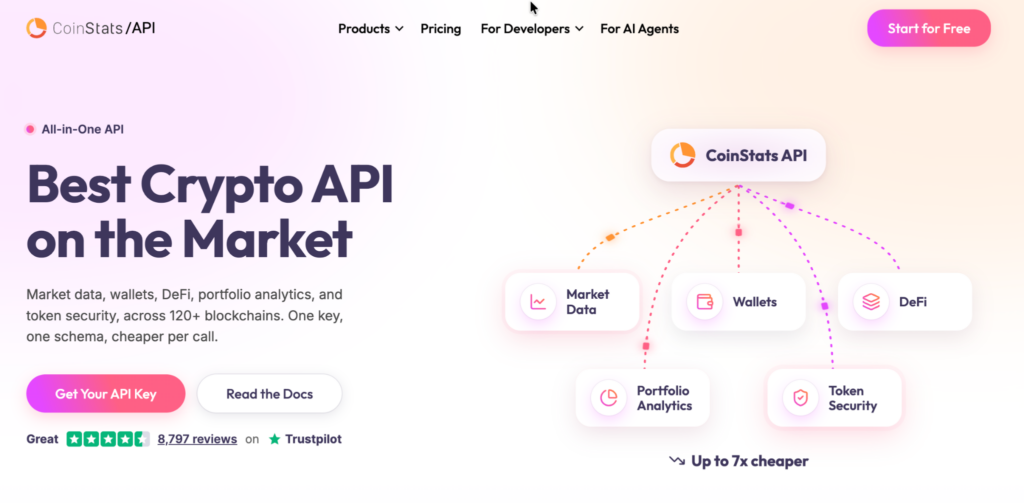
CoinStats Crypto API is an all-in-one crypto API. It combines market data, wallet data, DeFi positions, portfolio analytics, and token security data. Coverage spans 100,000+ coins, 200+ exchanges, and 120+ blockchains. Wallet endpoints return balances and transactions for Solana, Ethereum, EVM chains, and Bitcoin. Bitcoin support includes extended public keys (xpub, ypub, zpub). The DeFi layer auto-detects per-wallet positions across 10,000+ protocols. That covers staking, lending, and liquidity positions tied to an address. Around 1M users rely on CoinStats across its products.
On market data alone, coverage is broadly similar to CoinGecko or CoinMarketCap. The real difference is the wallet and DeFi layer on top. Developer communities often describe it as CoinGecko plus wallet data plus portfolio analytics. Pricing is credit-based with a free tier to start. A CoinStats MCP Server exposes wallet, DeFi, and portfolio data to AI agents. That data depth separates it from market-only MCP servers. For a fuller breakdown, see CoinStats’ best crypto API guide.

 
Best for: most crypto use cases, especially apps adding wallet or DeFi features.
Crypto APIs (cryptoapis.io)
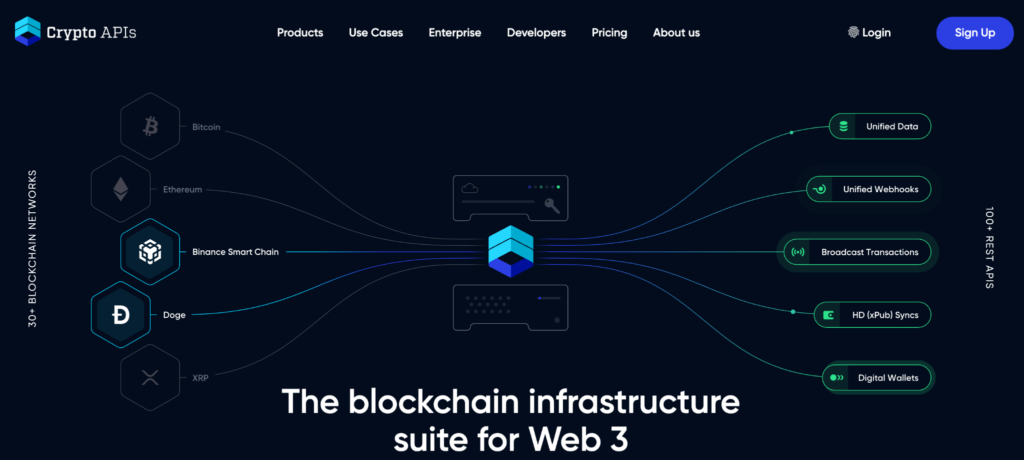
Crypto APIs focuses on blockchain infrastructure rather than data aggregation. It targets teams running wallets, exchanges, and custody in production. The suite covers real-time blockchain events with sub-100ms webhooks. HD wallet management includes xpub, ypub, and zpub support for Bitcoin. Address screening adds AML checks across 20+ blockchains. Dedicated and shared nodes provide direct JSON-RPC access. The provider is ISO 27001 certified. Customers include Ledger and Nexo. It also ships 14 MCP servers for AI agent workflows. A free API key is available, with custom enterprise plans on top. For a wallet-focused comparison, see Crypto APIs’ crypto wallet API guide.
Best for: production wallets, exchanges, and regulated fintech needing infrastructure-grade reliability.
StealthEX
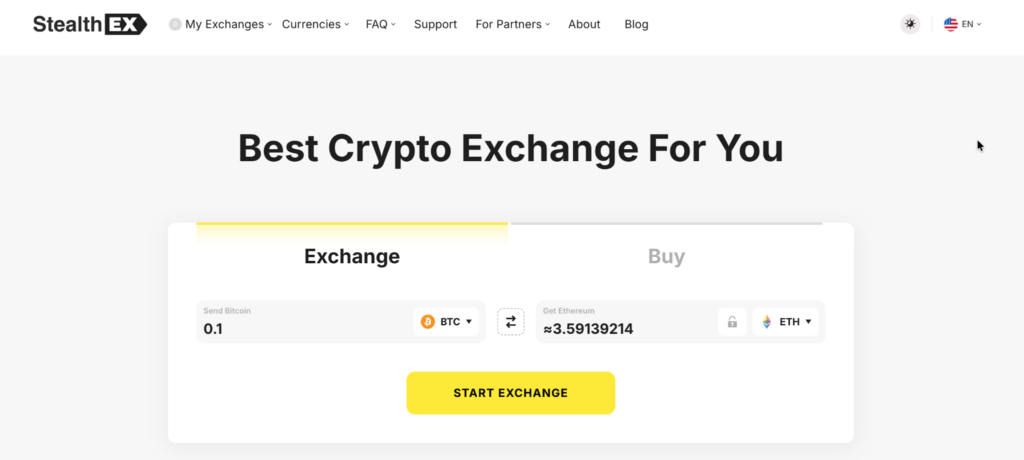
StealthEX takes a different angle from data providers. Its API embeds non-custodial token swaps inside crypto products. Wallets, aggregators, and trading terminals use it for in-app exchanges. Coverage spans 2,000+ cryptocurrencies and 100+ fiat currencies. It supports both fixed-rate and floating-rate swaps. Users swap without accounts, and the platform never holds funds. The integration model is revenue-sharing rather than a subscription. Partners set a custom fee on each transaction. For a free-tier breakdown, see StealthEX’s free crypto API comparison.
Best for: wallets and aggregators that want embedded swaps without custody.
Lambda Finance

Lambda Finance is a multi-asset, MCP-native data provider. It spans crypto, equities, options, and macro behind one endpoint. Most providers cover crypto only. Lambda exposes 198 tools through a single API surface. That replaces stitching several providers together. Transport is native MCP over Streamable HTTP and stdio, plus REST. AI agents in Claude, Cursor, and ChatGPT call any tool directly. Crypto derivatives depth includes funding rates and open interest. One agent pulls a token’s funding rate and the macro backdrop together. SDKs cover Python and TypeScript, with API-key auth. A free tier supports evaluation, and paid plans start at $29 per month. For more, see Lambda’s crypto API guide.
Best for: cross-asset research and AI agents spanning crypto and traditional markets.
CEX.IO API

CEX.IO API is a centralized exchange API for traders. It serves teams building bots, arbitrage strategies, and execution tools. Transport covers REST and WebSocket, with FIX available for institutions. REST handles order management cleanly, while WebSocket suits real-time data. WebSocket delivers around three times more information per request than REST. Endpoints expose order book, market depth, trade history, and OHLCV. Developers can stream real-time data and pull historical market data. A sandbox environment allows bot testing before going live. That feature is missing from many retail-focused exchanges. API access is free with a CEX.IO account. For a broader look at crypto data APIs, see CEX.IO’s provider roundup.
Best for: algorithmic traders and bots running on CEX.IO’s order book.
Glassnode

Glassnode is the on-chain analytics specialist. It focuses on network behavior rather than simple price feeds. The catalog runs into hundreds of metrics across many assets. Entity-adjusted metrics group addresses to surface real economic activity. Indicators include MVRV, SOPR, NUPL, and exchange flows. Data reaches developers through a REST API and Snowflake. A free plan exists with limited metrics and reduced granularity. Deeper datasets and finer resolution sit behind paid tiers.
Best for: researchers, analysts, and funds building on-chain valuation models.
CoinPaprika

CoinPaprika is a straightforward market data provider. Its REST API covers prices, market caps, volumes, and metadata. Coverage extends to tens of thousands of assets across hundreds of exchanges. A distinctive feature is its social and event data. The People endpoint exposes founder bios, team roles, and social profiles. The free tier allows roughly 20,000 calls per month. Free access caps assets near the top 2,000 coins. WebSocket streaming is reserved for enterprise plans.
Best for: market overview pages, asset directories, and lightweight research tools.
Messari

Messari is positioned as a research and intelligence platform. It layers curated analysis on top of market data. Coverage reaches 40,000+ assets across 200+ exchanges. The data extends into news, signals, fundraising, and token unlocks. Protocol research and narrative context sit alongside pricing. The free tier is rate-limited at around 20 requests per minute. Most depth lives behind enterprise pricing. Messari also offers an MCP server for AI assistants.
Best for: research-driven teams and intelligence-heavy agent workflows.
Side-by-Side Comparison
| API | Primary focus | Free tier | Transport |
| CoinStats API | All-in-one: market, wallet, DeFi, portfolio, token security | Yes | REST + MCP |
| Crypto APIs | Blockchain infrastructure: nodes, events, AML | Yes | REST + MCP |
| StealthEX | Non-custodial swaps and exchange | Yes (revenue-share) | REST |
| Lambda Finance | Multi-asset: crypto, equities, options, macro | Yes | REST + MCP |
| CEX.IO API | Centralized exchange trading and execution | Yes | REST + WebSocket |
| Glassnode | On-chain analytics and research | Limited | REST |
| CoinPaprika | Market data plus social and event data | Yes | REST |
| Messari | Research and intelligence | Yes (rate-limited) | REST + MCP |
How to Choose
Start with the job your product needs done. Market data, wallet data, swaps, analytics, and research are separate layers. A market data API will not replace a swap API. An on-chain analytics tool will not return wallet balances. Match the provider to the use case first. Add a second API only when the product demands it.
For broad coverage across prices, wallets, and DeFi, an all-in-one option fits most builds. For specialized needs, the focused providers above each win their lane. Define the use case, then pick the layer that serves it.



Be the first to comment