

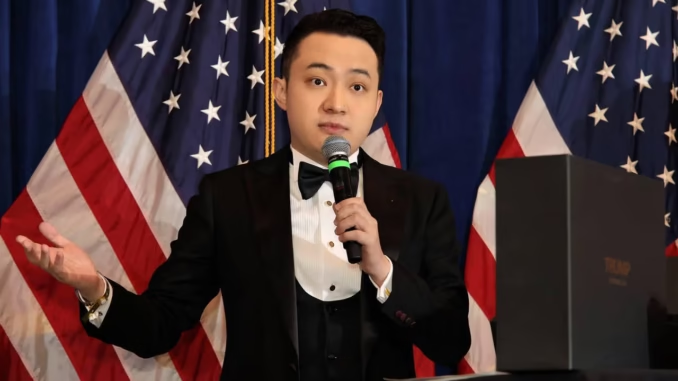

Crypto news turned to World Liberty Financial after Tron founder Justin Sun accused the project of concealing a blacklist function inside the WLFI token contract. Justin Sun said the function gave the company power to freeze or restrict token holders without notice or recourse. Sun invested in the project because it presented itself as a decentralized finance platform built to expand financial freedom and remove intermediaries.
The Tron founder also stated that WLFI blacklisted his wallet in 2025 and made him the largest affected investor. His comments arrived as WLFI faced fresh scrutiny over its borrowing activity and a sharp drop in token price.
Justin Sun says WLFI Concealed Central Control
Tron founder Justin Sun said World Liberty Financial did not disclose the blacklist function to him or other investors during the early stages of the project. He argued that the feature gave the company unilateral control over token holders’ assets and contradicted the public image of WLFI as a DeFi product. In his statement, he described the mechanism as a backdoor that could freeze, restrict, or effectively strip holders of control over their tokens.
Sun linked that claim to his own experience with the project. WLFI blacklisted his token wallet in 2025 and called himself the first and largest victim of that action. He stated that the move violated investor rights and basic blockchain standards of fairness. At the same time, he separated his criticism of WLFI’s operators from his support for President Donald Trump and his crypto policy stance.

Governance Process Faces Fresh Criticism
Justin Sun also challenged the governance structure that WLFI cited in past disputes. He said the votes used to justify key decisions did not follow a fair or transparent process. According to his statement, voters did not receive key information, participation remained restricted, and outcomes had already been determined before the community could weigh in.
That claim adds a governance dispute to the contract control issue. Sun argued that the team used governance as cover for actions that included fee extraction, token freezes, and backdoor controls over user assets. He noted investors who backed the project did not authorize those steps through any good-faith community process. His criticism focused on disclosure, transparency, and control over user funds.
WLFI Faces Pressure From Market Activity
The dispute surfaced days after World Liberty Financial drew criticism for using WLFI as collateral on Dolomite to borrow stablecoins. Reports said the project deposited billions of WLFI tokens and borrowed roughly $75 million, pushing lending pool utilization sharply higher. Market participants raised concerns after some pools tightened and depositors faced limited access to liquidity during peak utilization.
World Liberty pushed back against those concerns in public posts and said its position was not close to liquidation. The team said it could add more collateral if market conditions worsened and later reported repayments totaling $25 million in USD1. Even so, the episode added pressure to WLFI, which fell sharply over the week and extended losses from earlier highs.
Falling WLFI Price Deepens Scrutiny
The renewed attention on WLFI came as Sun’s frozen position lost more value during the token’s decline. Reports cited blockchain analytics data showing that wallets linked to Sun held hundreds of millions of WLFI tokens that remained frozen after the blacklist action. As WLFI dropped, the value of those holdings fell further, adding a financial dimension to the public dispute.
The token has now fallen steeply from earlier levels reached. That decline has kept focus on WLFI’s structure, liquidity model, and internal controls.



Be the first to comment