


What to know:
- XRP shows minor gains amid mixed technical signals, highlighting both risks and upside opportunities.
- A key breakout above $1.80 could trigger bullish momentum; failure may push the price toward $0.83.
- Debate grows over XRP’s identity, with experts emphasizing its decentralized potential beyond banking.
XRP is experiencing a minor increase while receiving conflicting technical indications that analysts say pose both risks and opportunities for the coin’s future. In addition to these developments, there is a recent discussion regarding the actual purpose of XRP, which has always been considered a banking-oriented cryptocurrency.
At the time of writing, XRP is trading at $1.31, with a 24-hour trading volume of $2.73 billion and a market capitalization of $80.90 billion. The XRP has recorded a 2.27% increase over the last 24 hours, reflecting cautious optimism among investors.
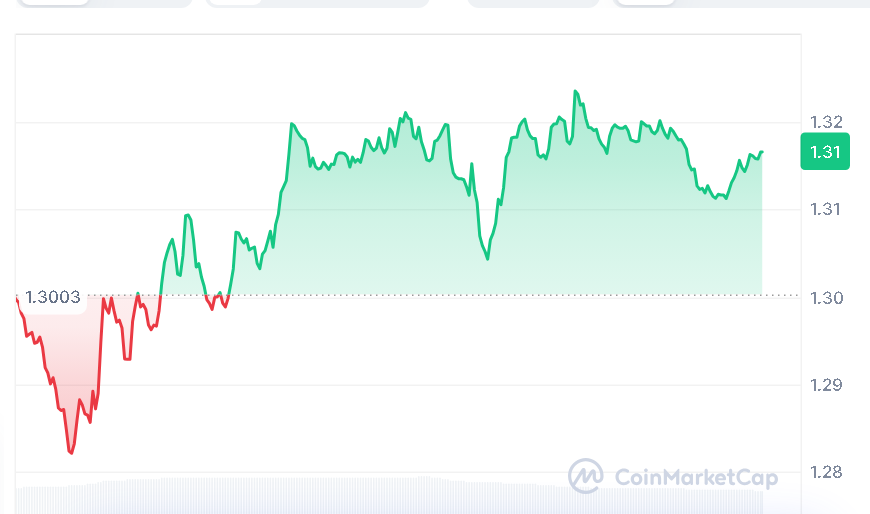
Source: CoinMarketCap

Also Read | Drift Protocol Suffers From $286 Million Breach, Triggers Market Shock
XRP Struggles as Breakout Level Holds
On April 3, 2026, the well-known crypto analyst EGRAG CRYPTO provided his technical analysis, stating that the chart for XRP at the moment looks bearish but is quite promising. The break above the level of $1.80 will destroy the current pattern of the falling wedge, and the crossing of resistance levels is predicted in the future.
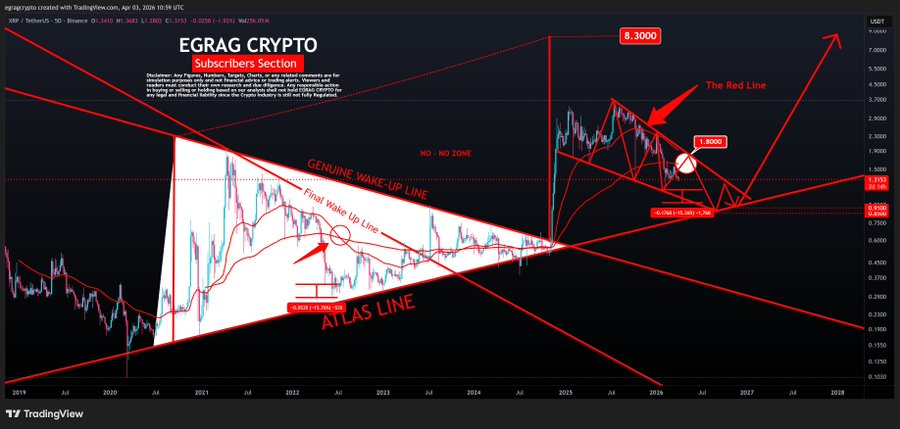
Source: EGRAG CRYPTO’s X Post
A further continuation of such weakness will push the price towards $0.83, but the upside potential is also indicated in the form of a target at $8.30. This will be possible only in a situation where the conditions change for the better, while failure to break above the Atlas Line would push the price lower.
XRP Faces Decentralization Debate Shift
On the other hand, another discourse has emerged concerning the nature and future use cases of XRP. Panos Mekras, Chief Executive Officer at Anodos Finance, suggested that XRP is no longer considered just a product meant to serve the banks. Instead, he sees XRP as a decentralized commodity running on a public and transparent platform.
His statements bring into question the established notion of XRP being mainly intended for institutional purposes, particularly in cross-border transactions. Although some proponents continue to concentrate on its application within global finance via Ripple’s collaborations, others feel this perspective overlooks its initial intent.
XRP Identity Moves Beyond Banking
According to Mekras, referring to XRP as “banker’s coin” is a misconception. It would be more accurate to refer to the origins of the project, mentioning David Schwartz, Jed McCaleb, and Arthur Britto, among other developers. It seems that from the very beginning, the objective was to create an alternative to centralized finance.
Also, he cited a previous statement made by Schwartz when he was frustrated that he could not make the payment because of PayPal’s limitations. According to Mekras, this particular scenario is one of the reasons for developing the XRP Ledger.
The XRP Ledger was created in 2012 as a public network where the sender and recipient can exchange value directly without any third-party involvement. According to Mekras, the ledger is a public network with the goal of putting more power in the hands of individuals through its exchange and token generation capabilities.
While XRP continues to make price movements that are unpredictable, the market direction of XRP and even its core identity have been significant issues.
This article contains market analysis and price predictions. These are not guarantees. Crypto markets are volatile. Always DYOR. Not financial advice.
Also Read | Bitcoin Slides as Bloomberg Strategist Warns of Potential Drop to $10,000



Be the first to comment