

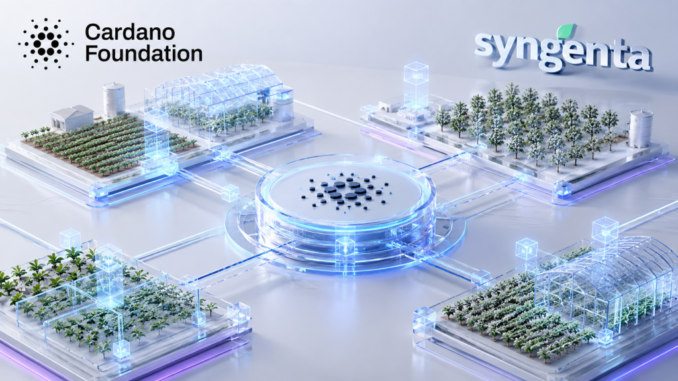

Project Swaminathan has registered 15,000 farms on Cardano, giving the network one of its clearest real-world adoption stories outside DeFi, trading and payments.
The initiative links smallholder farmers, farm parcels, land records, crop data and sustainability information into a verified trust layer that lenders, insurers, buyers and traders can reuse. Instead of forcing every institution to verify the same farm separately, the system creates a shared record that can support credit, crop insurance, traceability, compliance and market access.
That makes the milestone more important than a simple registration count. Each farm record can become part of a larger data layer where land boundaries, crop history and sustainability claims are backed by field validation, satellite observations and Cardano-anchored proofs.
Project Swaminathan Moves From Pilot To Scale
Project Swaminathan is a 1.5-year digital agriculture initiative from Syngenta Foundation India, Agri-Entrepreneur Growth Foundation and HashPoint Consulting. The project combines blockchain, AI-powered tools, satellite imagery and real-time data inside existing Agri-Entrepreneur Digital Diary workflows.
The project was designed to support crop-specific advisories, traceability, lower cultivation costs and better risk management for smallholder farmers. The initial target is 35,000 farmers across India, with a roadmap to reach 100,000 farmers and 1,000 Agri-Entrepreneurs.
The Cardano activity has already moved beyond the earliest proof-of-concept phase. The 5am.earth Cardano proposal previously recorded 10,500 farmer registrations on mainnet, with 500 new farmer registrations per day across districts in Maharashtra. The latest 15,000-farm update shows that onboarding has continued as the field network expands.
Satellite Data Becomes Trusted Infrastructure
The agriculture problem is not only data collection. It is trust.
Farmers often have fragmented records spread across paper documents, local databases, informal buyer relationships and repeated verification processes. That weakens their ability to access loans, insurance, premium markets and fairer pricing. Lenders and insurers need confidence that a farmer exists, farms a specific plot, grows certain crops and has a credible production history.
The Cardano-based model attacks that problem with a reusable verification layer. Satellite imagery, land-boundary checks, farmer and field-agent inputs, weather data and crop information can be connected into a tamper-resistant record. The Project Catalyst R&D proposal also includes decentralized identities for farm parcels, authenticated datasets and oracle infrastructure for Earth observation data.
That structure matters because the same verified farm record can support multiple services. A lender can assess production-linked credit. An insurer can price risk. A buyer can check origin and sustainability records. A trader can rely on cleaner supply-chain data. A farmer can avoid repeating the same onboarding process for every new service.
Cardano Gets A Stronger Real-World Adoption Story
Cardano’s agriculture use case fits the network’s broader pitch around low-cost records, identity, traceability and global access for underserved users. Public blockchain infrastructure can help prove origin, quality, certification status and production history in agricultural supply chains, while smart contracts can eventually support faster payments when quality or delivery conditions are met.
The timing is useful for Cardano. ADA has been under pressure, and the ecosystem has faced several difficult headlines around governance, tooling and project sustainability. A live agricultural trust layer gives Cardano a different type of proof point: real farmers, real land records and a path toward financial access that does not depend on speculative trading.
Cardano’s recent stress around founder speculation and ecosystem pressure has made practical adoption stories more important. Project Swaminathan gives the ecosystem a concrete counterweight because the value comes from infrastructure usage, not token hype.
The next test is how the 15,000 registered farms turn into active financial and commercial outcomes. Farmer identity, satellite-verified land data and sustainability records are the base layer. The stronger adoption signal will come when those records help unlock loans, insurance, traceability deals and better market access at scale.



Be the first to comment