


OKB costs $114.77 this Sunday morning, the equivalent of 102.15 euros. That gives OKX’s exchange token a market capitalisation of $2.41 billion and places it 43rd among the largest crypto-assets. Over the past 24 hours, however, only $17.89 million changed hands. The ratio between those two figures is the real finding: 0.74 percent of the market value changes owner per day. Anyone wanting to move larger sums notices it in the price.
cryptoticker.io has therefore counted where that trading actually takes place. The basis is all 33 publicly reported OKB trading pairs at 24 venues, with their respective daily turnover and their bid-ask spread. cryptoticker.io collected that data itself on October 18, 2026. The result explains why a token with a billion-dollar valuation trades so thinly, and it has a practical side for investors in Europe. An overview of the price history and the valuation is on our OKB price prediction page.
OKB’s daily turnover amounts to 0.74 percent of its market capitalisation
$17.89 million of turnover against $2.41 billion of market value: that ratio is the starting point. No outside study is needed for comparison, a look at the week is enough. On October 16 daily turnover was almost three times as high at $50.97 million, and on October 12 it was $20.98 million. The current figure is therefore not an outlier to the downside but the lower end of an already narrow range.
The circulating supply does not explain it. It stands at exactly 21 million OKB, and it is at the same time the total supply and the cap. There are no locked reserves artificially shrinking the freely tradable portion, and no unlock schedule releasing new units into the market over the coming months. The entire supply is in circulation, and still less than one percent of it moves on a normal day.

What trading volume and market depth measure for an exchange token
Trading volume is the sum of all purchases and sales over a period, counted in dollars. Market depth is something else: it describes how many buy and sell orders sit close to the current price in the order book. High turnover can come from a few large trades, and a deep book can stay quiet if nobody wants to trade. Both matter to you together, because both decide the price at which an order is actually filled.
The difference between the best bid and the best offer is called the bid-ask spread. It is the most visible price of illiquidity: anyone buying and immediately selling again loses that spread twice. With OKB it ranges from 0.017 percent to 1.21 percent depending on the venue. That is a difference of a factor of 70 for the same token.
An exchange token is a special case here. Its value does not rest on a network of its own with users of its own, but on the decisions of the company issuing it: on buybacks, on discounts for trading fees, on its role as the fuel of an associated blockchain. That is exactly why trading in such tokens usually concentrates on the issuer’s own exchange.

OKX handles 38.8 percent of all OKB trading itself
Of the $17.89 million in daily turnover, $6.95 million falls to OKX. That is 38.8 percent, and it is by far the largest single share. Behind it come GroveX with $2.76 million (15.4 percent), Gate with $2.25 million (12.6 percent) and LBank with $1.36 million (7.6 percent). Those four venues together carry 74.4 percent of the trading.
Concentration on the house exchange is the rule with exchange tokens and no shortcoming in itself. It only becomes a figure you have to allow for once you want to sell outside that exchange. The remaining 61.2 percent is spread across 20 further venues, most of which report daily turnover in the hundreds or thousands of dollars.
24 trading venues sound like choice, 20 of them carry a quarter
The number 24 stands for the venues where OKB is listed at all. It says little about the choice you really have. After OKX, GroveX, Gate and LBank come Tapbit with $811,000, XT.COM with $678,000, Hotcoin with $613,000, BitKan with $523,000, Websea with $469,000 and Pionex with $389,000. From eleventh place daily turnover is below $350,000, and from seventeenth place below $25,000.
At the bottom end sit the decentralised venues: Uniswap on X Layer manages $6,043, and the Ethereum versions together a little over $5,600. Anyone wanting to swap OKB without an exchange account will find barely any counterparty there.
Kraken is the only well-known MiCA venue on the list and turns over $1,571 a day
For investors in Europe that is the most important line of the count. Kraken appears on the list, with $1,571 of daily turnover. That is 0.009 percent of all OKB trading. Kraken runs its EU business through Payward Europe Solutions Ltd, authorised by the Central Bank of Ireland under the EU regulation MiCA since June 25, 2025.
Gate also holds a MiCA authorisation: its EU entity Gate Technology Ltd has been authorised in Malta since September 29, 2025 and ranks third in OKB trading with 12.6 percent. For the other large venues on the list we claim nothing here. The current position is maintained by the European securities regulator ESMA in its public register of authorised providers; check your own provider there before you place an order. What MiCA requires of an authorised provider is something we have put together in our overview of the MiCA obligations.
The bid-ask spread ranges from 0.017 to 1.21 percent
The tightest spread is reported by OKX at 0.017 percent, closely followed by Pionex at 0.017 and BitKan at 0.019 percent. Gate sits at 0.026 percent and XT.COM at 0.026. Above that it gets more expensive: GroveX, the second largest venue after all, comes in at 0.157 percent, Tapbit at 0.209 percent and Websea at 1.21 percent.
Concretely, for a sale of $10,000 that means the spread alone costs around $1.70 on the tightest book and around $121 on the widest. The trading fees of the respective house are added to that. The spread also applies only to the top level of the order book; larger orders run deeper into it and are filled correspondingly worse.
X Layer holds $157.96 million, down from $168.98 million on October 15
OKB is the fuel token of the X Layer blockchain. The capital locked in it rose to $168.98 million on October 15 and fell to $157.31 million on October 16, a drop of $11.67 million in a single day. Since then the figure has stood practically unchanged at $157.96 million.
The link to trading is indirect but real: the less capital works on the blockchain, the less reason there is to hold OKB for transaction fees. Demand from actual usage is therefore one of the two pillars the token rests on. The other is the scarcity created by the company.
The hard cap of 21 million OKB dates from the 2025 overhaul
That circulating supply, total supply and cap are identical is no coincidence. OKX rebuilt the token in August 2025: the function for creating new units was switched off, the supply was capped at 21 million, and the former OKTChain blockchain was discontinued, with its OKT token exchangeable for OKB until January 1, 2026. The details are in OKX’s help page on the X Layer migration.
The price reacted with a jump at the time; the all-time high of $228.74 dates from October 4, 2025. Measured against that, OKB trades 49.8 percent lower today. The cap therefore works on the supply, not necessarily on the price, and still less on turnover: a hard ceiling creates no buyers.
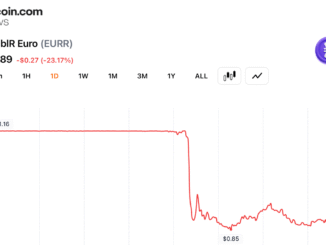
The price stands at $114.77, 8.9 percent below the weekly high
Over seven days OKB has lost 7.74 percent, and over 24 hours 2.12 percent. Over 30 days there is a gain of 0.67 percent, so the month amounts to a sideways move with a weak final week. The daily range this Sunday runs from $113.86 to $117.75.
The week starts on October 12 at $126.03 and falls through $120.95, $122.68, $122.29 and $117.06 to $114.91 today.
Levels between the weekly low of $114.91 and the weekly high of $126.03
To the downside the weekly low sits at $114.91 and therefore practically on the current price; below it follows the round $110 mark, which was not tested this week. To the upside there is first the session high at $117.75, then the area around $120, where the price sat three times from October 13 to 15, and finally the weekly high at $126.03.
Those are observations from the week’s course, not price targets. At a daily turnover of $17.89 million one qualification also applies that falls away with more liquid assets: single larger orders can move levels like these without anything having changed about the project’s position.
The newsroom’s view: the supply cap does not solve the turnover problem
From the newsroom’s perspective, the scarcity at OKB is well implemented and still not the decisive figure. The evidence sits side by side: the supply has been fixed at 21 million since August 2025, and over the same period the price has fallen from its high of $228.74 to $114.77. At the same time the capital locked on X Layer has fallen by $11.02 million since October 15, and daily turnover amounts to 0.74 percent of the valuation.
Against that, a hard ceiling works more strongly than a growing supply when demand picks up, and the valuation of $2.41 billion rests on a running business rather than on a promise. What follows is not a statement about the direction of the price but about execution: at this level of turnover, the size of your order is a risk factor in its own right. As with any crypto-asset, a total loss is possible.
Buying route in Germany: authorisation, custody and the holding period
Three points count if you want to buy or sell OKB in Germany. First, authorisation: since the transition period ended on July 1, 2026, providers in the EU need a MiCA permission to offer trading, exchange and custody. Check your provider’s status in the ESMA register before you deposit money.
Second, custody. OKB runs as a token on Ethereum and on X Layer; a hardware wallet takes both, as long as it supports the respective network. If you leave the balance on the exchange, you additionally carry that provider’s risk. Which devices are candidates is shown by our hardware wallet comparison.
Third, tax. Gains from selling crypto-assets are tax free in Germany after a holding period of one year; below that the threshold for private disposals applies. What is decisive is the date of each separate purchase, and that is exactly what becomes hard to track with a token you have bought across several venues.
OKB trading: $17.9 million a day sets the limit
The count of the 33 trading pairs leads to three steps you can work through in order:
- Check the venue. Look at whether your provider lists OKB at all and whether it is authorised in the EU. An overview of the houses reachable from Germany is in our comparison of regulated crypto exchanges.
- Match the order size to the book. At $17.89 million of daily turnover, an order of several tens of thousands of dollars is no longer a small matter. Split it, or use a limit order instead of a market order. Which exchange offers which order types is in the exchange comparison.
- Record your purchase data. Note the date, quantity and price for every purchase, otherwise the one-year period cannot be documented cleanly later. The tools from our comparison of tax and portfolio tools help with that.
(As of October 18, 2026. This article is not investment advice. Prices and fee structures change; check the terms with the provider before you buy.)





Be the first to comment