


TL;DR
- Shiba Inu entered Q3 with a major supply shift: investors withdrew 2.6 trillion SHIB from centralized exchanges after the token closed its worst Q2 on record with a 29.5% quarterly drop.
- XRP defended the $1 level at the Q2 close: buyers held the token above its key psychological support as the price bounced near the 3-month 23 EMA, preserving the broader bullish structure.
- Citi cut its Bitcoin forecast by 27%: the bank lowered its 12-month BTC target from $112,000 to $82,000, citing capital rotation from crypto into artificial intelligence.
- Bitcoin is stuck near critical support: BTC is trading close to $58,500 after its worst month in a year, with the $53,000–$58,000 zone now deciding whether Citi’s bearish $53,000 scenario comes into play.
- The broader crypto market opens July defensively: ETF outflows, tighter Fed expectations, stalled U.S. crypto legislation and thin holiday liquidity leave traders exposed to sudden weekend moves.
Investors withdrew 2.6 trillion SHIB from exchanges after the worst quarter in history
The meme-cryptocurrency market closed the quarter with a major regrouping of forces. According to Arkham, on June 30, investors withdrew 2.6 trillion Shiba Inu (SHIB) tokens from centralized exchanges in a single move. This powerful on-chain outflow was the culmination of an entire month — for thirty days, major players had been systematically draining wallets on trading platforms such as Binance and Kraken.
The massive token withdrawal coincided with a historic low. According to CryptoRank statistics, Shiba Inu has just closed the worst second quarter in its history, with Q2 2026 ending in a -29.5% decline. In June alone, the token fell by 24%, dropping to the $0.000004194 level — SHIB has never had such a prolonged summer downtrend in all previous years.

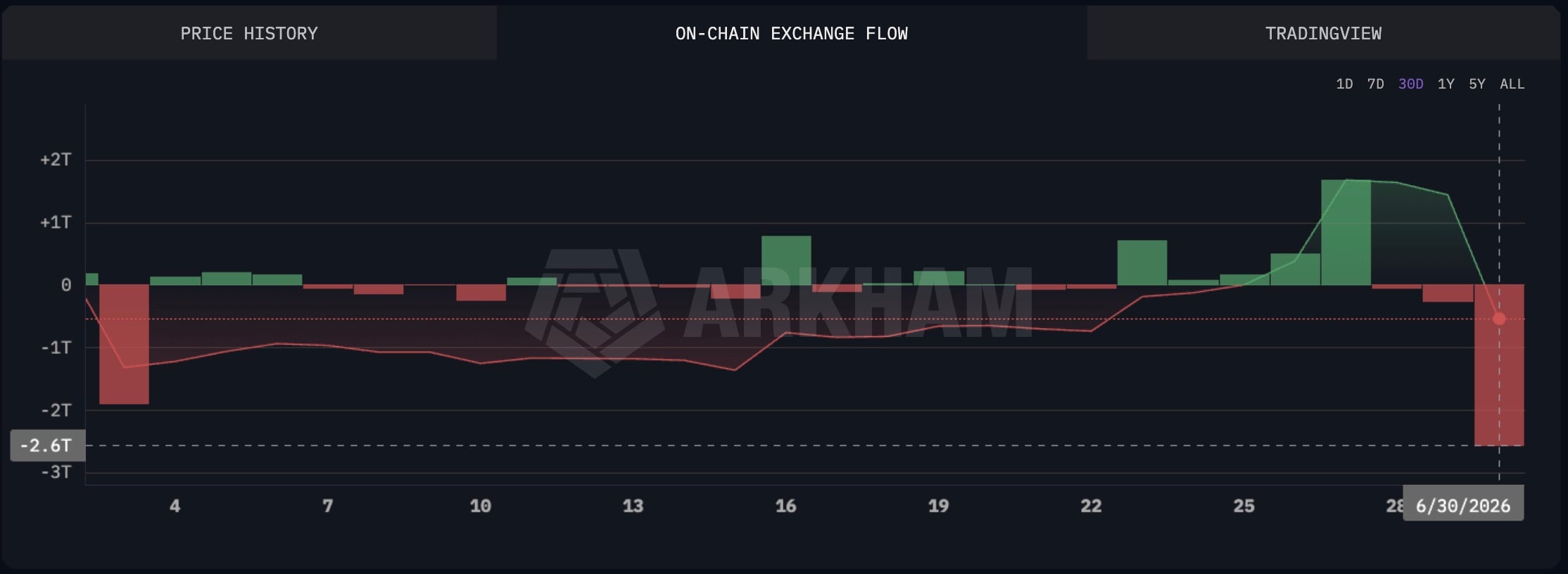
The only clear pattern behind this pre-Q3 exodus is historical cycles: for the last four years, from 2022 to 2026, July has always closed in positive territory for SHIB — for example, by +13.4% in 2022 and +8.92% in 2025. Moving assets to cold wallets right before July technically dries up exchange supply, reducing pressure on order books before the start of the new quarter.
Nevertheless, this token deficit is only an internal movement of capital. Whether it turns into a July rally, or whether the transfer of 2.6 trillion SHIB was just a routine technical reshuffling inside funds with no connection to growth expectations, will become clear in the coming weeks.
Rare macro trend saved XRP at the Q2 close
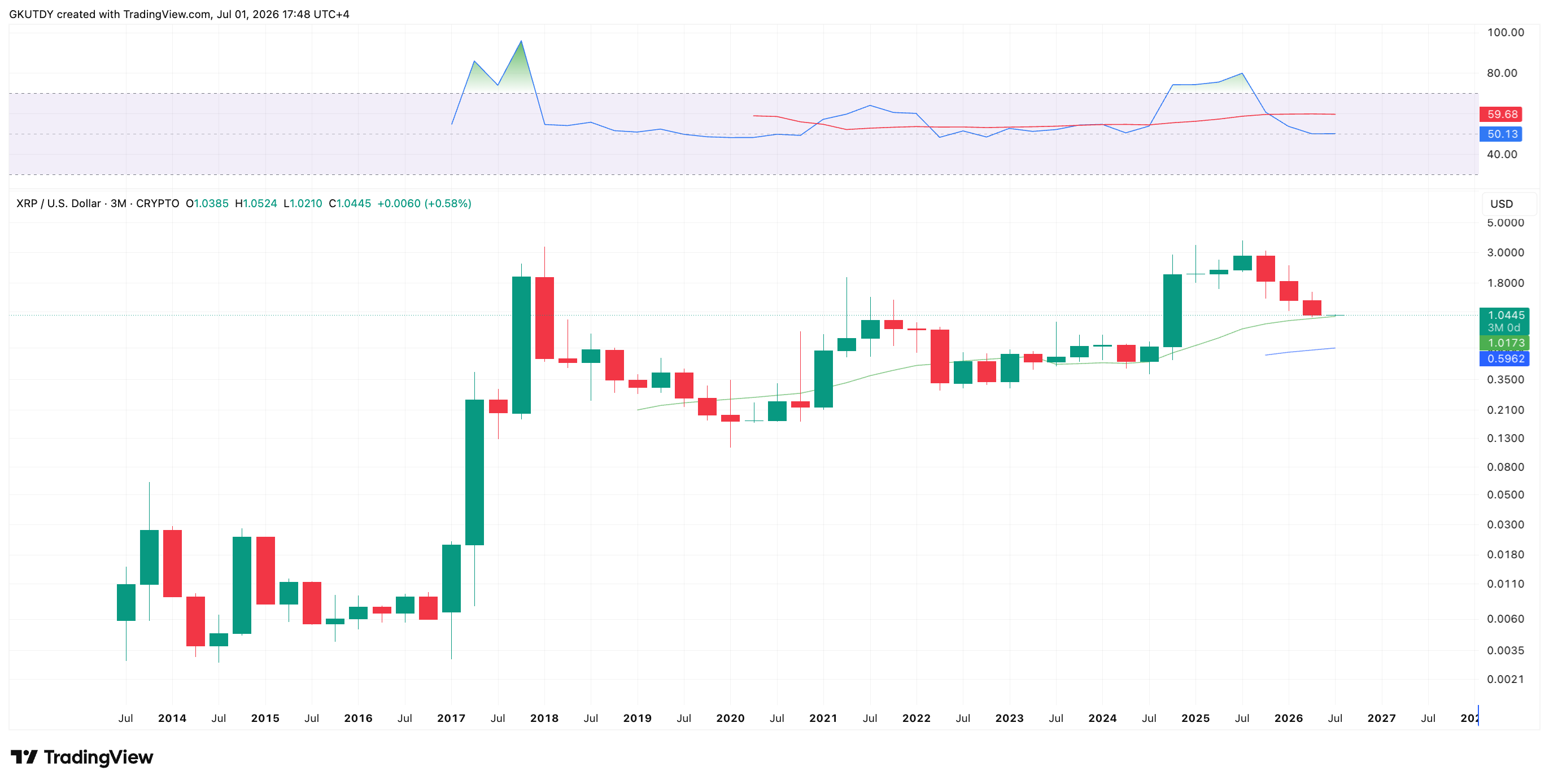
XRP buyers managed to defend the key psychological level of $1.00 at the most important moment — the close of Q2 2026. The June decline, triggered by a broader cooling of the crypto market, stopped around $1.01–$1.04 — exactly where the chart met a strong long-term support level that had been forming over the past several years.
The main protective factor for the asset was a rare macro trend. On the three-month (3M) chart by TradingView, it is clearly visible that the price landed precisely on the 23-period exponential moving average (23 EMA). This green indicator line acted like a reinforced-concrete barrier, as it protected the global uptrend and did not allow sellers to close the quarterly candle below the critical dollar mark.
Panic among retail traders during the sell-off was offset by a restrained external backdrop and the cold calculation of major players. Some of the market pressure was eased by steady capital inflows into spot XRP ETFs and the long-awaited completion of important regulatory deadlines in the United States.
In particular, this refers to the California Digital Financial Assets Law (DFAL), which came into force on July 1, and for which Ripple adapted its custody services in time, reducing legal risks.
Holding the moving average at the Q2 close preserved the integrity of XRP’s global bullish structure. The fact that the price held above $1.00 protected the market from automatic stop-order triggers, which otherwise could have set off a deep chain correction at the very start of July.
AI instead of crypto: Why Citigroup cut its Bitcoin forecast to $82,000
American investment bank Citigroup revised its expectations for the cryptocurrency market, cutting its 12-month Bitcoin forecast from $112,000 to $82,000 and its Ether forecast from $3,175 to $2,240.
The main reason for such a significant revision of its models was the massive outflow of institutional capital into the artificial intelligence (AI) sector, which is now showing record returns and appears to be a more tangible growth driver for large investors.
Against this backdrop of rotation, Citi analysts completely reset their expectations for net inflows into spot ETFs over the next year, lowering the target from the previous $10 billion to zero. This is supported by stark market statistics: since the beginning of the current year, net outflows from Bitcoin funds have already exceeded $3.3 billion.
Additional pressure on the industry is coming from the prolonged political deadlock in the U.S. Senate, where the adoption of sector-specific legislation has stalled, as well as from growing risks that large corporate treasuries may begin selling their digital reserves to cover operating expenses.
Under its updated scenarios, Citi sees Bitcoin’s base-case target at $82,000. However, if capital outflows from ETFs accelerate further, a severe bearish scenario could be triggered, sending the price down to $53,000.
Crypto market outlook: Break below the 200-week MA and ETF flight pin Bitcoin to support
The crypto market is opening July in deep defense mode: fear is intensifying, capitalization is shrinking again, and Bitcoin is holding near a yearly low after its worst month in a year. Pressure is coming from three factors at once — record ETF outflows, a more hawkish Warsh-led Fed, and the failed momentum around the CLARITY Act.
Key checkpoints:
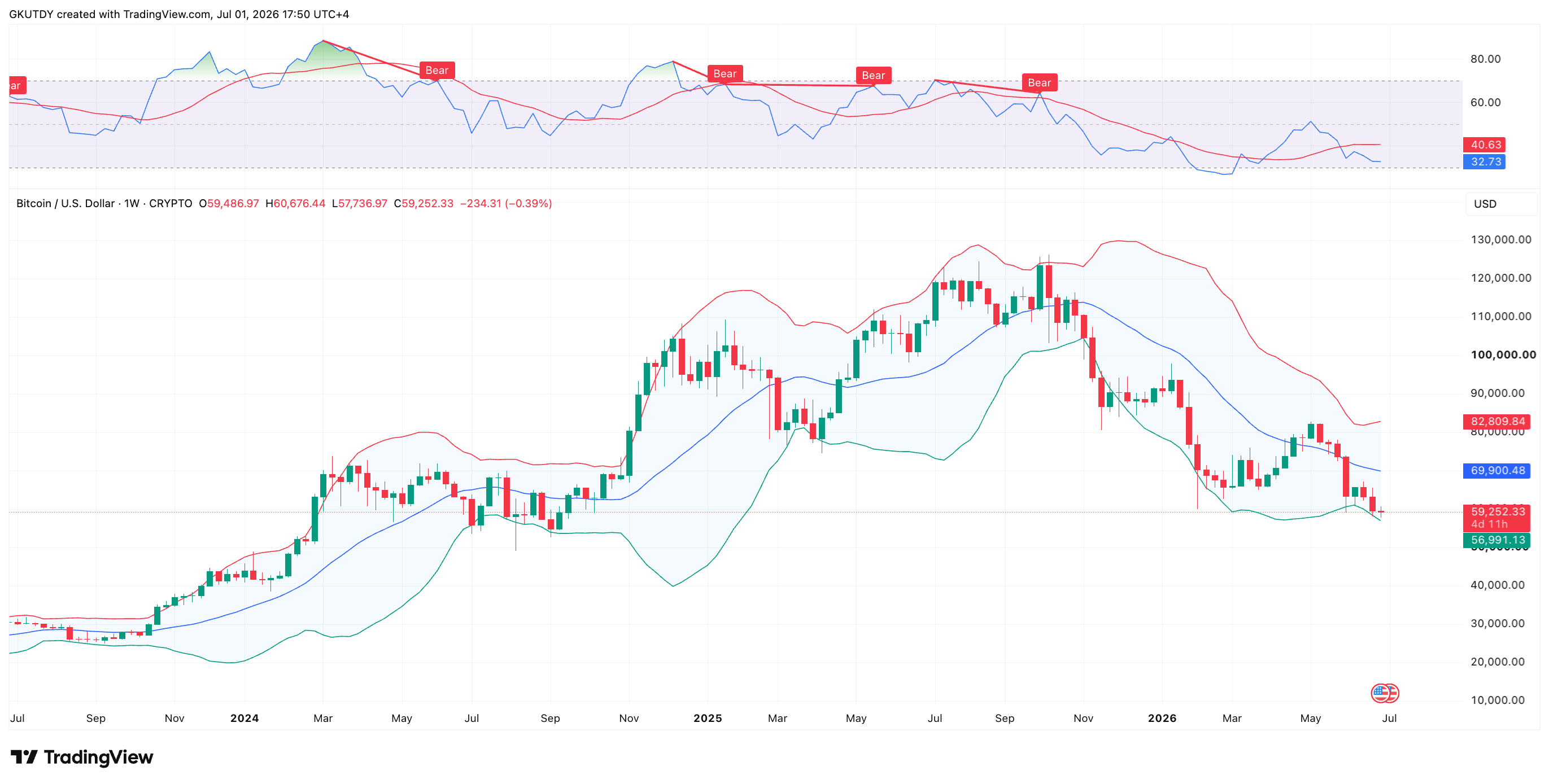
- Bitcoin’s trend breakdown: BTC is trading near $58,500, losing 2.2% over the past 24 hours and staying close to its yearly low of $58,190 after falling 20.5% in June. It also closed below the 200-week moving average (MA) for the first time since 2023.
- Regulatory split in the EU: The launch of MiCA on July 1 forced Binance, MEXC and Bitget to suspend part of their services in the European Union. The delisting of USDT affected the stability of $186 billion in capital. OKX, Backpack and Coinbase are introducing deposit bonuses to capture the freed-up share of the European market.
- Record ETF exhaustion: Spot Bitcoin ETFs lost $4.5 billion in June — the worst month since the instrument launched in 2024. The main blow fell on BlackRock’s IBIT, from which investors withdrew $3.55 billion.
- The Warsh Fed removes the macro driver: The first meeting under Kevin Warsh shifted market expectations toward tighter policy. The updated dot plot effectively removed the fast rate-cut scenario and left the crypto market without a key growth catalyst.
- Political deadlock around the CLARITY Act: The odds of the law passing in 2026 on Polymarket fell to 48%, down from 74% a month earlier. The reason is the breakdown of negotiations over ethics provisions. The next window for legislative progress will open only after senators return on July 13.
- Macro calendar and thin liquidity: On Thursday, July 2, the Non-Farm Payrolls report, the unemployment rate and Initial Jobless Claims will be the nearest test. The situation is worsened by the long weekend in the U.S. for Independence Day on July 4. The closure of traditional venues and the absence of U.S. market makers will sharply reduce order book depth, multiplying the risks of manipulation and cascading liquidations over the weekend.
You Might Also Like




Be the first to comment