


What to know:
- Bitcoin and Ethereum exchange balances have dropped to their lowest levels in years.
- Santiment says shrinking exchange supply reduces immediate selling pressure.
- The combination suggests a supportive long-term market structure, but future demand from ETFs, institutions, and retail investors will determine the next major move.
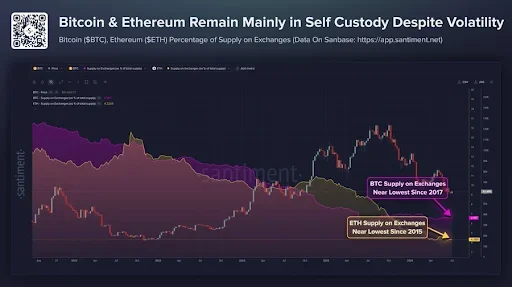
Bitcoin and Ethereum holders are keeping more of their assets off centralized exchanges, according to the latest on-chain data from Santiment, a trend that has historically been associated with stronger long-term investor confidence.
According to the analytics provider, Bitcoin on exchanges has reached its lowest level since 2017, while Ethereum on exchanges has reached its lowest level since 2015. It does not mean that we will see increases in price, but it implies that there is less supply of coins available for immediate trading.

Source: X

Why Exchange Supply Matters for the Crypto Market
Monitoring of exchange reserves is highly important since they indicate what investors do. Tokens held by exchanges are readily saleable, whereas tokens transferred to custodial wallets are meant for longer-term holding.
Santiment revealed that people were still withdrawing their Bitcoin and Ethereum from exchanges despite months of volatility in prices.
This indicates that they expect to keep their positions for an extended period. With reduced coins at exchange sites, there is reduced supply, which may cause increased prices with rising demand, but not necessarily.
Also Read: Circle Leads Top 8 Tokenized Stocks With $32M Weekly DEX Volume
Ethereum and Bitcoin Exchange Supply Continues to Tighten
The decline in Ethereum’s balance on exchanges indicates something much more profound than just holding the cryptocurrency privately. Millions of ETH are being held for staking purposes, and DeFi applications and Layer-2 solutions continue to suck up the supply.
Simultaneously, the permanent burning of ETH via the EIP-1559 makes the liquid supply of Ethereum even more constrained. The story is no different for Bitcoin. Since 2021, exchange balances of the coin have been dropping as institutions, ETFs, businesses, and individuals lock up their BTC.
Bitcoin Has Not Reached a Historical Bottom
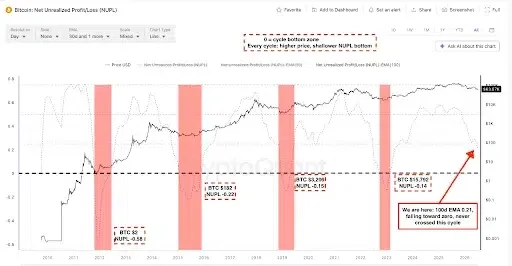
The Santiment analysis demonstrates that the selling pressure is declining. In turn, the latest CryptoQuant analysis examines the place of Bitcoin in the market cycle. This analysis is done with the help of Bitcoin NUPL (Net Unrealized Profit/Loss). It measures the overall profit/loss status of Bitcoin investors.

Source: CryptoQuant
Nevertheless, despite the decline of the short-term average beneath the long-term average in early June, the indicator of Bitcoin remains above the zero level.
Previously, in Bitcoin’s large bear cycles, a bottom formation was preceded by the fall of the 100-day NUPL average below the zero level in 2011, 2015, 2018, and 2022. Currently, such a scenario is not being played out in the market.
What Investors Should Watch Next
Taking all into account, data from Santiment and CryptoQuant provide a better perspective on the present market situation. Decreasing exchange balances lead to decreased selling pressure and an increase in holding periods.
However, Bitcoin’s NUPL reveals that the present market is not as accumulated as in the case of previous cycle bottoms. In regard to future forecasts, further trends will be driven by demand, and big players, retail, and the economic environment will play a role in this respect.
This article contains market analysis and price predictions. These are not guarantees. Crypto markets are volatile. Always DYOR. Not financial advice.
Also Read: Chainlink CCIP Selected by YuzuMoneyX for Yield 2026


Be the first to comment