



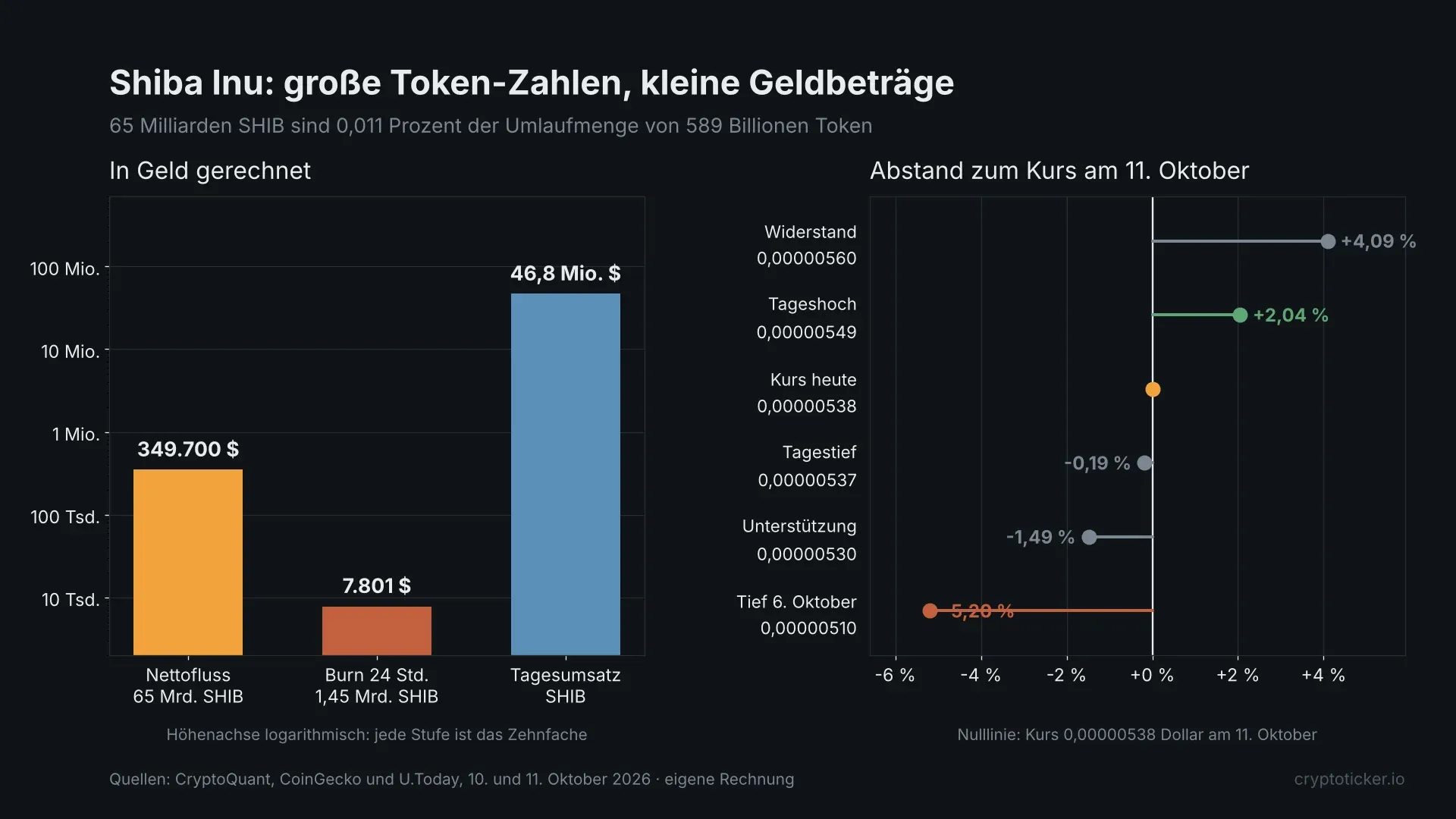
The analytics firm CryptoQuant reports a positive net flow of roughly 65 billion SHIB for Shiba Inu. Positive, in this calculation, means that more tokens moved onto trading venues than were withdrawn from them. The figure sounds enormous. At Sunday midday’s price of $0.00000538 it comes to $349,700, which is 0.75 percent of what SHIB turns over in a day.
The finding behind the headline is therefore not that a wave of selling is building. It is that token counts at Shiba Inu are distorted by a circulating supply of 589 trillion units. Hearing billions in this coin means converting before trading. This article does the arithmetic, sets it against the price picture and shows what moving tokens into self-custody means for tax purposes in Germany.
Shiba Inu: a net 65 billion tokens to exchanges, $349,700 in money terms
CryptoQuant measures net flow as the difference between two streams: tokens arriving at exchange addresses from private ones, set against tokens leaving exchanges. The reading covers Saturday, October 10. U.Today reported it on Sunday morning and read the 65 billion as a slowdown: inflows had previously run into several hundred billion SHIB.
The direction is unchanged. The balance still points towards the exchanges, not away from them. What has changed is the pace. A fall from several hundred billion to 65 billion means the supply of sale-ready tokens is thinning, not that buyers have taken control.

Net flow is an auxiliary measure, not a price signal. It describes how many tokens are theoretically available for sale on trading venues. Whether they are sold, it does not say.
How an exchange net flow arises, and why it does not reach the price one for one
A transfer to an exchange is not yet a sale; it is preparation for one. Between deposit and execution sit decisions a flow chart cannot see: someone shifting holdings between two venues, a market maker topping up inventory, a platform moving client funds into a new custody structure.
For the price, what counts is the moment a sell order enters the book and meets demand there. With enough bids on the buy side, even a large order barely moves the price. With a thin book, a small one is enough. That is why the comparison with daily turnover says more than the token count on its own.
The counter-calculation: 0.75 percent of daily turnover and 0.011 percent of supply
CoinGecko puts SHIB at $0.00000538 at Sunday midday, with daily turnover of $46.8 million and a market capitalisation of $3.17 billion. Circulating supply stands at 589.2 trillion tokens. Three figures follow from that, and they are usually missing from net-flow reports:
- 65 billion SHIB equate to $349,700.
- That is 0.75 percent of the $46.8 million traded in a day.
- And 0.011 percent of the 589.2 trillion tokens in circulation.
A sum of $349,700 does not move an order book that trades 134 times as much in a day under its own steam. By comparison: at Dogecoin the same share of daily turnover would be about $2.5 million, because $327 million changes hands there each day. The same percentage carries wholly different amounts from coin to coin.
A second ratio drawn from the same data stands out. Daily turnover equals just 1.48 percent of market capitalisation. A coin with thin turnover reacts more sensitively to single large orders than one with deep turnover. The real risk sits there, not in the net flow.
What has changed at Shiba Inu since October 10
On Friday a different number held this spot: capital locked in Shibarium had fallen 68 percent, driven by a single liquidity pool, as we showed on October 10 in our analysis of Shibarium’s capital outflow. The price stood at $0.00000541 then.
Little has happened to the price since. $0.00000538 at Sunday midday is 0.6 percent below Friday, and 1.24 percent down over 24 hours. The $0.00000530 level, treated on Friday as the next line of support, has not been tested. The session low sits at $0.00000537, effectively at the current price.
What is new is the angle. Friday concerned capital leaving the chain itself; today it is tokens moving to the trading venues. Both are outflow stories, but with different recipients. The Shibarium capital leaves an ecosystem, while the 65 billion SHIB merely change where they are kept inside the same market.
The burn of 1.45 billion SHIB comes to $7,801
The same conversion is worth doing for token burns. U.Today reported 1.45 billion SHIB burned in 24 hours on Sunday morning. At today’s price that is $7,801.
A burn permanently removes tokens from circulation by sending them to an address without a key. The idea: as supply tightens, the price rises at unchanged demand. At 1.45 billion tokens a day that is 0.00025 percent of circulating supply. Extrapolated over a year at the same pace it would be 0.09 percent.
Those are the orders of magnitude involved. For scarcity to carry the price, the pace would have to rise by powers of ten. Burn reports remain a useful gauge of community activity, just not of supply.

Price levels on October 11: $0.00000560 above, $0.00000510 below
Above the price lies the zone between $0.00000550 and $0.00000560, where SHIB has been turned back several times in recent days. The distance to it is 2.2 to 4.1 percent. The session high of $0.00000549 shows that the price has already tested the lower edge of that zone today.
To the downside, U.Today’s technical reading names $0.00000530 as the first catch, 1.5 percent below the current level. Beneath it comes the October 6 low of $0.00000510, 5.2 percent away. On that level the analysis says, in its own words, that a close below $0.00000510 would invalidate the reversal idea.
Set against the month: SHIB is 14.1 percent off its late-September high of $0.00000626. It is 93.8 percent below its all-time high of $0.00008616.
Our assessment: thin turnover weighs more heavily than the net flow
In the view of this newsroom, the net flow of 65 billion SHIB is the weaker of the weekend’s two figures. The evidence is above: $349,700 against $46.8 million in daily turnover, or 0.75 percent. Reading imminent selling pressure into that means counting in tokens rather than money.
The second figure weighs more. Daily turnover at 1.48 percent of market capitalisation is thin, and has been for days. In a thin market, individual larger orders move the price disproportionately, upwards as well as downwards. That argues for taking the zone around $0.00000510 more seriously than the flow report.
Against that: the drop in inflows from several hundred billion to 65 billion is real and points in the friendlier direction. It only becomes meaningful once the balance turns negative for several days running. No recommendation to buy or sell follows from any of it; SHIB remains an asset that can lose all of its value.
SHIB from the exchange into self-custody: the holding period keeps running
Reversing the direction of the net flow for yourself means withdrawing your tokens from the exchange. For investors in Germany the tax question comes first, and the answer is a relief.
Section 23(1) sentence 1 no. 2 of the German Income Tax Act covers disposals of other assets where no more than one year lies between acquisition and disposal. Everything hangs on the word disposal. A transfer to an address you own yourself is not one: no owner changes, no consideration flows. The one-year clock keeps running from the date of acquisition.
What matters in practice is documentation. On the chain, the tax office sees only two addresses and a transfer. That both belong to you is something you have to be able to prove. So record when you bought which quantity at which price, and which of your own addresses it went to. A portfolio tracker with a tax report handles that bookkeeping automatically and also reflects the FIFO order, under which the tokens bought first count as the first ones sold.
The same provision names a threshold that becomes relevant quickly with SHIB-sized amounts: gains stay tax-free if total gains from private disposals in the calendar year come to less than 1,000 euros. This is an exemption threshold, not an allowance. At a gain of 1,000.01 euros the entire amount is taxable, not merely the part above the line.
Which form of custody suits which sum
At a price of 0.0000048 euros, 100 euros buys roughly 20.8 million SHIB. The 1,000-euro threshold corresponds to about 208 million tokens. Those figures are why many holders never check the quantities: one digit more or less barely registers to the eye.
For the choice of custody, the euro value counts, not the number of units. At small three-figure sums an account with a regulated exchange is defensible, because the withdrawal fee makes up a noticeable share. At four-figure sums that shifts: there a hardware wallet costs a small fraction of the total and removes the risk of a platform suspending withdrawals.
In both cases the recovery phrase belongs on paper or metal, never in a photo and never in a password manager in the cloud. Lose it and you lose the tokens; pass it on and you have given them away.
Buying under MiCA: how to spot an exchange licensed in the EU
Under the EU Markets in Crypto-Assets Regulation, MiCA for short, providers need authorisation as a crypto-asset service provider to trade crypto-assets in the EU. In Germany, BaFin grants and supervises that permission. Two pointers help in making the judgement: the imprint names a European company with its seat in an EU member state, and the provider names the competent supervisory authority explicitly.
The difference is not a formality. Authorisation brings duties to segregate client and proprietary holdings, and a complaints route. Which platforms meet those requirements and how their fees differ is set out in the overview of regulated crypto exchanges.
Which dates and figures count in the coming days
Net flow is updated daily. It only becomes meaningful across several days: if the balance turns negative on three or four consecutive days, more tokens are leaving the trading venues than arriving. A single daily reading says nothing about that.
On the price there are two numbers. Above, the zone from $0.00000550 to $0.00000560, where SHIB has repeatedly failed of late. Below, the $0.00000510 from October 6. Between them lies a band of roughly ten percent, in which the price has been moving for a week.
The third quantity is daily turnover. Should it rise well above the current $46.8 million, every flow and burn figure gains weight, because more participants are then involved. Should it stay thin, moves will keep being triggered by individual addresses.
Shiba Inu: below $0.00000510 the picture turns, above it the band holds
In money terms the 65 billion SHIB are a small item. In the coming days what counts is the band between $0.00000510 and $0.00000560, and whether turnover picks up. Three things follow from that:
- Convert token headlines into euros before you trade. With a circulating supply of 589 trillion units, figures in the billions say nothing on their own.
- Size your custody to the euro value. From four-figure sums upwards, self-custody outweighs the convenience of an exchange account; the hardware wallet comparison shows the differences in price and handling.
- Document every transfer. The one-year clock under section 23 of the Income Tax Act survives a move to your own address only if you can prove it; a tax tool logs that as you go.
(As of October 11, 2026. This article is not investment advice. Prices and fee structures change; check the terms with the provider before you buy.)



Be the first to comment