



U.S. spot Bitcoin ETFs have extended their outflow streak to a record 13 consecutive trading days, turning what began as a risk-off rotation into one of the heaviest redemption waves since the products launched.
The latest flow breakdown puts the May 15 to June 3 streak at roughly $4.33 billion in net outflows, equal to about 59,351 BTC. The scale is not only large in dollar terms. Galaxy Research’s trailing-window data shows the 7-day, 10-day and 20-day Bitcoin outflow windows each reached their worst BTC-denominated readings on record.
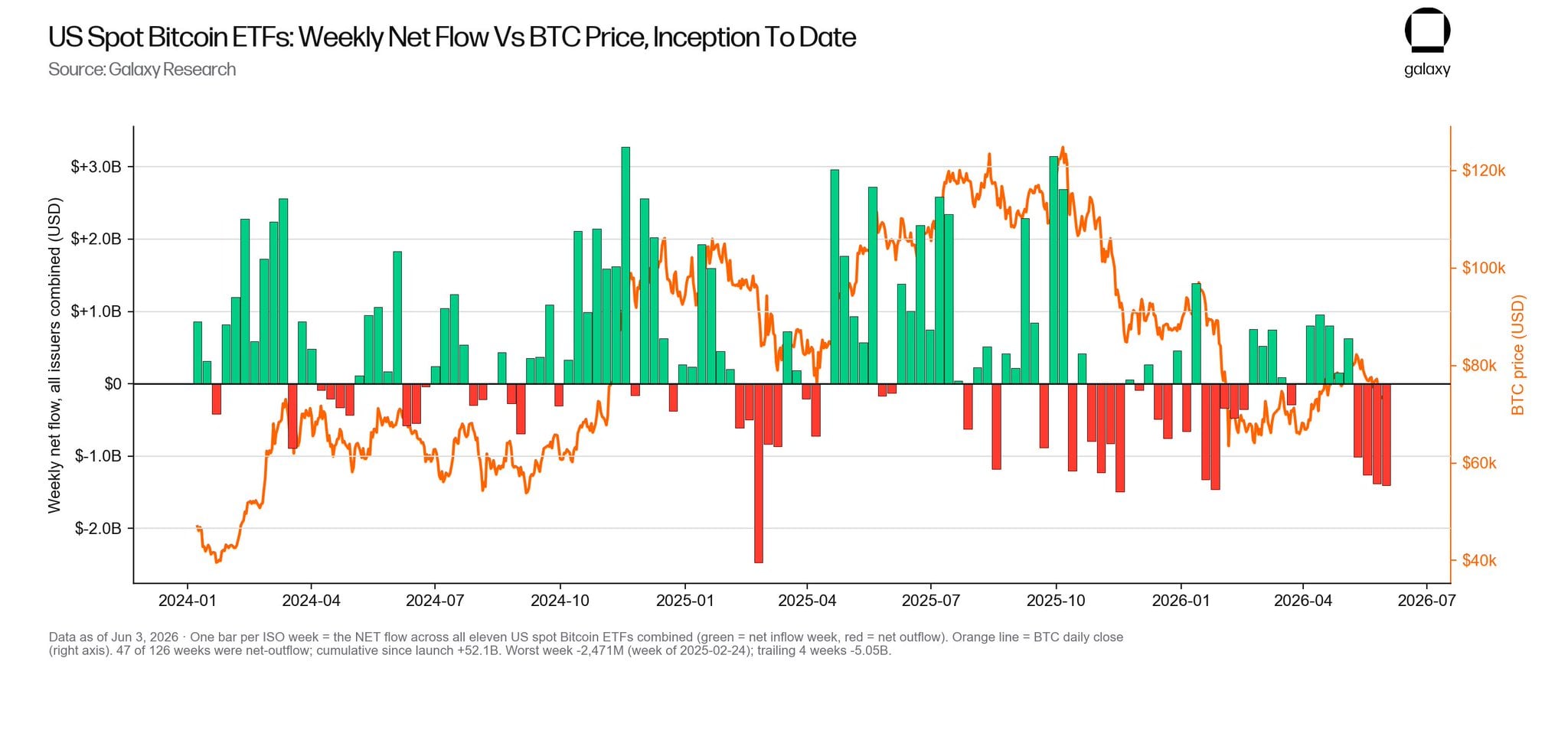
The run has now become a clean institutional-demand warning for Bitcoin. Spot ETFs were one of the strongest engines behind BTC’s rally after launch, converting brokerage-account demand into direct spot-market exposure. When that flow reverses for almost three straight trading weeks, the effect moves beyond headlines. It drains bid support, weakens dip-buying confidence, and forces traders to watch ETF closing prints almost as closely as exchange order books.
ETF Selling Pressure Keeps Building
The daily numbers show how persistent the pressure has become. The Farside Investors flow table shows net outflows every trading day from May 15 through June 3, including $290.4 million on May 15, $648.6 million on May 18, $733.4 million on May 27, $519.1 million on June 2 and $396.6 million on June 3.
That string of redemptions has hit several major issuers at the same time. BlackRock’s IBIT, which had been the strongest accumulation vehicle for much of the ETF era, recorded heavy exits during the stretch, including $342.3 million on June 3. Fidelity’s FBTC also saw persistent withdrawals, adding to the sense that the selloff is not isolated to one product.
The difference between this streak and normal ETF noise is duration. A single large outflow can reflect rebalancing, tax positioning or a short-term arbitrage unwind. A 13-session streak points to a broader change in allocation, especially when it arrives while BTC is losing key price levels and broader risk capital is moving toward AI stocks, mega-raises and private-market opportunities.
Bitcoin Price Feels The Liquidity Hit
The ETF exit is landing into an already fragile Bitcoin market. BTC has been fighting to stabilize after a flash crash toward $61,500, with leverage flushed out and spot buyers still cautious around the low-$60,000 zone. The broader crypto market has also been under pressure, with total capitalization pushed back toward the low-$2 trillion range after the market erased more than $2 trillion from its October 2025 peak.
The market’s structure now looks thinner than it did during the ETF inflow phase. ETF redemptions reduce passive spot demand, futures funding becomes more defensive, liquidity providers widen spreads, and altcoins struggle to hold bids when Bitcoin cannot reclaim momentum. That is why even pockets of relative strength, including HYPE during the latest crypto market bleed, are being treated as exceptions rather than signs of a broad recovery.
ETF flows do not prove that long-term holders have abandoned Bitcoin. They do show that one of the most important regulated demand channels is currently moving against the market. For BTC bulls, the cleanest repair signal would be a break in the outflow streak, stronger spot volume near support, and a reclaim of the price levels lost during the latest liquidation wave. Until that happens, every ETF close becomes another test of whether the market still has enough real demand to absorb institutional redemptions.



Be the first to comment