




TLDR
- South Korea’s KOSPI fell 8.3% on Monday, its biggest single-day drop since March, triggering circuit breakers that halted trading for 20 minutes
- Samsung Electronics dropped 10.2% and SK Hynix fell 7.7%, leading the selloff in chip stocks
- Strong U.S. jobs data killed hopes of Federal Reserve rate cuts, sparking a global tech selloff
- The South Korean won hit a 17-year low on Friday before recovering slightly after authorities held an emergency meeting
- Broadcom’s disappointing forecasts helped send the Philadelphia Semiconductor Index down more than 10% on Friday
South Korea’s main stock index fell 8.3% on Monday, its worst day in months. The KOSPI closed at 7,484.41, down from a record high of 8,801.49 hit just six days earlier on June 2.
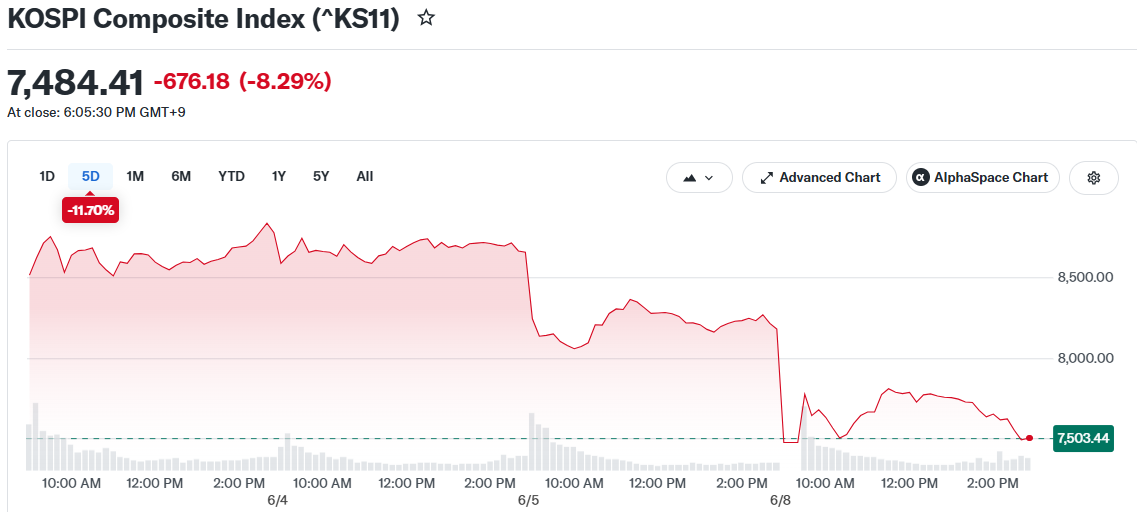
The drop triggered circuit breakers shortly after markets opened. Trading was halted for 20 minutes. It was only the ninth time in history this had happened on the KOSPI.
The selloff was driven largely by two stocks. Samsung Electronics fell 10.2%. SK Hynix dropped 7.7%. Both companies have powered the KOSPI’s rise this year, with their market caps each growing more than 150% and 200% respectively.
Together, the two chipmakers now account for more than half of the benchmark index’s total value. Both recently joined the $1 trillion market cap club.
The trigger for Monday’s move came from the United States. Strong payroll data released Friday crushed hopes that the Federal Reserve would cut interest rates. Markets had been counting on cuts to keep the tech rally going.
The Nasdaq fell 4.2% on Friday. The Philadelphia Semiconductor Index dropped more than 10%, its steepest decline since March 2020.
Broadcom Forecasts and Middle East Tensions Add to Pressure
Chipmaker Broadcom also played a role. Investors were disappointed by the company’s latest forecasts, adding to the negative mood around semiconductor stocks globally.

Middle East tensions made things worse. Iran launched missiles at Israel over the weekend, adding to fears about global growth and energy prices.
Despite the bad timing, Nvidia’s CEO Jensen Huang was in South Korea announcing new partnerships. He named SK Hynix as Nvidia’s “biggest partner.” Nvidia also unveiled deals with Naver and Doosan to build AI data centres in the country.
Naver was one of the few bright spots in the market, rising 9.2% after its Nvidia deal was announced. Hyundai Motor fell 8.7% despite also securing a new Nvidia partnership.
The South Korean won fell to 1,615 per dollar on Friday, its weakest level since March 2009. Authorities held an emergency meeting. By Monday, the won had recovered to 1,533.7 per dollar after officials warned against speculative trading and intervened in currency markets.
Market Still Up Sharply for the Year
Foreign investors sold local shares worth 355 billion won on Monday. That extended their selling streak to 21 straight sessions.
Despite Monday’s losses, the KOSPI is still up 78% year-to-date. South Korea’s 10-year bond yield rose to 4.366%, its highest since October 2023.
President Lee Jae Myung said the market remained “undervalued” and called the current exchange rate “temporary and abnormal.”
Analysts say the correction was overdue given how fast semiconductor stocks had risen. Earnings momentum for chipmakers remains intact for now.
🚨 Our MAY Stock Picks Are Live!
A new month means new opportunities. Our analysts have just released their top stock picks for May, highlighting companies with strong momentum that rank highly on our KO Score algorithm. We’re also now sharing trade ideas for both long-term and short-term investors, giving you more ways to spot potential opportunities in the market.
Sign up to Knockout Stocks today and get 50% off to unlock the full list and see which stocks made the cut.
Use coupon code Special50 for your exclusive discount!



Be the first to comment