

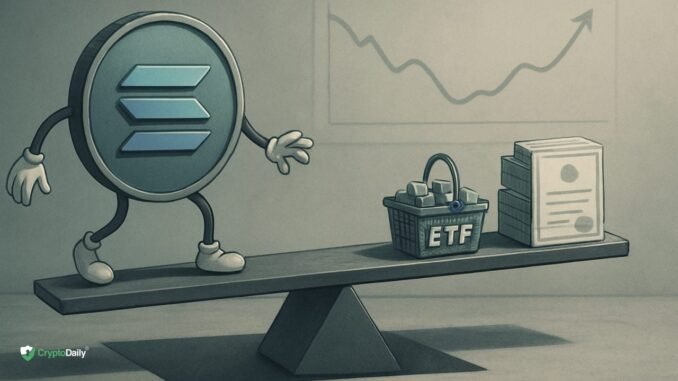

Solana’s price has been volatile into mid-2026, but two demand drivers are crystallizing: regulated tokenized equities settling on-chain and steady spot ETF inflows in the U.S. The question is whether these flows and real-world asset activity can provide durable support for a rebound.
Rather than a single catalyst, SOL tends to move when multiple pillars line up: net new capital, clear utility, and confidence that the rails can handle volume without friction. Tokenized stocks and ETFs touch all three—if adoption persists.
Below, we map the thesis, the caveats, and practical ways to monitor conviction without buying into hype.

| Point | Details |
|---|---|
| Regulated tokenized-equity rails went live | Securitize, Jump Trading Group, and Jupiter launched a fully on-chain, regulated trading stack on Solana with KYC-enabled wallets and atomic settlement in one block (PR Newswire). |
| Demand signal: tokenized stocks/ETFs TVL | Ondo Global Markets crossed $1B in TVL in May 2026, claiming over 70% share among tokenized equity issuers (PR Newswire). |
| SOL ETF flows strengthened | U.S. spot SOL ETFs recorded ~$115.3M May net inflows; combined AUM reached about $1.13B by month-end (Solana Foundation). |
| Market share in tokenized equities | Solana captured ~97% of cumulative on-chain tokenized-equities spot trading volume in May 2026 (Solana Foundation). |
| Investment case | If regulated tokenization and ETF demand persist, they could improve liquidity and narrative support. Execution, regulatory, and market-structure risks remain high. |
What a SOL rebound needs in 2026
Editor’s note: After the Securitize/Jump/Jupiter announcement, several traders told me atomic settlement reduced some operational friction, but they’re still watching secondary depth and broker connectivity. ETF figures helped sentiment in May, yet no one I spoke with is extrapolating in a straight line—most are tracking whether these flows persist through quieter market weeks. — Maya Sinclair
Sustained rebounds rarely hinge on one metric. For SOL, the flywheel looks like this:
- Capital formation: net inflows via ETFs and on-chain funds; builder grants and venture deployments that expand the pipeline.
- Utility that touches mainstream finance: tokenized stocks and ETFs settling on-chain, with compliance features institutions require.
- Operational reliability: throughput, latency, and a smooth user experience for both retail and professional market makers.
- Market structure tailwinds: exchange liquidity depth, basis stability in derivatives, and tighter spreads across venues.
Tokenized equities and ETFs are strengthening the first two pillars. The question is whether those flows are sticky and whether the network—and market plumbing around it—can scale gracefully.
Tokenized stocks on Solana are becoming real markets
For years, “real-world assets on-chain” meant mostly credit funds and stablecoins. In May 2026, the tokenized-equity stack took a step closer to mainstream trading on Solana: Securitize, Jump Trading Group, and Jupiter unveiled a fully on-chain, regulated workflow that connects KYC-whitelisted wallets, updates ATS/transfer-agent records, and settles atomically in a single block (PR Newswire).
Two practical implications for SOL:
- Liquidity bridges: If market makers can quote and settle tokenized stocks on-chain with clarity on compliance, they may also inventory SOL or SOL-priced collateral to fund those workflows.
- Settlement certainty: Atomic settlement reduces fail risk between broker legs. If volumes scale, fee demand and chain usage can become a reflexive tailwind for SOL.
Separately, Ondo Global Markets said it surpassed $1B in TVL less than eight months after launch, reporting a dominant share among tokenized equity issuers (PR Newswire). While TVL is not the same as volume, it’s a credible sign that capital is willing to park in tokenized stocks and ETFs—a precondition for deeper secondary markets.
How this ties back to price: If tokenized equities ride on Solana rails, SOL can benefit indirectly via fees, validator economics, and treasury demand from service providers that denominate costs in SOL. But the link is probabilistic, not guaranteed.
ETF demand and the price mechanism
ETF flows are often interpreted as a clean read on net demand. In May 2026, U.S. spot SOL ETFs posted their strongest monthly net inflows of the year—about $115.3M—and combined AUM hit roughly $1.13B by month-end, according to the Solana Foundation’s May roundup (Solana Foundation).
Mechanically, here’s what matters for price support:
- Creation/redemption engine: Authorized participants arbitrage deviations from NAV. Persistent creations imply buying pressure on underlying SOL; persistent redemptions imply selling pressure.
- Breadth of buyers: Are flows concentrated in one product or dispersed across multiple issuers and brokerage channels? Broader access generally means more resilient demand.
- Basis and liquidity: If futures basis tightens and spot/futures liquidity deepens, ETF flows transmit more efficiently to price without blowouts in slippage.
One month doesn’t make a cycle. But consistent, positive net creations across months can change the medium-term tape, especially if they arrive alongside improving on-chain activity rather than in isolation.
Pro tip: Track daily creations/redemptions from ETF issuers and observe whether price impact per dollar of flow is rising or falling. Efficiency increases often precede trend changes.

Does Solana’s tokenization dominance hold?
The Solana Foundation reported that Solana captured ~97% of cumulative on-chain tokenized-equities spot trading volume in May 2026 (Solana Foundation). Dominance in a nascent market is encouraging, but the sustainability test is tougher:
- Standardization: Will issuers coalesce around Solana-native primitives for compliance and settlement, or hedge across multiple chains?
- Market-maker tooling: Does the chain continue to offer predictable latency and robust risk tooling so professional firms can scale?
- Regulatory clarity: Jurisdictional comfort with on-chain records for equities is evolving. Any reversal or new guardrails could alter where tokenization volumes sit.
If Solana retains the majority of tokenized-equity trading, narrative support for SOL improves: “the RWA-chain for stocks.” If share fragments across L2s or other L1s, the price impact could dilute even if the sector grows overall.
Scenarios and signposts for H2 2026
Base case: Flows grind, utility builds
ETF inflows remain positive but uneven; tokenized-equity trading gradually expands as more brokers integrate. In this path, SOL’s drawdowns may compress and rallies may stair-step higher on strong flow days, but breakouts likely require catalysts such as major issuer listings or new ETF distribution channels.
Upside case: Distribution widens, velocity climbs
Multiple retail brokerages or private banks add access to tokenized stocks settling on Solana; issuers ramp the product set. ETF creations remain steadily net positive. On-chain DEX/ATS volumes lift, validators capture higher fee revenue, and the market assigns a premium to Solana’s RWA moat. Momentum could build if correlations with broader alt baskets decline.
Downside case: Fragmentation or policy shock
Regulatory pushback slows tokenized-equity growth, or liquidity disperses across chains, reducing network effects. ETF flows stall or flip negative for a stretch. SOL re-correlates with risk-off moves across crypto, and volatility rises as derivatives basis widens.
Signposts to watch
- Monthly net creations for U.S. spot SOL ETFs (issuer updates, custody disclosures, and AUM continuity).
- Tokenized-equity secondary trading volumes and the number of integrated brokers/venues tied to Solana.
- On-chain performance indicators: failed/late settlements, fee markets behavior during peak hours, and throughput consistency.
- Cross-chain competition: new tokenization stacks going live on other L1s/L2s, and any shifts in issuer preferences.
Positioning choices and trade-offs
There’s no one-size-fits-all way to express a view on SOL’s rebound. Each instrument carries distinct risks and frictions.
| Instrument | What it offers | Key trade-offs |
|---|---|---|
| Spot SOL | Direct exposure; usable on-chain for staking or fees | Self-custody and security burden; taxable events when rebalancing; exchange liquidity risk |
| U.S. spot SOL ETFs | Brokerage access; retirement accounts; standardized tax docs | Expense ratios; NAV/tracking considerations; limited on-chain utility |
| Perpetual futures | Leverage; easy hedging; 24/7 liquidity | Funding costs; liquidation risk; counterparty and venue risk |
| Options | Defined risk strategies; express views on volatility | Complexity; potential illiquidity in some strikes/tenors |
| Staking | Yield in SOL; aligns with network security | Lock-ups or unbonding delays; validator/operator risk; rewards vary with network conditions |
Checklist before sizing up:
- Confirm custody and operational setup (hardware wallet, brokerage permissions, or exchange risk limits).
- Decide whether you need on-chain utility or pure price exposure.
- Stress-test downside with a simple scenario (e.g., 25–40% drawdown) and ensure the position still fits your risk limits.
- Map catalysts over the next 90–180 days and define exit/adjust rules ahead of time.
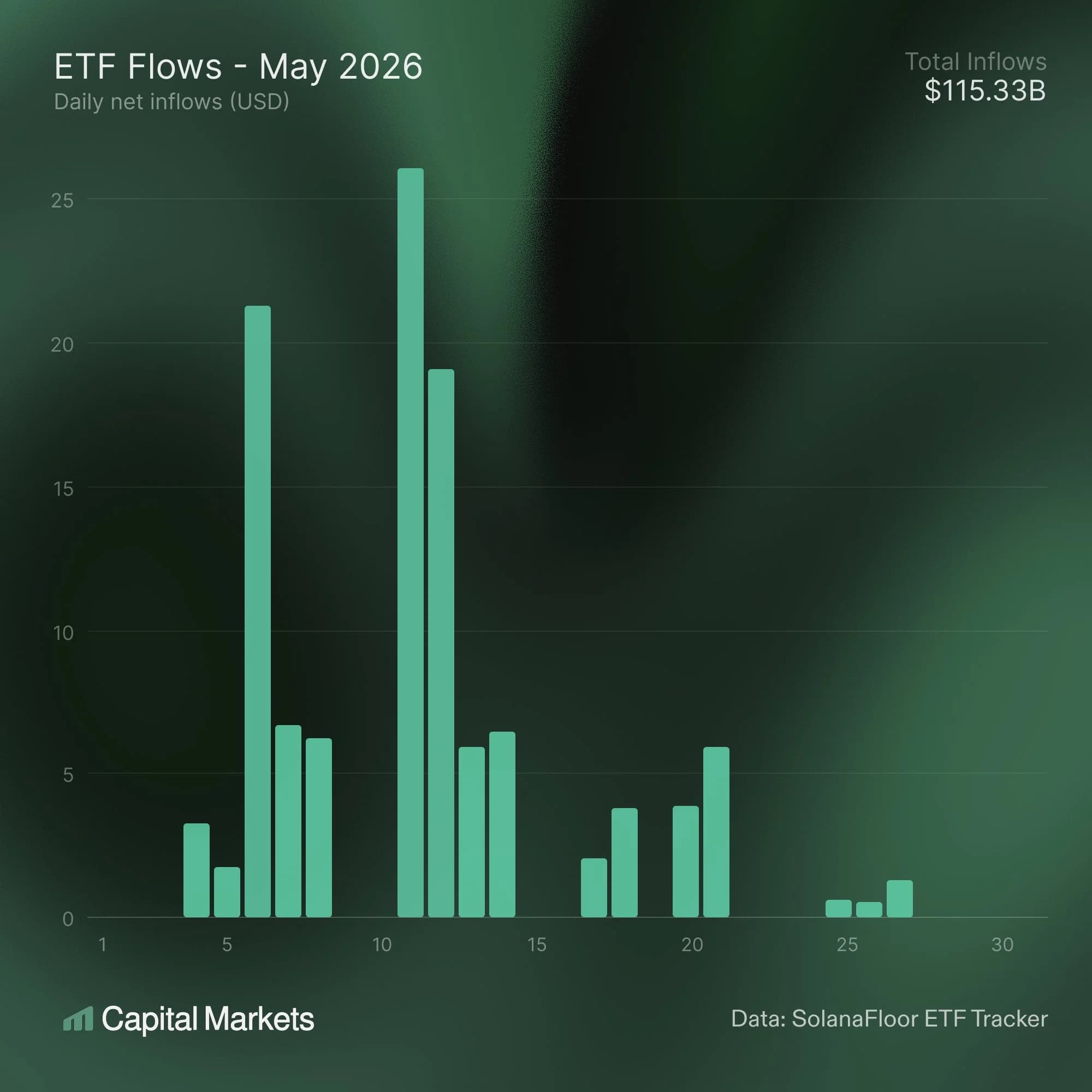
Bar chart titled ‘ETF Flows – May 2026’ showing daily net spot SOL ETF inflows in May (total ~ $115.3M) — useful to visualize recent institutional ETF demand for Solana and its timing relative to price/action. — Source: Solana Foundation
Risks, pitfalls, and how to avoid them
Regulatory and issuer risk
Tokenized-equity programs rely on oversight of transfer agents, ATS operators, and record-keeping that regulators must accept. Press releases—like those from Securitize/Jump/Jupiter and Ondo—signal progress, but they are still issuer claims. Verify who the regulated entities are and the exact permissions in each jurisdiction (PR Newswire; PR Newswire).
Liquidity illusions
TVL and headline volumes can mask fragmentation. Check where the liquidity sits (primary vs. secondary), spreads across venues, and the presence of continuous two-sided quotes from reputable market makers.
Network and market-structure frictions
Throughput bottlenecks, MEV dynamics, and fee spikes can erode the user experience during peaks. Meanwhile, derivatives basis blowouts or funding spikes can force deleveraging unrelated to fundamentals.
Narrative drift
Even with strong May numbers, momentum can fade if tokenization pilots don’t translate into everyday trading or if ETF inflows normalize. Treat one-off prints as data points, not destiny.
Custody and counterparty exposure
Whether holding SOL directly, using ETFs, or interacting with tokenized equities, map the custody chain. Who holds the keys or the underlying? What are the recourse mechanisms?
Metrics to track weekly
- Net creations/redemptions and AUM for spot SOL ETFs across issuers; any changes in custody or authorized participants (referenced by the Solana Foundation roundup for May figures).
- Tokenized-equity secondary trading volume on Solana-linked venues; number of listed tickers and active KYC-whitelisted wallets (as initiatives like Securitize/Jump/Jupiter expand).
- On-chain reliability indicators: transaction success rates, congestion under load, and typical finality during peak sessions.
- Perp funding and spot/futures basis for SOL to gauge leverage build-ups and unwind risk.
- Cross-chain competitive launches in tokenization and any migrations by major issuers like Ondo (PR Newswire).
If these indicators trend favorably together—ETF creations remain positive, tokenized-equity trading deepens on Solana, and the chain handles load—the probability of a credible rebound improves. None of this removes volatility risk, but it can shift the odds.
For ongoing, critical coverage without the hype, Crypto Daily tracks ETFs, tokenization, and on-chain activity across major networks. Browse our latest analyses at Crypto Daily.
Frequently Asked Questions
How could tokenized stocks on Solana affect SOL’s price?
If tokenized equities settle on Solana at scale, the network may see higher transaction demand, increased validator revenue, and more professional participants holding SOL for operations or collateral. That can be supportive for price, but the effect depends on sustained volume and competitive dynamics.
Are the recent SOL ETF inflows enough to power a lasting rally?
May 2026 posted strong net creations—about $115.3M—and combined AUM near $1.13B, per the Solana Foundation. A single month helps sentiment, but multiple consecutive months of net creations are more indicative of durable trend support.
What should I monitor to validate the rebound thesis?
Watch net creations/redemptions for spot SOL ETFs, tokenized-equity secondary volumes on Solana, on-chain reliability under peak loads, and derivatives positioning (funding and basis). Improvement across several of these simultaneously is a stronger signal than any one metric.
Is Solana’s ~97% share of tokenized-equity trading secure?
Dominance for a month shows traction, but it may fluctuate as alternatives launch. Track issuer announcements, broker integrations, and any cross-chain expansions. Market share is earned each quarter.
What risks could undermine the tokenization narrative?
Regulatory hurdles, limited secondary-market depth, operational hiccups on-chain, or issuer concentration risk could slow adoption. Even with promising pilots and press releases, execution risk remains material.
Does Ondo’s TVL growth guarantee higher SOL prices?
No. Ondo’s $1B TVL milestone signals demand for tokenized stocks/ETFs, but its impact on SOL depends on how much activity executes on Solana and whether that activity translates into fees, collateral demand, and liquidity that support SOL.
Is this financial advice?
No. Markets are volatile and speculative. Consider independent research and professional guidance before making decisions.
Disclaimer: This article is provided for informational purposes only. It is not offered or intended to be used as legal, tax, investment, financial, or other advice.






Be the first to comment