




TLDR
- US spot Bitcoin ETFs saw their largest 30-day net outflow since launching in January 2024, totaling $6.35 billion
- Bitcoin dropped 17.4% over the past month, falling to four-month lows around $60,000–$61,300
- A 13-day consecutive outflow streak from May 15 to June 3 accounted for roughly $4.4 billion in redemptions
- BlackRock and Fidelity’s funds absorbed the heaviest selling pressure
- BlackRock’s Jay Jacobs said short-term outflows don’t change the firm’s long-term view of Bitcoin
US spot Bitcoin ETFs just had their worst 30-day stretch since they launched in January 2024. According to data from Galaxy Research, these funds recorded $6.35 billion in net outflows over the past 30 trading days.
U.S. Spot Bitcoin ETFs See Record $6.35B Outflow Over 30 Days
According to Galaxy Research, U.S. spot Bitcoin ETFs have posted their largest 30-day net outflow on record. Data shows the funds saw $6.35 billion in net outflows over the past 30 days, ranking first across all 582… pic.twitter.com/e3fuIkEF8W
— Wu Blockchain (@WuBlockchain) June 21, 2026
That drop brings cumulative net flows down to $53.4 billion, falling from a peak of $63 billion in October 2025.
Galaxy Research noted that daily outflows are “still deepening day over day,” raising questions about near-term demand from institutional investors.
Bitcoin itself has felt the pressure. The asset is currently trading around $64,167, down 17.4% over the past month. It fell as low as $60,000–$61,300 in early June, hitting four-month lows.
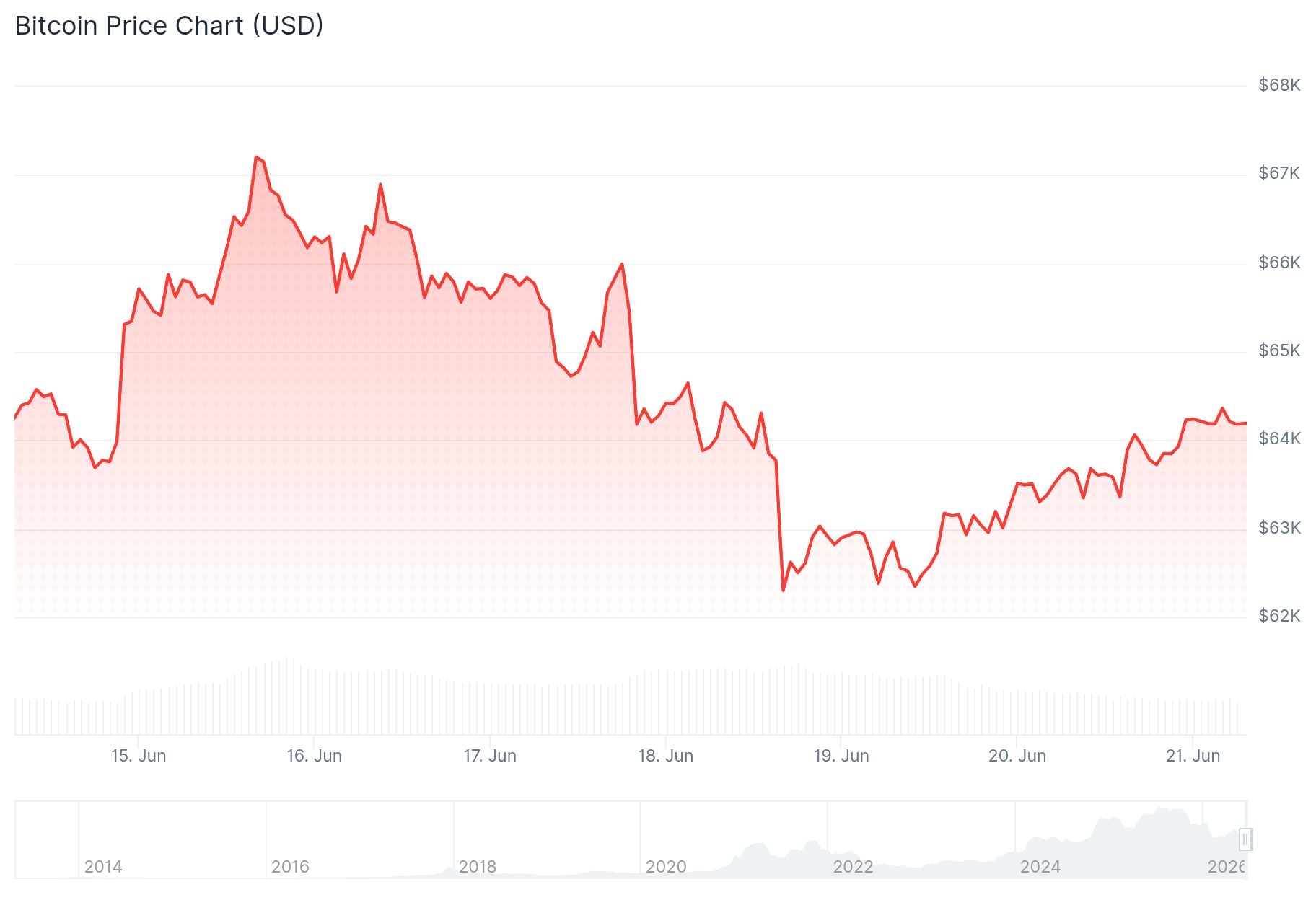
The steepest stretch came between May 15 and June 3, a 13-day consecutive outflow streak that saw roughly $4.4 billion leave the market. In Bitcoin terms, that’s around 59,400 BTC.
Where the Selling Was Concentrated
Not all ETFs were hit equally. The bulk of redemptions came from the two largest funds: BlackRock’s iShares Bitcoin Trust and Fidelity’s fund. Both saw peak daily outflows in the hundreds of millions of dollars.

The streak briefly broke around June 4–5 with a modest net inflow of $3 million. But outflows resumed, with one week alone seeing $1.7 billion in net redemptions.
Macroeconomic pressures have played a role. Rising US inflation and the ongoing conflict between the US and Iran have weighed on risk assets broadly, including Bitcoin.
Bloomberg ETF analyst Eric Balchunas described the outflow levels as “noise” within the wider story of institutional adoption.
BlackRock Stays the Course
BlackRock’s US head of equity ETFs, Jay Jacobs, pushed back on the idea that outflows signal a shift in institutional sentiment.
“What I think is maybe sometimes misunderstood by the market is that if we see a day of outflows, there could be a million reasons why,” Jacobs told Cointelegraph.
He also noted that BlackRock manages over 450 ETFs across asset classes, and sees inflows and outflows daily across all of them.
“In the short term, it’s absolutely not something that changes the way we view the asset or the utility of the asset,” Jacobs said.
Jacobs pointed to Bitcoin’s role as a global, decentralized, nonsovereign monetary alternative as the firm’s core thesis.
It’s worth keeping the outflows in context. Since launching in January 2024, spot Bitcoin ETFs have attracted total net inflows of between $50 and $60 billion. The recent redemptions represent a small percentage of total capital invested.
Year-to-date flows for 2026 were near breakeven before the May–June streak hit.
Galaxy Research data shows daily outflows are continuing to deepen, making the next few weeks a key period to watch for any signs of stabilization.



Be the first to comment