

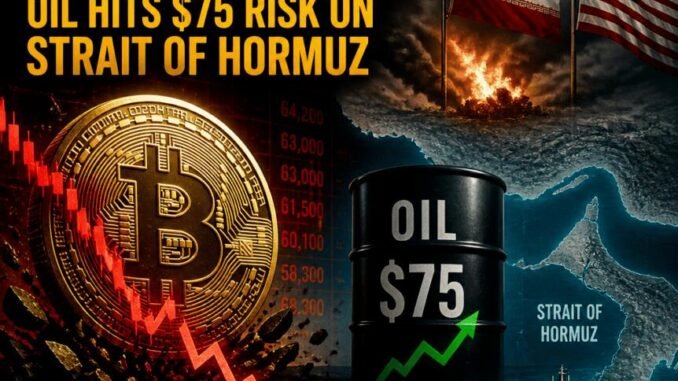

Bitcoin hovered just under the $62,000 mark after the Wall Street open, as fresh geopolitical pressure around Iran dragged on risk sentiment and pushed oil prices higher. Traders cited Trump’s comments that a US-Iran ceasefire is “over,” alongside reports that both sides are considering actions affecting the Strait of Hormuz—an outcome that would typically amplify inflation and policy-rate expectations.
Market pricing reflected that shift: daily BTC downside moves were circulating around the 2.5% range, while US WTI crude rose above $75 per barrel to its highest level since June 22. At the same time, interest-rate probabilities moved further toward the possibility of a September hike, according to CME Group’s FedWatch tool.
Key takeaways
- BTC slipped to roughly $61,500 after Trump said the US-Iran ceasefire is “over.”
- Reports of renewed threats to the Strait of Hormuz coincided with a jump in WTI crude above $75.
- CME FedWatch increased expectations for a September rate hike, while July remained priced as more likely to stay unchanged.
- Traders highlighted the $61,000 area as a key technical zone to watch for the next directional move.
Geopolitics meets macro expectations
TradingView data referenced in the report showed Bitcoin’s move around 2.5% to the downside as markets digested the breakdown of the US-Iran ceasefire. The immediate catalyst was a press conference at the NATO summit in Ankara, Turkey, where US president Donald Trump said, “To me, I think it’s over.”
Additional reporting cited claims that the US and Iran were weighing renewed pressure, including possible moves that could impact shipping flows through the Strait of Hormuz. Even without confirmed operational details, the market reaction was swift: crude oil moved sharply higher, reinforcing the idea that energy risk could spill into broader economic expectations.

Oil prices were not subtle. US WTI crude passed $75 per barrel, reaching levels not seen since June 22. For crypto traders, energy-driven inflation risk often matters because it can change the path investors expect for central-bank policy—especially during periods when rate expectations are already shifting.
Rate probabilities tilt as oil surges
According to CME Group’s FedWatch Tool, the odds of a Federal Reserve interest-rate hike at the September meeting increased, while July was still viewed as more likely to end with rates staying at current levels. The significance for Bitcoin is straightforward: a repricing toward tighter monetary policy can raise yields and reduce the relative attractiveness of high-beta assets.
Other market pricing reflected similar uncertainty. On prediction platform Kalshi, users placed the odds of a hike in 2026 at 55%. While prediction markets are not the same as central bank guidance, they can still indicate how participants are thinking about the distribution of future outcomes.
In the near term, this macro backdrop helps explain why Bitcoin struggled to hold earlier gains. When oil volatility rises and rate expectations move at the same time, traders often reduce risk until the direction of policy expectations becomes clearer.
Traders watch $61,000 as the next test
On the technical front, crypto trader and analyst Michaël van de Poppe pointed attention to $61,000 as a crucial level. In posts on X, van de Poppe suggested Bitcoin could retest that area, followed by a potential stabilization or reversal as “markets reverse,” adding that the move would likely unfold over a short window.
Van de Poppe also previously argued that BTC’s price action showed “no problem,” emphasizing that it remained above $60,000 even as Middle East tensions reportedly re-emerged. That framing matters: it implies that dips below recent support may be viewed by some traders as temporary rather than the start of a deeper breakdown—provided the market can absorb selling pressure near key levels.
A separate trader, Jelle, described the environment as one where flaring tensions could lead to “cheaper accumulation opportunities,” referencing an attempt by BTC to reclaim prior range lows. The underlying message from both traders is consistent: while a drop toward new local lows is being contemplated, participants are also looking for signs that buyers will step in around established support.
What to watch next
Whether Bitcoin stabilizes above the $61,000 zone will depend on how long oil remains elevated and how quickly rate expectations settle back—or continue to move toward a September hike. Traders will likely watch for follow-through in BTC’s level behavior after the initial geopolitical headline shock, and for any further developments tied to the Strait of Hormuz risk narrative.


Be the first to comment