



Every major AI lab is quietly running into the same wall — data. Most frontier models have been trained on Common Crawl — a nonprofit web archive running since 2008, totalling more than 10 petabytes and cited in over 12,000 research papers. The low-hanging fruit is gone. What’s left? Private data, personal data, data locked inside hospitals, financial institutions, and…your phone.
This is where an old Web3 narrative is getting a serious second look: data tokenization for AI training. The pitch is elegant, let users own their data, contribute it to AI training pipelines, and get paid in tokens for doing so. But is it actually working? And more importantly — is it a 100x opportunity or a rebranded ICO narrative with better timing? Let me break it down.
Why AI Labs Actually Need This
Let’s start with the supply-side problem. Researchers at Epoch AI estimated that high-quality public text data will be effectively exhausted for training purposes by 2026. We’re already there.
Yes, labs are generating synthetic training data, but synthetic data trained on synthetic data produces model collapse — outputs that regress toward the mean and lose nuance. You need real-world signal to anchor synthetic pipelines. Specialized domains are data-starved. Want a medical diagnosis AI? You need real patient records. Financial risk model? You need real transaction histories. Legal AI? Real case filings with outcomes.

None of this is on the public internet in usable form. The conclusion is uncomfortable for centralized AI labs: the next competitive moat in AI is proprietary data pipelines. And that’s exactly what Web3 data marketplaces are trying to build.
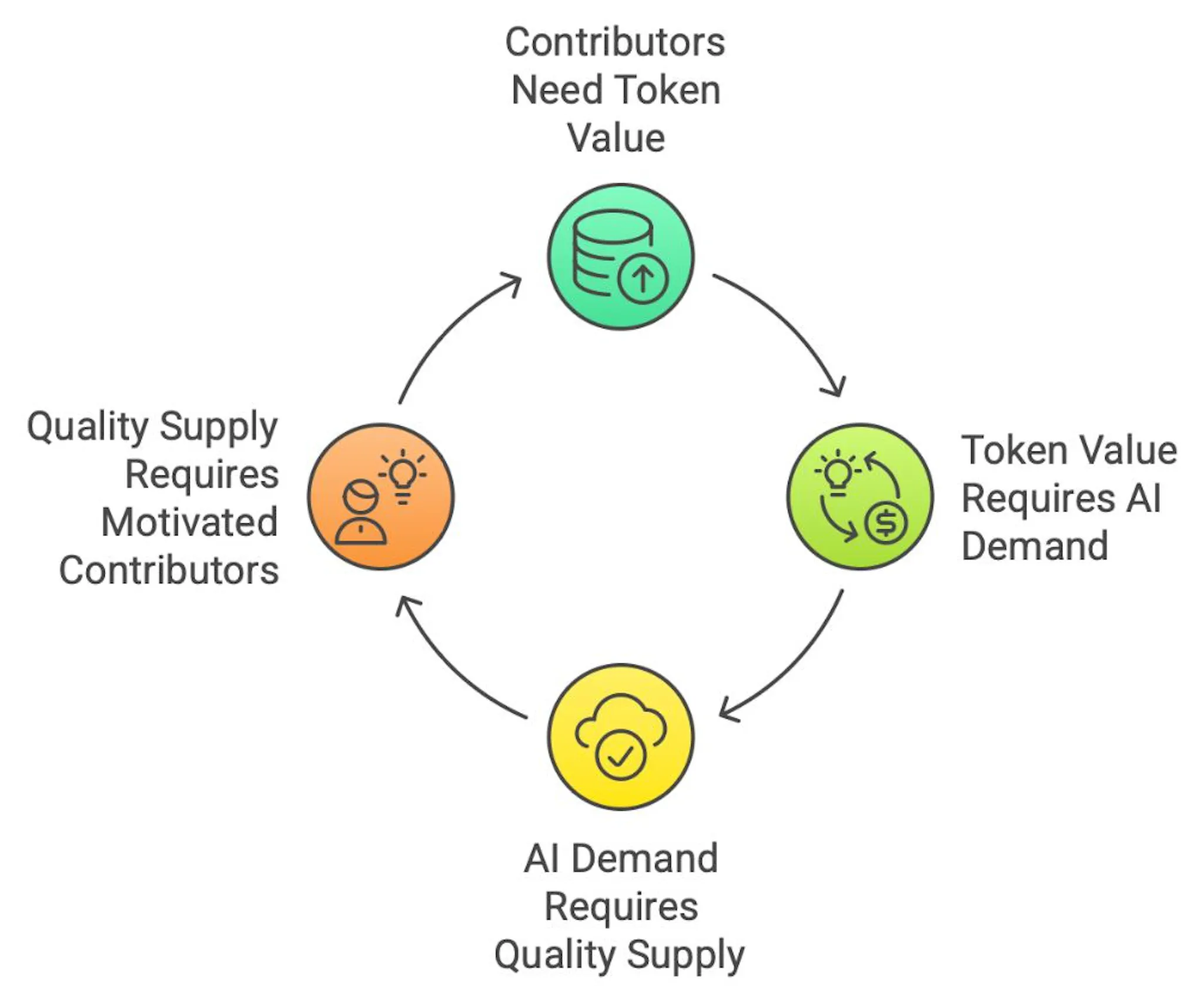 The Web3 Data Paradox Cycle
Who’s Actually Building This
- Ocean Protocol: The OG Data Marketplace Ocean has been around since 2019, which makes it ancient in crypto years. Their core innovation is Compute-to-Data, so instead of sending your raw data to a buyer, you let the buyer’s algorithm run on your data on your infrastructure. The raw data never leaves your control. An AI company can train a model on your medical records without ever seeing your medical records. The compute runs in your enclave; they get gradients, not data. Real enterprise pilots with Daimler and Roche Diagnostics validate the concept. The problem: Discovery and liquidity. Most data sits unlisted or unbought. The marketplace UX is still deeply developer-facing.
- Vana: Personal Data is betting on your personal behavior — Reddit posts, Google searches, Spotify history, fitness data — aggregated into what they call “Data DAOs.” Users contribute their personal data exports to a pool, the pool collectively negotiates licensing deals with AI companies. Revenue flows back to contributors proportionally. This matters because it solves the free-rider problem: you can’t extract value from the pool without contributing to it. Google paid Reddit [$60M/year](https://Every major AI lab is quietly running into the same wall — data. GPT-4, Gemini, Claude, these models were trained on essentially the entire public internet.) for API access to user-generated content, the users who created that content got nothing. Vana is making the argument that this was theft, and building the infrastructure to prevent it next time.
- Grass: Decentralized Web Scraping Grass takes a different angle, instead of personal data, they focus on web data collection. Users install a browser extension that routes AI companies’ scraping traffic through their IP address. Users get paid in native Grass tokens. The AI company benefits by scraping from diverse residential IPs (avoiding blocks), while users monetize their idle bandwidth.
- Bittensor Subnet 13 (Data Universe): Decentralized Dataset Curation Bittensor’s subnet model allows specialized networks to emerge. Subnet 13 specifically incentivizes miners to scrape, clean, and serve web data on demand. Validators pay miners in Bittensor’s native token for high-quality, unique datasets. The elegant part is that quality is enforced by the economic mechanism, not a central curator. Miners who serve duplicate or low-quality data get slashed, and the result is a self-cleaning dataset pipeline.
Tokenomics: Where It Gets Complicated
Here’s where I’ll push back on the pure bull case. The data valuation problem is hard. How much is your Spotify listening history worth to an AI company, $0.001? $50? There’s no established pricing mechanism. Most token rewards in current systems are essentially speculative. You’re being paid in governance tokens that are worth something only if the network succeeds. This creates a classic bootstrapping paradox:
- Data contributors need token value to make contribution worthwhile
- Token value requires real AI company demand
- Real AI company demand requires high-quality, reliable data supply
- High-quality supply requires motivated contributors
Most projects are trying to solve this with emissions schedules — paying early contributors generously to bootstrap supply. This works until emissions dry up, at which point you need real revenue. Very few have crossed that bridge. Compute-to-Data and federated learning sound like perfect privacy solutions. In practice, model inversion attacks can sometimes reconstruct training data from model weights. Differential privacy adds noise but degrades model quality.
Regulatory risk is real as GDPR, HIPAA, CCPA — the legal framework for data monetization is fragmented and evolving. A network that happily tokenizes European health data today could face enforcement action tomorrow. The fact that it’s on-chain doesn’t make it compliant.
What Needs to Be True for 100x
Let’s be precise about the conditions under which this narrative actually plays out at scale.
- AI labs need to hit the data wall publicly. Right now, OpenAI and Google have enough runway with existing data strategies. When scarcity becomes undeniable, likely within 18 months, enterprise demand for alternative data pipelines will spike.
- A killer use case needs to emerge. The most likely candidate: medical AI, hospitals have data. They can’t share it centrally. Compute-to-Data or federated approaches could unlock billion-dollar fine-tuning markets. One major healthcare AI partnership with a Web3 data protocol would validate the entire sector.
- UX needs to collapse to mobile. The current onboarding flow for most data DAOs is: download extension → connect wallet → sign transactions → wait for rewards. For mass adoption, this needs to be: “tap yes to share your data, get paid monthly.” Projects that solve this will capture the retail layer.
- Token value needs real revenue backing. Protocols that transition from emission-based rewards to actual AI company licensing fees will be structurally different assets. Watch for protocols announcing enterprise data licensing deals — that’s the signal.
The Honest Take
Data tokenization for AI training is solving a real problem at exactly the right time. The AI industry’s data hunger is structural, not cyclical. The Web3 infrastructure for data ownership, provenance, and micropayments is more mature than it’s ever been. But the space is also littered with projects that have great whitepapers and no real data demand.
The difference between a huge outcome and a 0 is whether real AI companies start cutting real checks for tokenized data pipelines. That hasn’t happened at scale yet but the conditions for it have never been better. The narrative is right but the execution risk is high.
If you’re evaluating projects in this space, the questions that matter are:
- Do they have actual data buyers, or just data suppliers?
- Is the token reward tied to real revenue, or just emissions?
- Does their privacy tech hold up to academic scrutiny?
- Is there a credible path to regulatory compliance?
The projects that can answer all four honestly are worth watching, the ones that can’t are just the next chapter of the same old story.
*Disclosure: The author does not hold positions in any of the tokens or projects mentioned in this article.


Be the first to comment