



What happens when an institutional trading desk routes its orders through a third-party order management system to the world’s largest cryptocurrency exchange, and the system cannot see how those orders actually perform once they arrive?
That is the gap Binance announced it is closing with the launch of its OMS Toolkit, a dedicated exchange solution for order management system providers, execution management systems, and other trading technology platforms serving both crypto-native and traditional finance clients.
The 2030 logic
Binance is doubling down on growth during a crypto downturn, aiming to expand its verified active user base from about 310 million to 3 billion by 2030. A target that requires a ten-fold increase in a four-year window cannot be achieved on retail distribution alone. Every institutional OMS provider that integrates OMS Toolkit brings its own book of institutional clients with it. If there are 300 institutional technology firms operating in the crypto-native and TradFi-crossover space, and each has dozens to hundreds of professional trader clients, OMS Toolkit is a distribution channel as much as it is a product.
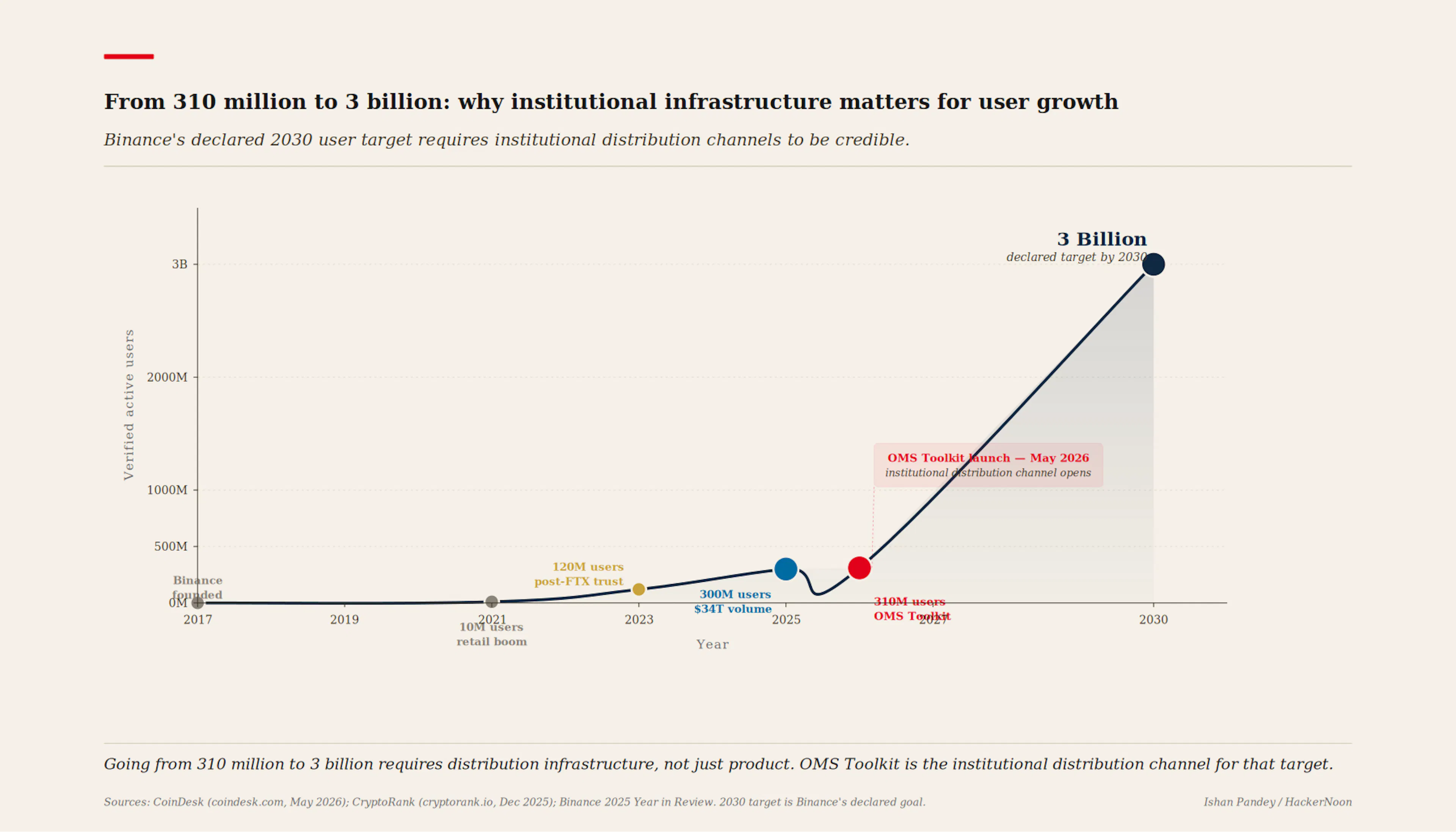 Binance 2030 growth trajectory
What an OMS is and why visibility matters
An Order Management System is the software backbone of institutional trading. It sits between a portfolio manager’s decision to trade and the actual execution on an exchange, centralizing order routing, execution tracking, and post-trade reconciliation across fragmented markets. In traditional finance, platforms like Bloomberg AIM, Charles River, and ION have spent decades building deep connectivity to exchanges, with execution quality data flowing back to the OMS in near real time via the FIX protocol, a messaging standard that has been the plumbing of institutional equity and fixed-income trading since 1992.
Crypto never had a FIX-equivalent. Every exchange published its own API format. What flowed back from the exchange to the OMS was minimal: confirmation that the order was received, the fill, and the timestamp. The richer layer underneath, client engagement patterns, cross-product usage, routing quality across trading sessions, the kind of data that TradFi OMS providers have had for two decades, stayed locked at the exchange level. The OMS provider built the platform, delivered the connectivity, and then flew blind on execution quality once the trade crossed the wire.
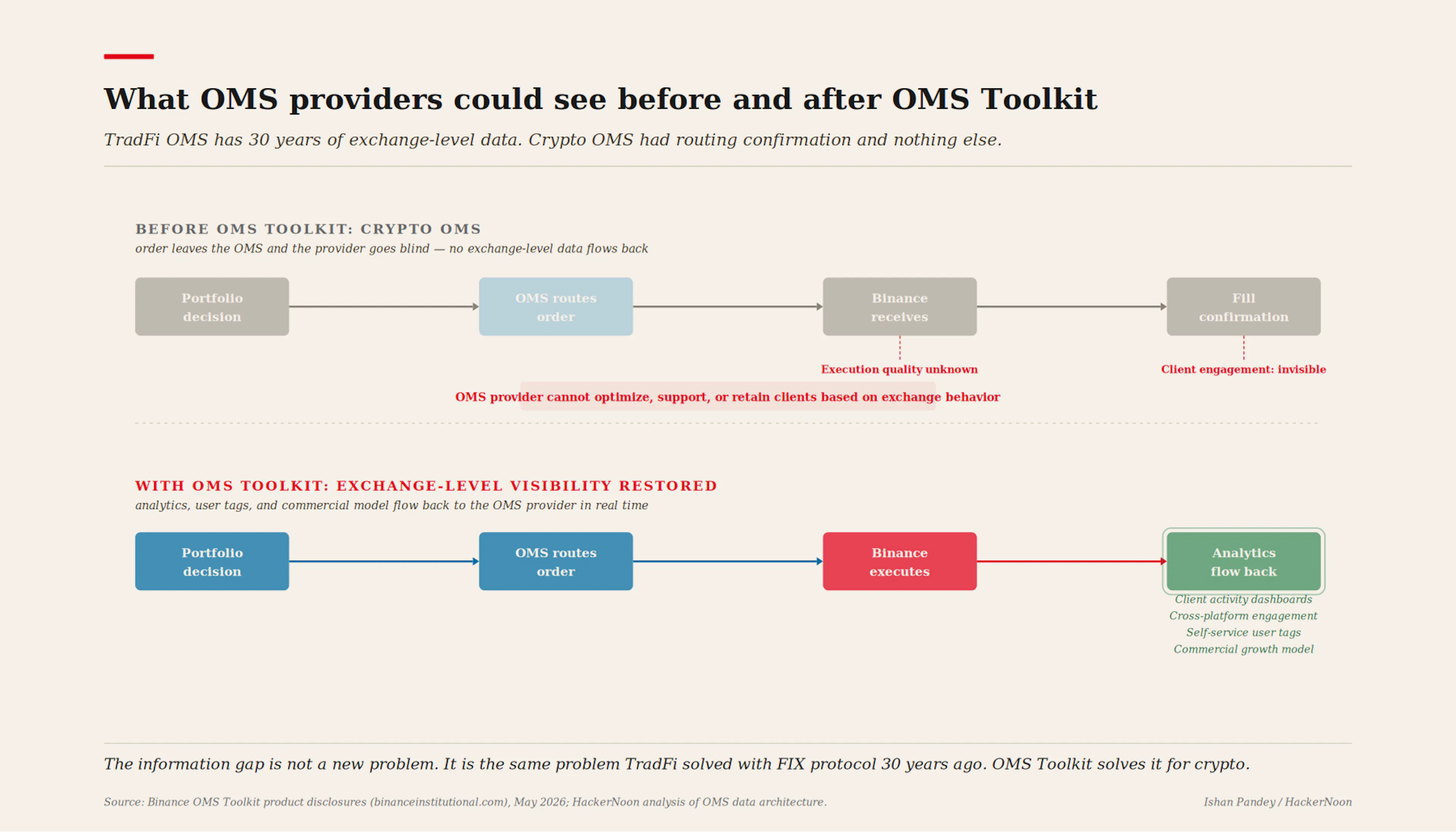 OMS information gap before and after OMS Toolkit
OMS Toolkit bundles five capabilities around that gap. Analytical dashboards surface end-client trading activity and cross-platform engagement, giving OMS providers the kind of execution-quality picture they have in TradFi but have not had in crypto. A custom user-tagging system lets providers segment and manage client accounts directly inside the platform, without routing routine adjustments through Binance support. White-glove onboarding and ongoing support from Binance’s VIP and Institutional team replaces the generic developer-documentation relationship most API integrations get. And expanded product access adds Binance Futures alongside Spot, broadening what the OMS can route to.
 Catherine Chen, Head of VIP and Institutional at Binance
The commercial layer is the part of this that is easy to underread. OMS Toolkit builds on Link and Trade, Binance’s existing spot and futures API trade-tracking system. That system tracked volume. OMS Toolkit reframes the relationship: providers do not just connect, they participate in a commercial model that grows with their clients’ activity on the platform. This is what Catherine Chen, Head of VIP and Institutional at Binance, means when she describes giving technology providers “a stake in the ecosystem.”
The “sustainable model” language is precise. An OMS provider whose revenue grows in proportion to client activity on Binance has an entirely different incentive from one whose revenue depends on a flat integration fee. The first optimizes for client performance. The second optimizes for switching costs.
Binance’s Institutional Business is Growing Faster Than The Market
The numbers that frame this launch are not small. Binance reported $34 trillion in total product trading volume in 2025, with institutional trading volume growing 21 percent year on year and institutional users growing 14 percent year on year. The exchange holds approximately 41 percent of global spot crypto trading volume, making it the single largest liquidity pool for any institutional client routing crypto orders. Binance is targeting a more than $2 billion gap between traditional finance and crypto infrastructure spending, and the OMS Toolkit is the first product it has built explicitly to address that gap from the institutional technology side rather than the client side.
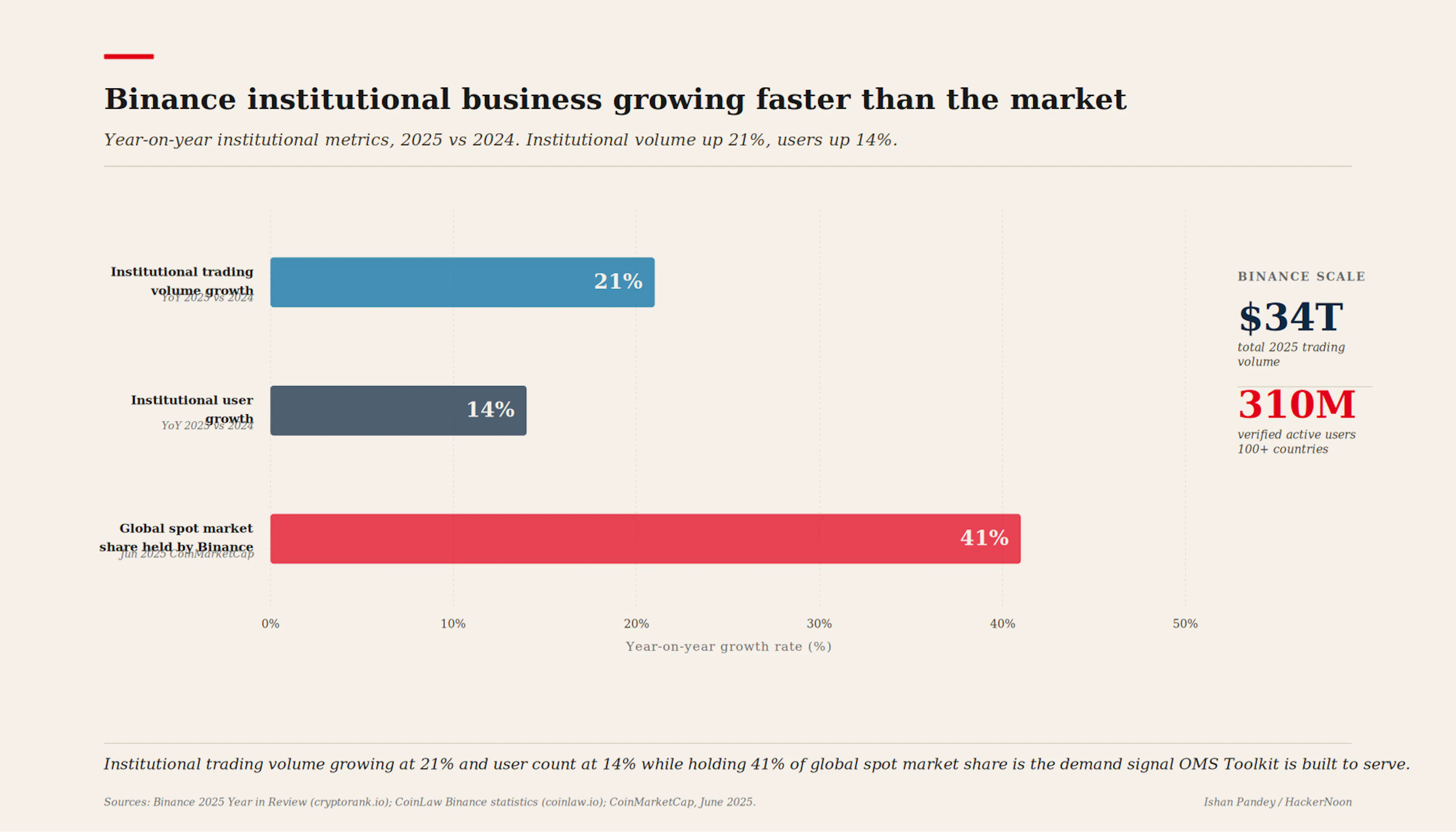 Binance institutional growth
The OMS and trading software market, the category OMS Toolkit’s customers operate in, was valued at approximately $6.8 billion in 2025 and is projected to reach $10 billion by 2030. The financial services segment of that market, the one where crypto-native and TradFi OMS providers compete, sits at $4.17 billion in 2026 and is expected to reach $9.3 billion by 2035. Every firm in that segment that handles institutional crypto client flow is a potential OMS Toolkit customer.
 OMS market size
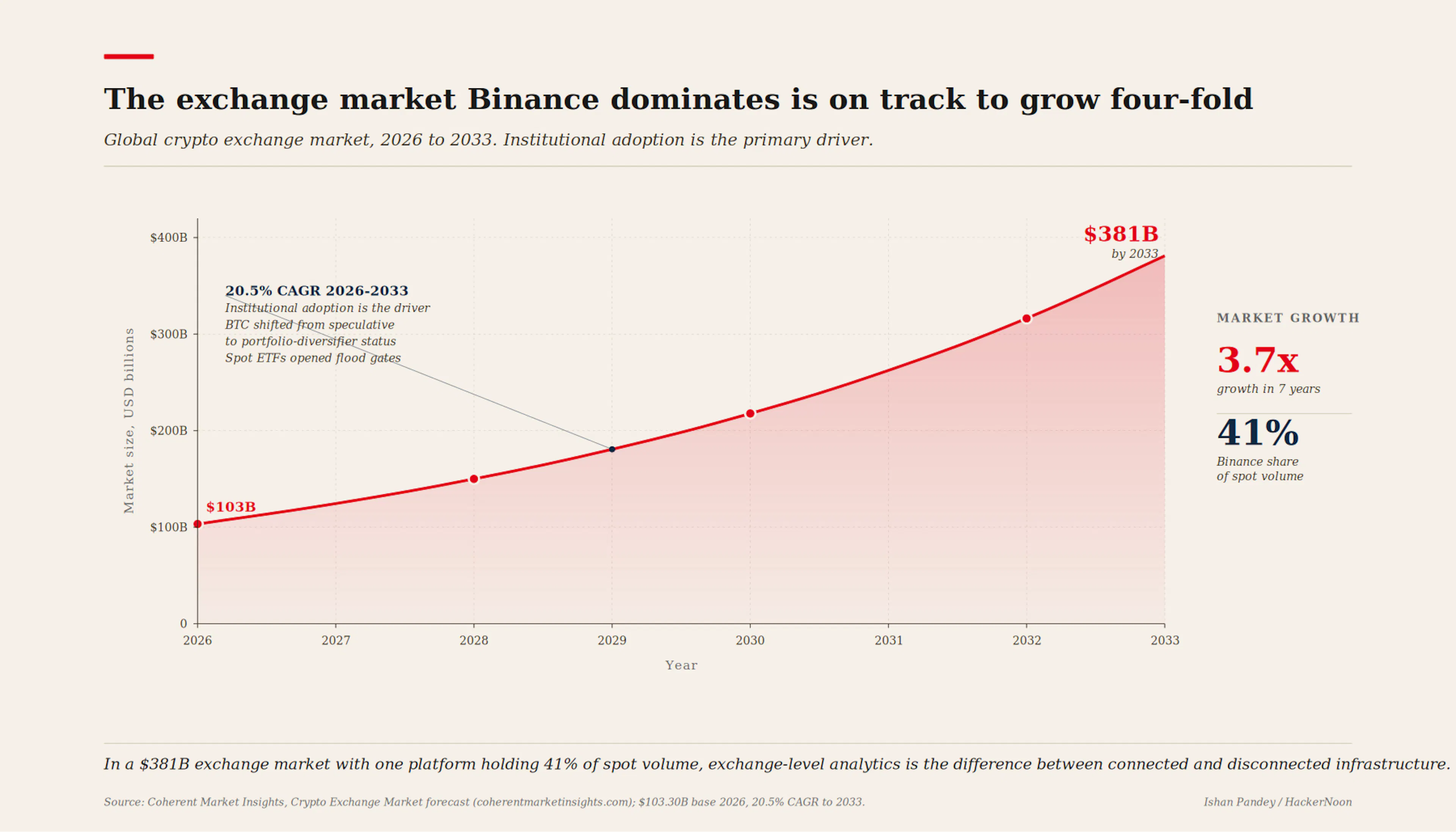
The broader crypto exchange market provides the context for why the timing is now. The crypto exchange market crosses USD 103.30 billion in 2026, growing at a CAGR of 20.5% to reach USD 381.18 billion by 2033. That growth is not happening in retail. The institutionalization of bitcoin has reached an inflection point, transitioning from a speculative retail instrument to a foundational component of diversified investment portfolios. Institutions need institutional infrastructure, and OMS Toolkit is Binance building the exchange side of that infrastructure.
What to Watch For
The most analytically interesting thing about OMS Toolkit is not the product. It is the commercial framing. Binance is not selling an API upgrade. It is building a partner layer where the people who build on top of the exchange share in the economics of what they build. That structure is different from how most exchanges have handled OMS relationships, and it is the structure most likely to produce long-term integration depth, because partners with revenue tied to client activity have the right incentive.

The gap this closes has been real and consequential. Institutional adoption of crypto has consistently been slowed by the infrastructure mismatch between what TradFi trading operations require and what crypto exchanges have historically provided. Binance is the right exchange to close it because it has the liquidity depth that makes execution quality matter and the institutional user base that already exists to demonstrate proof of demand. Whether OMS Toolkit converts that demand into the kind of deep infrastructure embedding that characterized Bloomberg’s dominance of equities OMS is the question to watch over the next eighteen months.
Don’t forget to like and share the story!
HackerNoon has reviewed the report for quality, but the claims, opinions and analysis herein belong to the author.
All claims, opinions, and analytical conclusions are those of the author, who retains full control over the work. #DYOR


Be the first to comment