


What does on-chain trading infrastructure look like once we stop pretending bridges are a long-term answer?
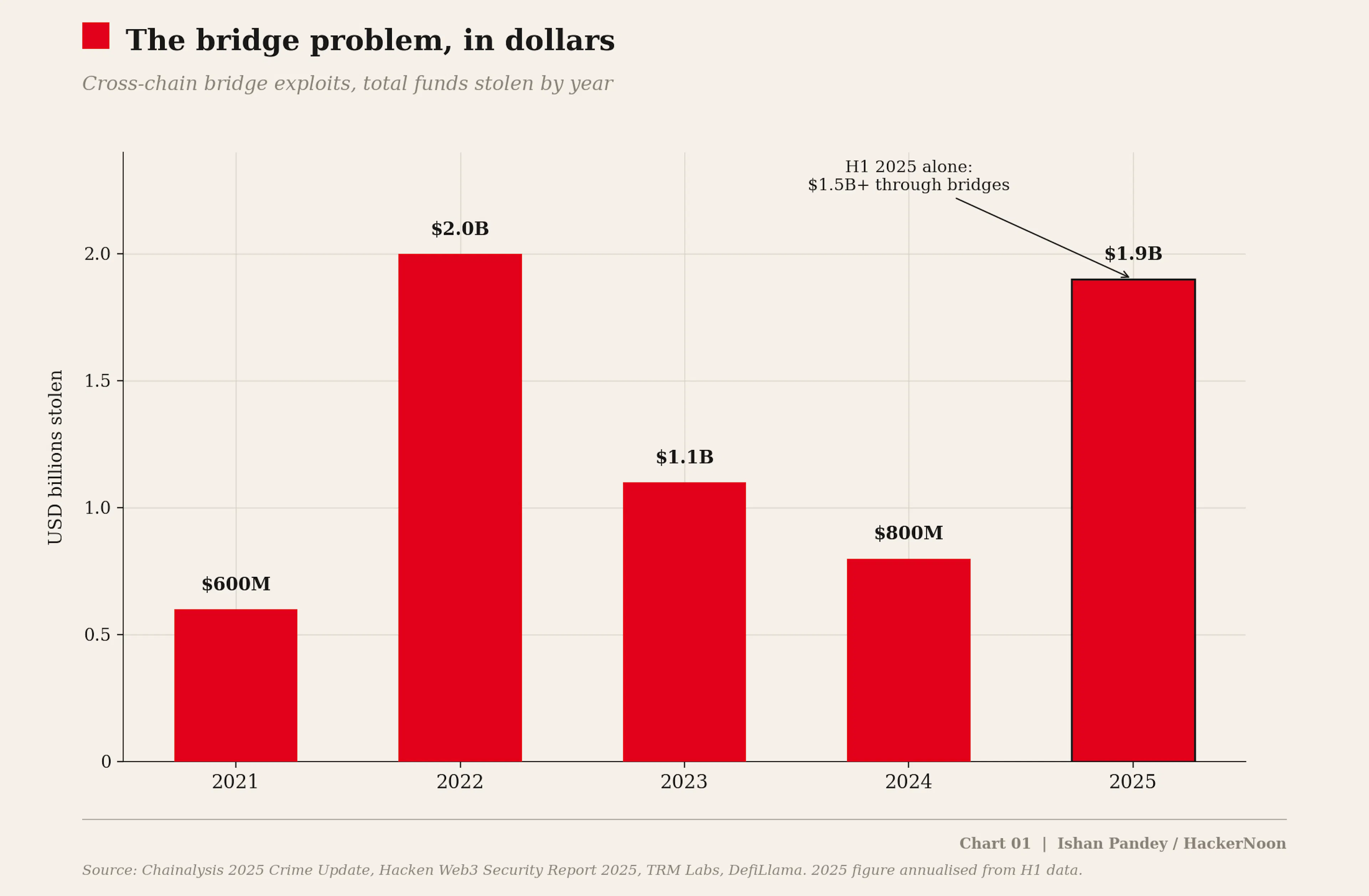
By the Chainalysis mid-year tally for 2025, over $2.17 billion in crypto was already stolen by July, surpassing the entire 2024 figure. Cross-chain bridges did most of the heavy lifting on the wrong side of that ledger. Hacken’s 2025 Web3 Security Report put bridge-attributable losses past $1.5 billion in the first half alone. Cumulatively, bridges have absorbed roughly $2.8 billion in exploits since 2022, or about 40% of all Web3 hacks by value.
This is the backdrop against which Orbs, the decentralized Layer-3 blockchain that powers on-chain trading protocols including dTWAP, dLIMIT, Liquidity Hub, and Perpetual Hub, has announced a V5 Committee Sync MVP, now live on Ethereum and Arbitrum. The architecture is built around a single quietly radical idea: instead of moving funds between chains, you move signed state. The funds stay home.
If it works at scale, this is the kind of infrastructure shift that does not get a market reaction on the day of the press release and then quietly reshapes how the next $50 billion of on-chain trading volume settles.
The news in one paragraph
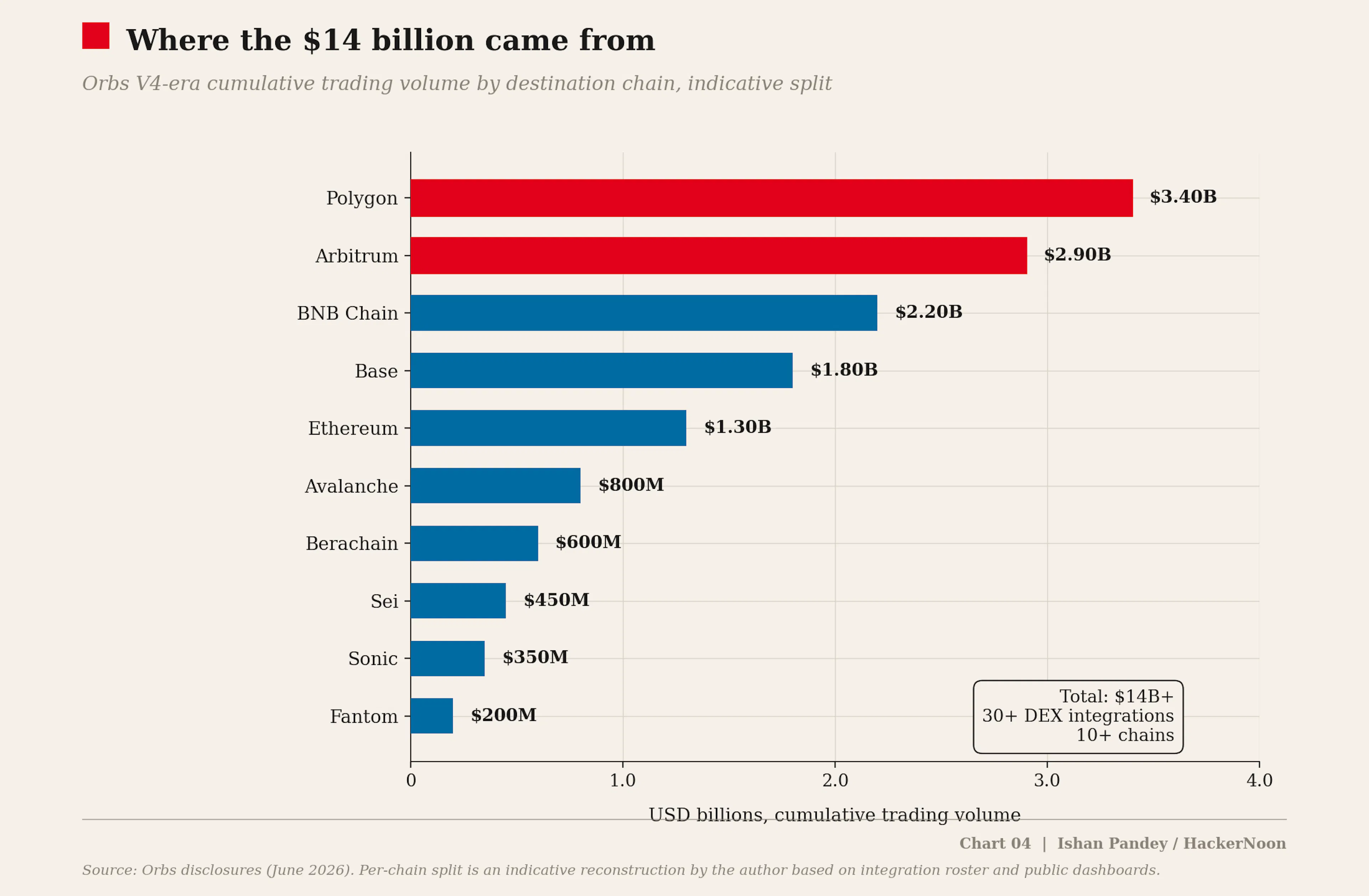
Orbs has activated the first phase of its V5 architecture on Ethereum and Arbitrum. The mechanism, called Committee Sync, propagates the authoritative state of the Orbs Layer-3 committee across EVM-compatible chains using signatures collected from the network’s Guardian validators. Smart contracts deployed on each destination chain verify those signatures locally against an on-chain registry. No user funds pass through the protocol during synchronization. Only signed state data crosses the boundary. Orbs reports its existing V4 stack has processed more than $14 billion in trading volume across 30+ DEX integrations on 10+ chains, generating $3.2 million in protocol revenue.

Why this isn’t just another cross-chain announcement
Three structural facts make the V5 move worth a second look.
First, the demand side is real and it is exploding. Perpetual DEX trading volume grew 346% in 2025 to roughly $6.7 trillion, with monthly volume crossing $1 trillion in late 2025 and again into Q1 2026. Hyperliquid alone processed an estimated $1.6 trillion between August 2025 and January 2026, enough to land it among the top ten crypto venues globally, centralized exchanges included.
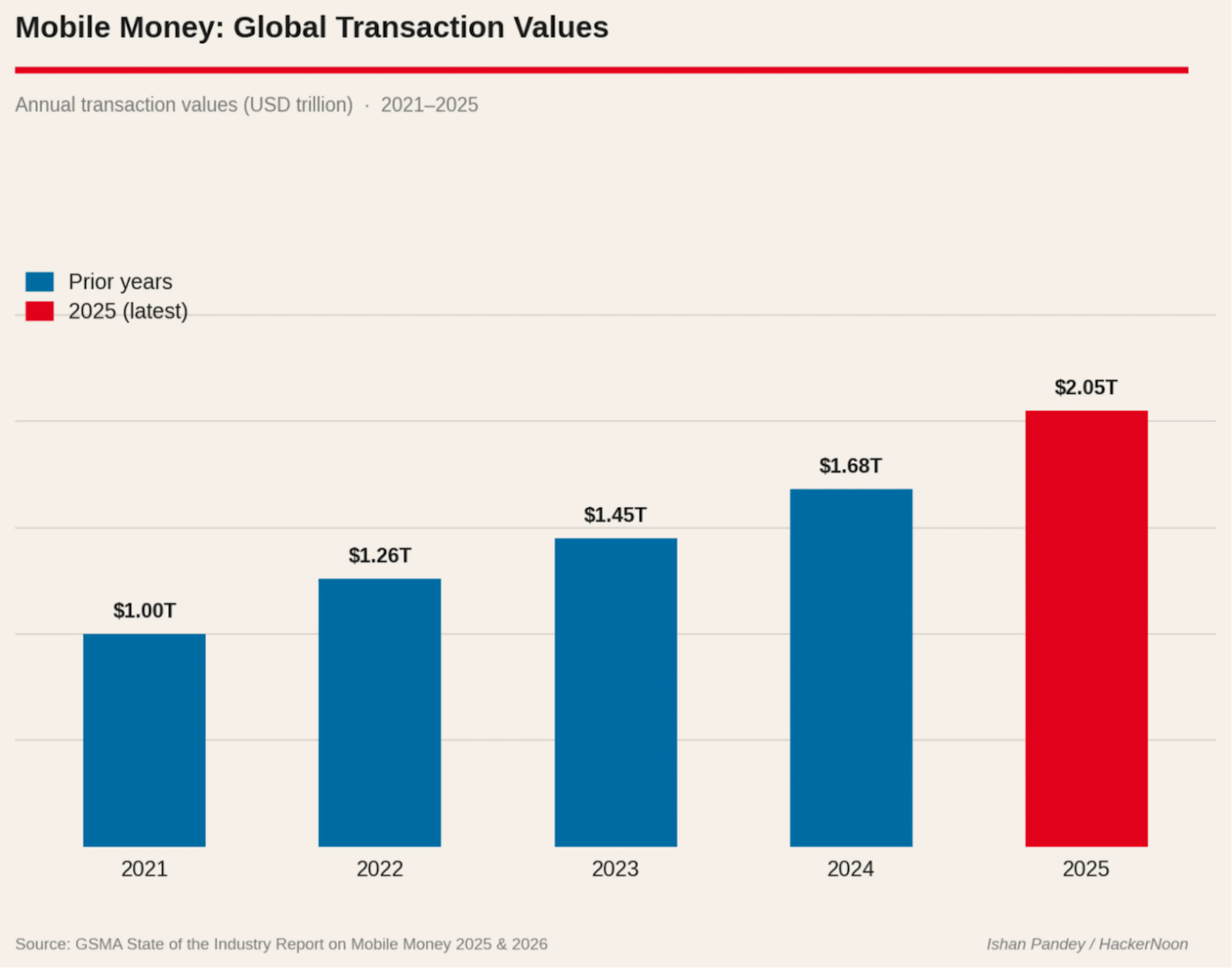
Second, the market structure is shifting. DEX share of all perpetual futures volume climbed from 2.0% in January 2024 to 10.2% in January 2026, and continues to compound. The Block’s DEX-to-CEX spot ratio touched 21.2% in November 2025, an all-time high. One in every five spot trades now bypasses a centralized exchange.
Third, and most importantly for the V5 thesis, the bottleneck in this market is no longer order flow. Order flow is solved. The bottleneck is now verification, custody risk, and the cost of supporting a growing list of destination chains.
What Committee Sync actually does
The mechanic is straightforward enough to describe in plain language, which is rare in this corner of the industry.
Orbs runs an off-chain executor network that processes trading logic for protocols sitting on top of it, decentralized TWAP orders, limit orders, perpetual hedging, liquidity routing, and now agent-initiated trades. These executors generate signed actions. The Orbs Guardian network, a set of permissionless Proof-of-Stake validators that have been running on mainnet since 2019, verifies those actions and produces a signature payload that represents the authoritative state of the L3 committee at a given moment.
Under V4, that state had to be re-verified on each destination chain through a dedicated stack. Under V5, the committee state is propagated, and smart contracts on each supported chain verify it locally against an on-chain registry, using Guardian signatures as the source of truth.
The result, structurally, is that the same off-chain compute can be cheaply trusted by an unbounded number of destination chains, without operating a separate verification stack on each. The marginal cost of adding the next chain falls dramatically.
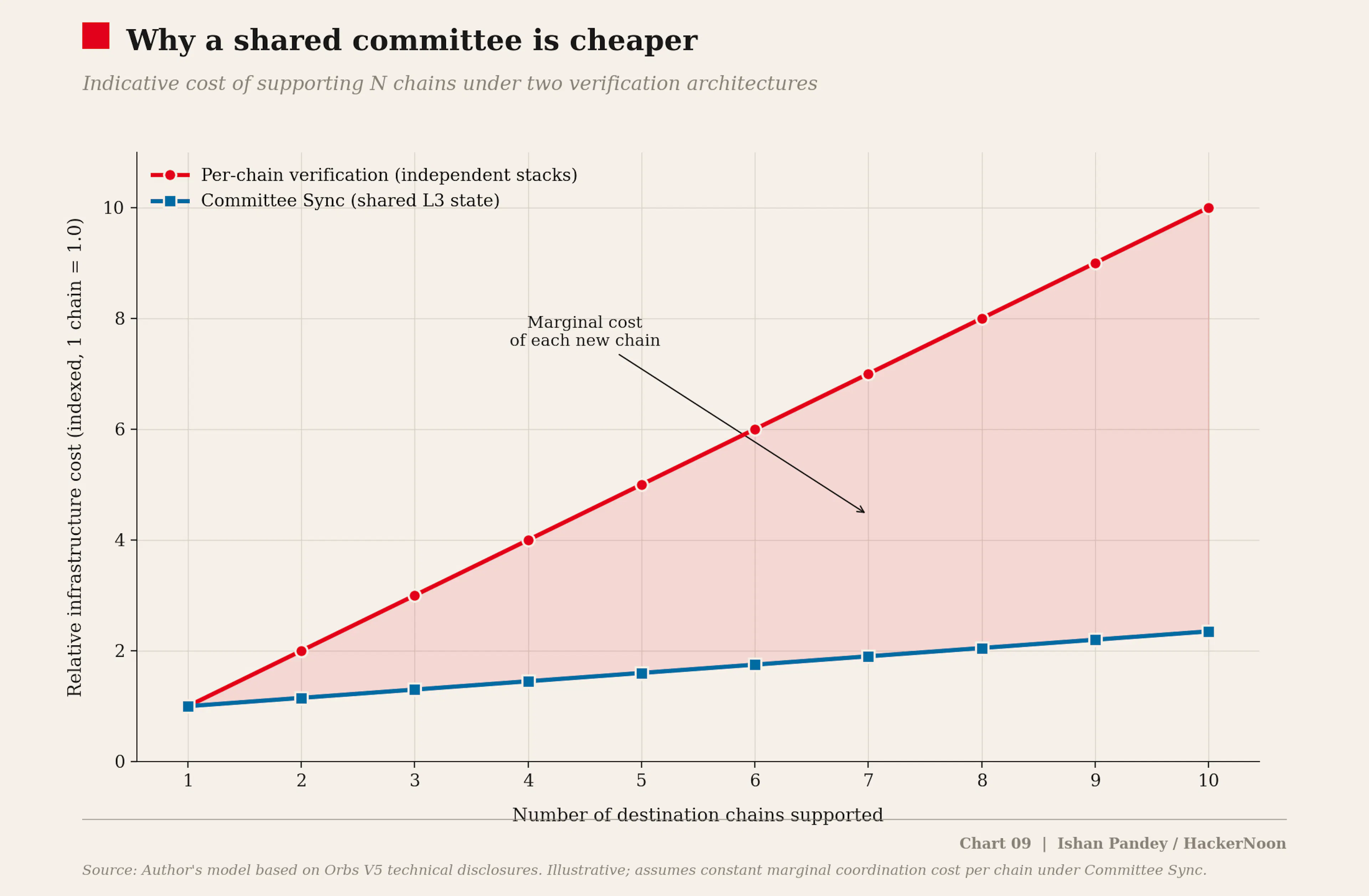
This is the kind of cost curve that lets infrastructure scale without the usual death-by-fragmentation that has hit other multi-chain protocols.
The bridgeless thesis, and why it matters now
There is a category error in how the industry has historically talked about cross-chain. Bridges, in the traditional sense, are custody systems wearing the costume of messaging protocols. They take funds, hold them on Chain A, and mint or release equivalent funds on Chain B. Whatever clever cryptography or validator set or zero-knowledge wrapper sits on top, the core mechanic is custodial. That is why every bridge of meaningful size has been a target. The funds are there.
What Committee Sync changes is the unit of work that crosses the chain boundary. Under V5, no funds move. The thing that moves is a cryptographic statement, signed by a sufficient quorum of the Guardian set, saying “this executor was authorized to perform this action at this nonce.” Smart contracts on the destination chain check that statement against their local registry, and if it verifies, the action proceeds on-chain using assets that never left Chain B in the first place.
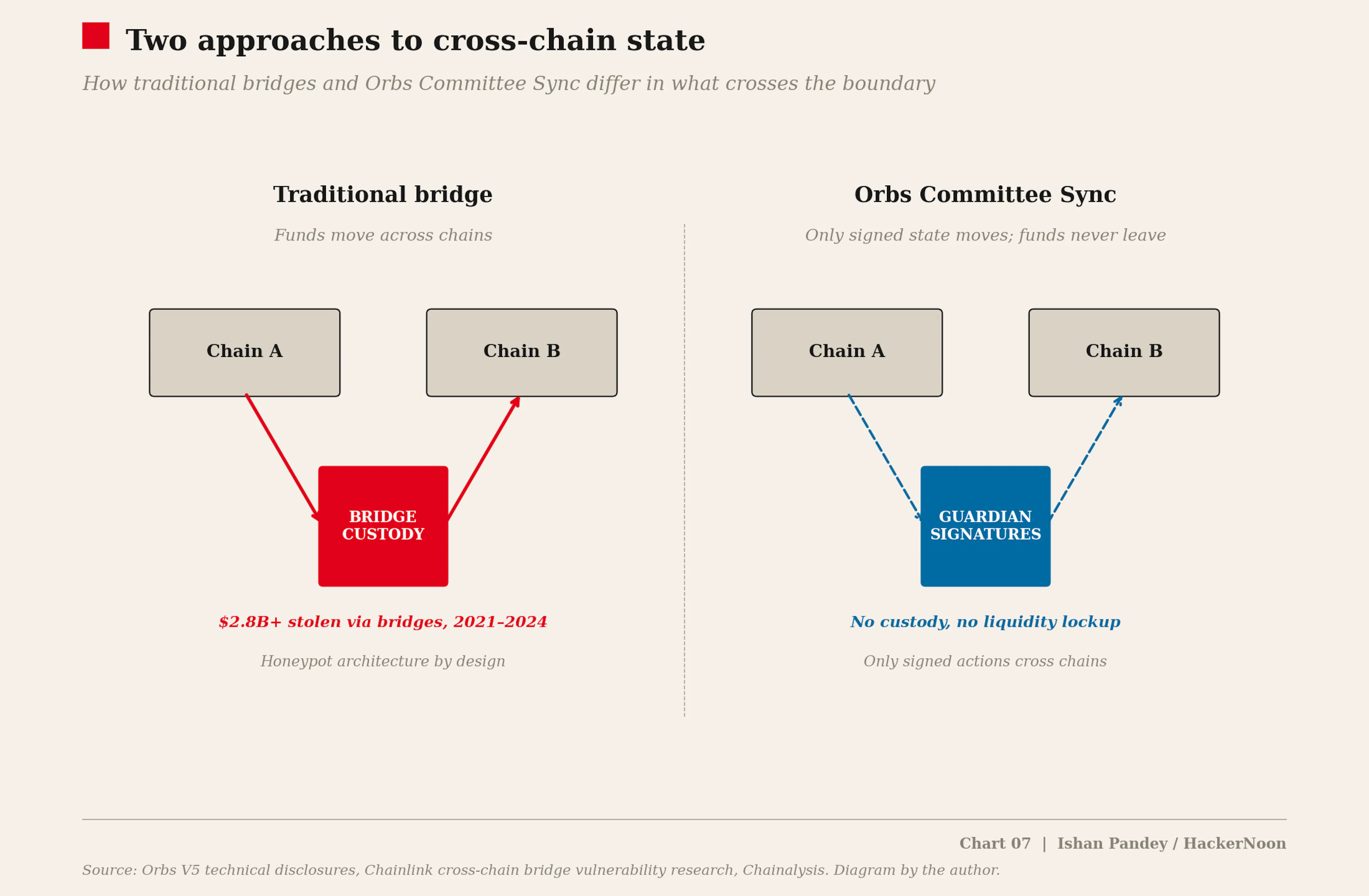
For traders, the implications are not abstract. If the synchronization layer fails or is compromised, no one’s funds are at risk in a pooled custody contract. The worst case is that a legitimate action fails to verify, in which case the action does not execute. There is no honeypot to drain.
The economic question is whether this design is robust under adversarial conditions at scale. That is what Phase 1 on Ethereum and Arbitrum is meant to test.
Reading the numbers behind V4
Before assessing V5, it helps to understand what V4 actually accomplished. The headline figures, $14 billion in cumulative trading volume, 30+ DEX integrations, 10+ chains, $3.2 million in protocol revenue, are useful but do not capture the underlying texture.
Volume distribution skews toward EVM L2s and high-throughput L1s, with Polygon and Arbitrum carrying disproportionate weight, a function of where the integrated DEXs, including Chronos, QuickSwap, SpookySwap, and Thena, have built their order books. The volume mix is not concentrated on any single integration, which is the relevant fact for an infrastructure provider. Single-DEX risk is structurally low.
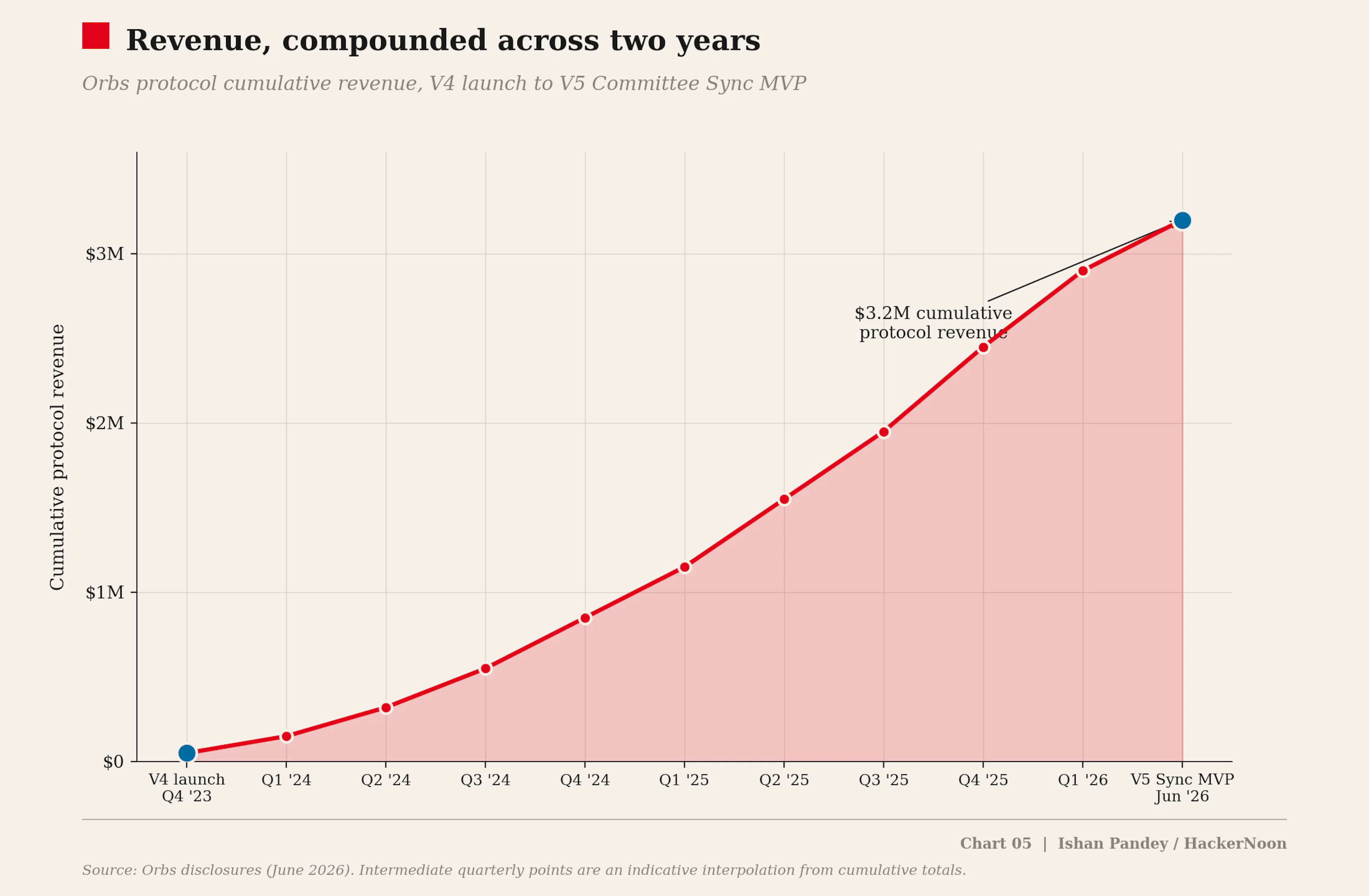
The revenue figure is a more useful proxy for product-market fit than total volume. $3.2 million accruing to a Layer-3 infrastructure protocol over the V4 lifecycle implies the integrated DEXs are willing to pay for execution quality, not just bolt on free tooling. That kind of revenue base, modest in absolute terms but compounding, is what separates infrastructure that gets adopted from infrastructure that gets demoed.
The stack, mapped
To see where V5 fits, it helps to lay the whole product surface side by side.
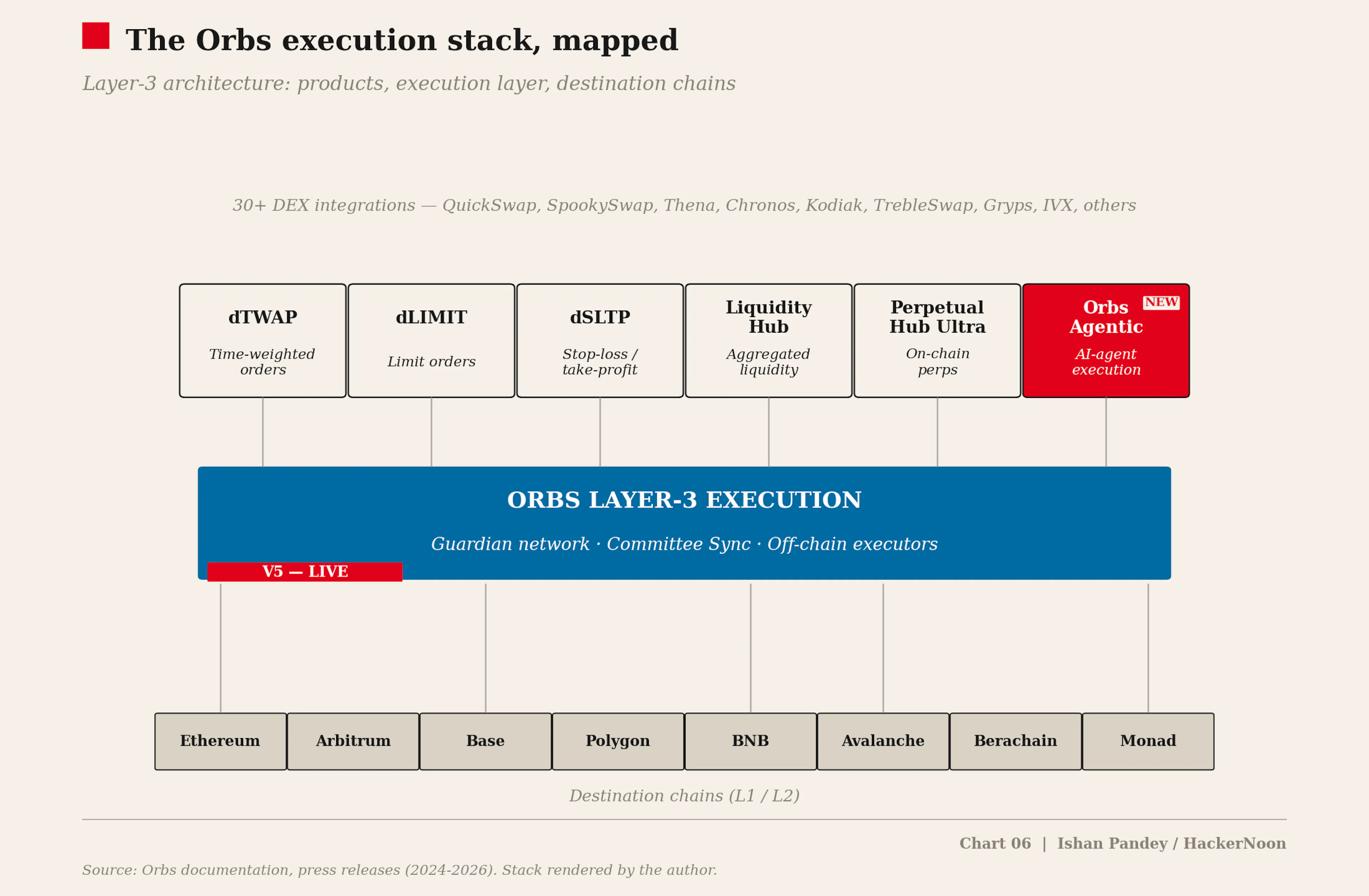
The execution layer is the spine. Sitting on top of it are six trading primitives, of which Orbs Agentic, launched in March 2026, is the newest. Agentic is worth flagging here because it is the most direct beneficiary of Committee Sync. AI agents trading on-chain need deterministic, verifiable execution across whichever chain holds the position they want to manage. A bridgeless cross-chain verification primitive is exactly the kind of infrastructure that lets agent-driven flow operate at scale without the periodic custody crises that have plagued bridge-dependent systems. Orbs has already disclosed $2.2 billion processed through products that share the same Layer-3 backbone Agentic now extends.
The under-the-hood claim is that all of these products inherit V5’s properties as the rollout completes. The same Guardian signatures that authorize a TWAP execution will, under V5, authorize an agent action or a perpetual hedge across whichever chain holds the underlying.
Where it sits in the competitive landscape
If you map the on-chain execution market on two axes, distribution model on one and execution capability breadth on the other, the picture is more interesting than the standard “DEXs vs. CEXs” framing.
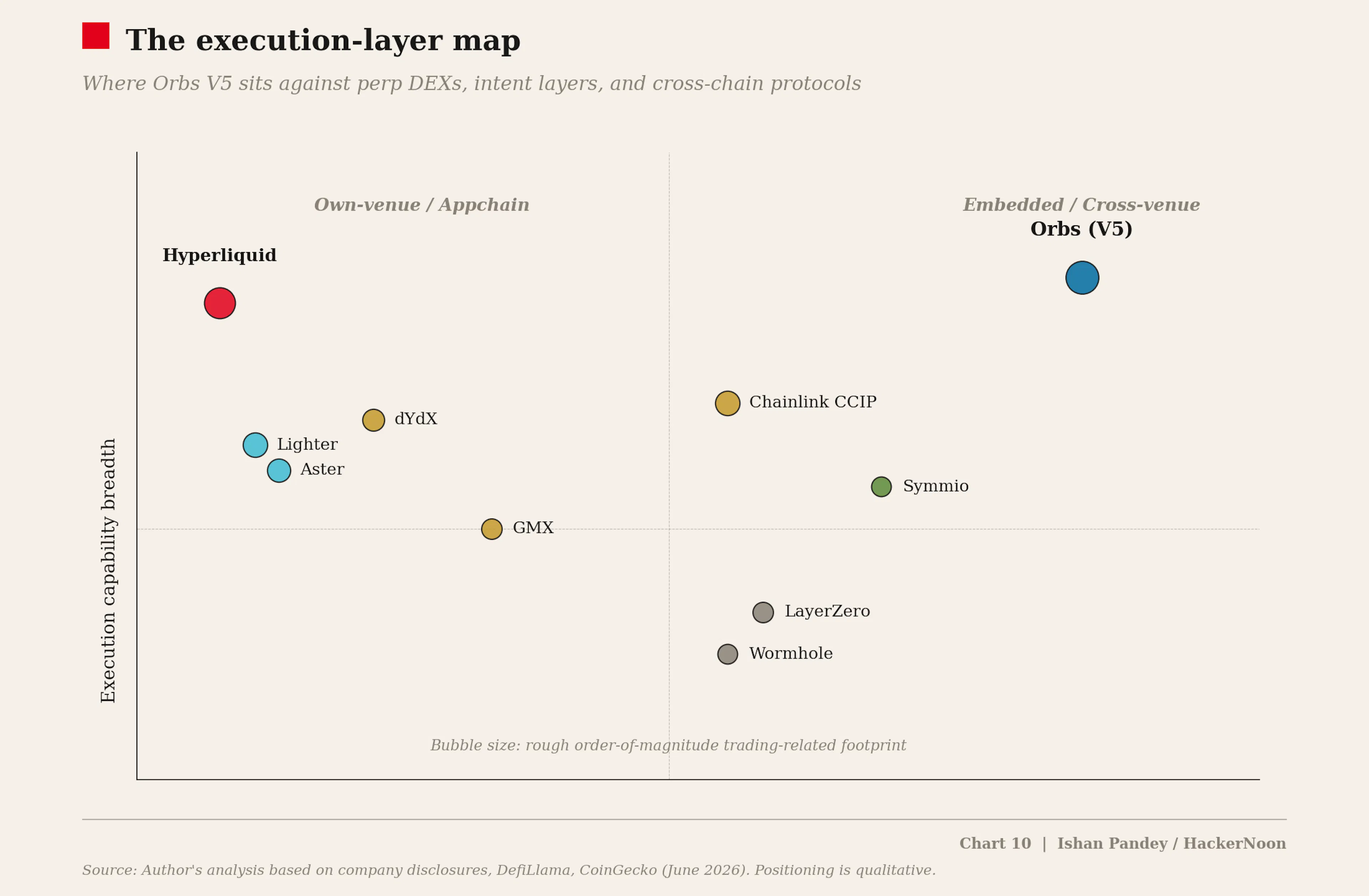
The market has bifurcated, and the bifurcation is more strategically meaningful than the volume rankings let on.
Quadrant one: appchain dominants. Hyperliquid is winning the own-venue bet, an integrated appchain with its own order book, where the execution layer and the venue are the same entity. Lighter, Aster, and the next wave of perp DEXs are pursuing the same model with different design choices. Volume concentrates here because liquidity loves a single venue.
Quadrant two: embedded execution layers. Orbs sits here, and so does Symmio for perps and Chainlink CCIP for messaging. The distribution model is fundamentally different: rather than building a venue, you become the execution backbone for 30+ venues. The volume scoreboard looks lower in isolation, but the franchise risk is diversified across all integrated DEXs.
The question for the next 18 months is which model captures the marginal trader. Hyperliquid’s thesis is that traders follow liquidity to a single venue. Orbs’ thesis is that traders are loyal to DEXs they already use, and what wins is the infrastructure that makes those DEXs match Hyperliquid-grade execution without rebuilding their stack.
Both can be right. They are not actually competing for the same dollar of integration spend.
The phased rollout, and what could go wrong
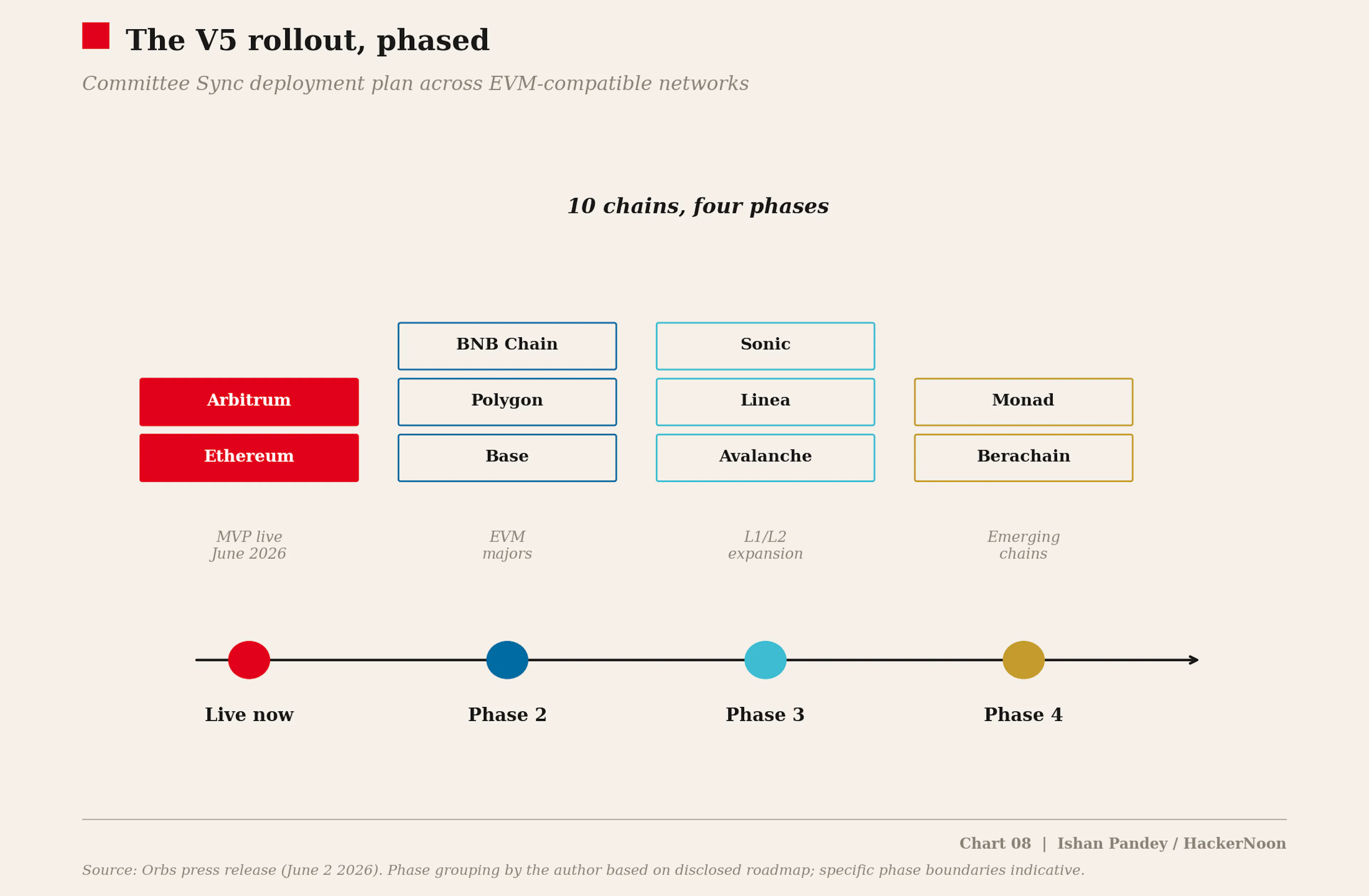
The V5 deployment is not a one-shot launch. Orbs has disclosed a phased rollout, with Ethereum and Arbitrum live now, followed by expansion to Base, Polygon, BNB Chain, Avalanche, Linea, Sonic, Berachain, and Monad in subsequent phases. Future work includes subnet expansion, signature persistence, historical state replay, and the deployment of new Guardian node software across the network.
The risks, plainly stated:
-
Guardian set capture. The whole design rests on the assumption that the Guardian set cannot be subverted to sign fraudulent state. This is the standard Proof-of-Stake security assumption, and Orbs has run a Guardian network on mainnet since 2019 without incident, but the threat surface widens as the value of trades verified by Guardian signatures grows.
-
Smart contract risk on destination chains. Local verification logic on each chain has to be implemented correctly. Bug bounties and formal verification will matter more, not less, as the chain list expands.
-
Liveness on individual chains. If a destination chain experiences degraded block production, executions can stall, even if the signature itself is valid. This is a property shared with most cross-chain systems, but it is worth naming.
-
Coordination cost of the migration itself. Orbs has said all existing products will remain operational throughout, with no expected disruption for users or ecosystem partners. The execution risk of multi-month migrations across 30+ integrations is real even when the technical work is sound.
None of these risks are unique to Orbs. They are the cost of operating cross-chain infrastructure in 2026.
The bottom line
The V5 Committee Sync MVP is not a flashy product. It is a piece of infrastructure that will, if it works, make on-chain trading execution feel slightly cheaper, slightly more reliable, and slightly less dependent on whatever bridge is currently fashionable. None of that is a headline-driver in isolation.
But the structural read is more interesting. The on-chain trading market is no longer fringe. Perpetual DEX volume is on a path to compete meaningfully with centralized derivatives. The bottleneck has migrated from order flow and matching to verification, custody, and cross-chain coordination. The protocols that solve that next layer of the stack, without rebuilding the honeypots that have already cost the industry billions, are the ones whose infrastructure quietly becomes load-bearing for the entire decentralized derivatives market.
Orbs has spent two years building a Layer-3 execution layer that already moves real volume on real chains for real protocols. V5 is what happens when that team turns its attention to making the layer cheaper to scale and harder to compromise.
Whether the bet pays off is a question of execution over the next 12 to 18 months. The architecture is sound. The chains are landing in sequence. The customer base is already there. The question now is whether the migration goes as cleanly as the press release suggests.
That is worth watching.
Don’t forget to like and share the story!
HackerNoon has reviewed the report for quality, but the claims herein belong to the author. #DYOR.



Be the first to comment