


When KuCoin and Tomorrowland announced their multi-year partnership in December 2025, the deal read as significant but unproven. Three months later, the first activation under that deal ran at Tomorrowland Winter in Alpe d’Huez, where roughly 25,000 attendees moved through a fully integrated crypto-payment environment for the first time at a Tier-1 festival. The Belgium editions are still ahead, two weekends in Boom across July. But the Winter run has already settled one question. The crypto-meets-music partnership is no longer experimental marketing. It is a working acquisition channel.
The KuCoin deal is the most visible entry in a four-year arc. At least seven major crypto-meets-music partnerships have rewritten how exchanges approach mainstream cultural acquisition since 2022. The Crypto.com Arena and stadium-naming-rights era is being replaced by something quieter and more deliberate. This is the list, in chronological order, followed by the analysis of what the pattern actually means.
1. KuCoin x Tomorrowland, December 2025 — The Centerpiece
In December 2025, KuCoin announced a multi-year partnership with Tomorrowland covering Tomorrowland Winter 2026 in Alpe d’Huez and the return of Tomorrowland Belgium in Boom, with the deal extending through 2028. KuCoin became the exclusive cryptocurrency exchange and payment partner, with crypto rails accepted for ticketing, merchandise, food and beverage, and VIP services. The announcement landed weeks after KuCoin received its MiCA license from Austria’s Financial Market Authority in November 2025.
The Winter edition ran in Alpe d’Huez from March 21 to 28, 2026. Four pillars defined the activation:
-
The 12 KuCoin Guardians, character-driven brand ambassadors woven into Tomorrowland’s existing fantasy narrative rather than running alongside it. The Guardians felt native to the festival’s universe, an integration choice rather than an interruption.
-
La Folie Douce and the KuCoin Base Point, immersive installations that turned shared zones and green-lit nightlife environments into atmospheric branding. The spaces prioritized presence and participation over conversion, and the brand was experienced socially before it was interpreted commercially.
-
The Limited Edition Tomorrowland KuCard, a payment-collectible hybrid that gated future Tomorrowland Belgium ticket access through an onsite waiting list, creating a physical-to-digital engagement loop pointed at the Boom editions still ahead in July.
-
Out-of-home placements at airports and transit hubs feeding into Alpe d’Huez, intercepting the audience during the emotional anticipation phase of their travel rather than the conversion phase at point of sale.
KuCoin CEO BC Wong tied the deal to the exchange’s broader brand thesis, calling Tomorrowland a gathering that “unites the People of Tomorrow with creativity, connection and a shared belief in a better world,” and aligning that with KuCoin’s positioning as “the People’s Exchange.”
Why it matters: First exclusive multi-year crypto-payment partnership at a Tier-1 global festival. The Winter activations demonstrated the format. The Belgium editions in July will test whether it scales to 400,000-attendee weekends. Either way, the template every other Tier-1 festival will now be asked to copy is on the table.
2. Luno x All Points East, 2022 — The First Mainstream Festival Test
In August 2022, London’s All Points East festival in Victoria Park named Luno its presenting partner, running the on-site “Luno Lounge” and offering fast-track entry to Luno customers across the ten-day run. AEG Presents CEO Jim King framed the deal as a long-term relationship with music fans rather than a one-event drop, citing the festival’s “forward thinking crowd” as the right cultural fit for a crypto category trying to escape its trading-app skin.
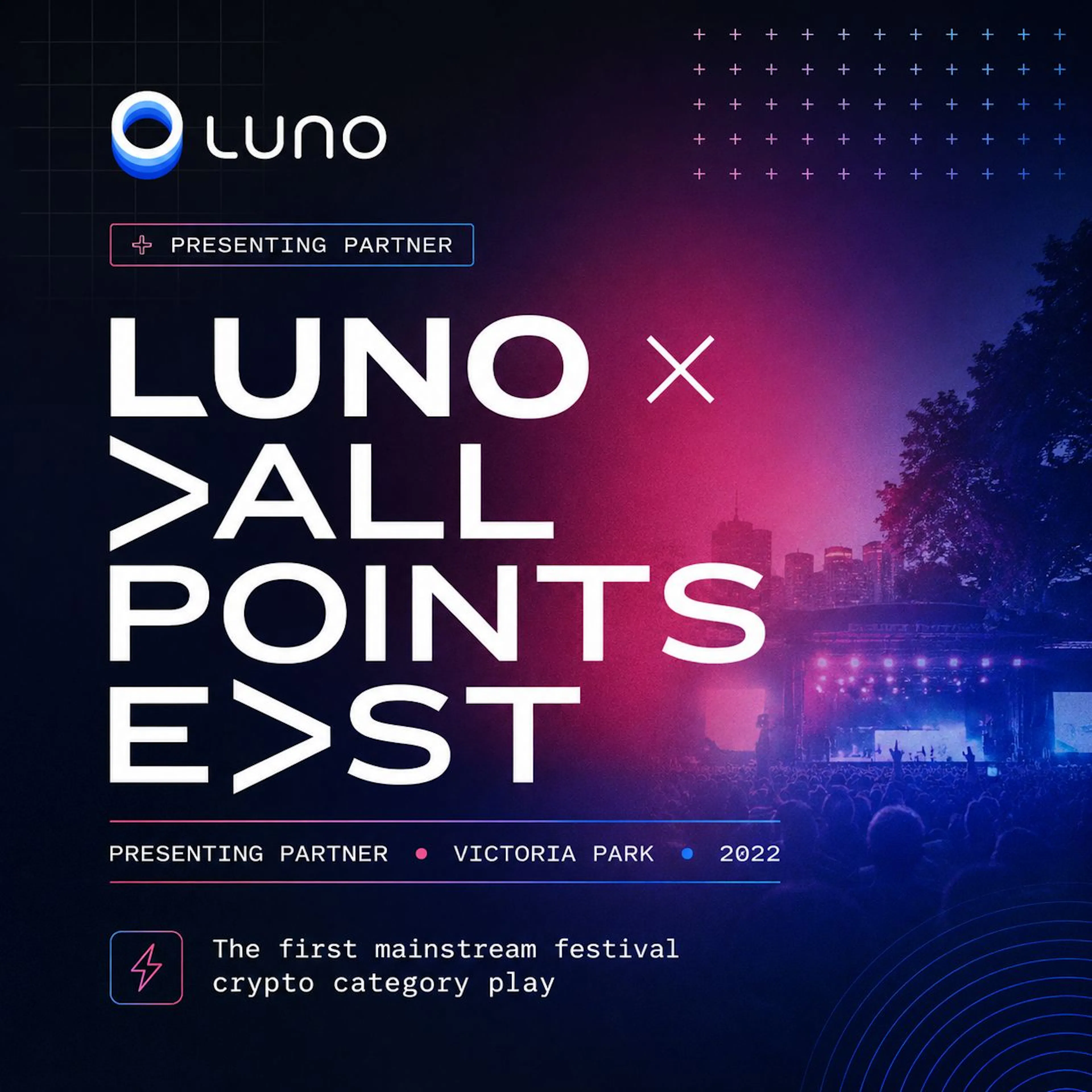
Why it matters: First mainstream Western festival to treat crypto as a category partner rather than a logo placement. Quiet, but the template every later deal would refine.
3. Binance x Primavera Sound, 2022 — The Stage and the Booth
In June 2022, Binance ran a strategic partnership with Primavera Sound across the festival’s Barcelona and Porto editions, including the Binance Stage in Barcelona and on-site Booths in both cities where attendees claimed POAP NFTs, mystery boxes and Binance swag. The activation tied a free 2023 international Primavera ticket to specific NFT holdings, building an attendance loop rather than a one-time drop.
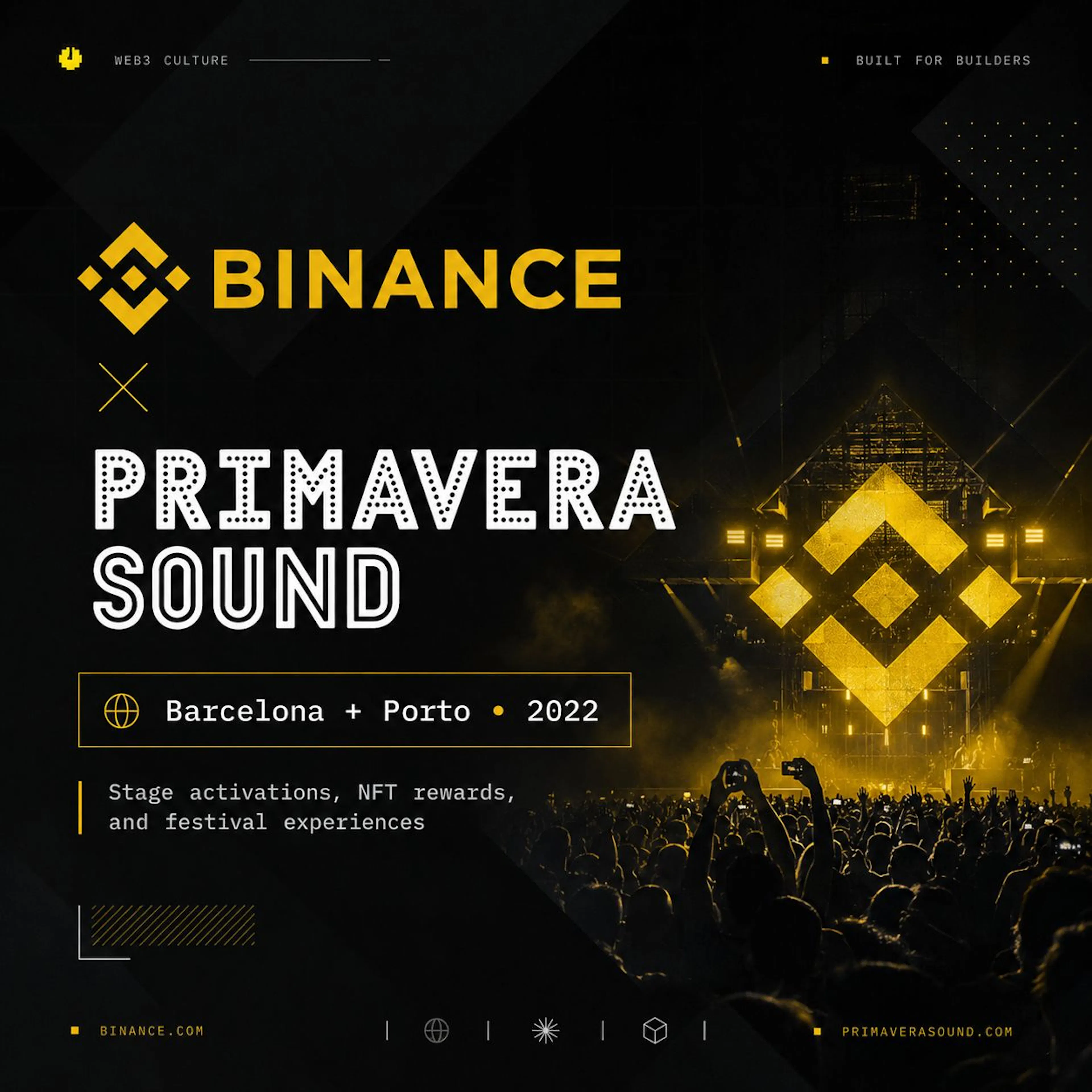
Why it matters: Set the on-site activation template, dedicated stage, branded booth, NFT-gated rewards, that several later deals would build on.
4. Breakaway Music Festival x Crypto Payments, 2024 — 12 Cities, One Payment Rail
In November 2024, the Breakaway Music Festival announced that all twelve of its 2025 dates across Dallas, Phoenix, Tampa, Atlanta, Columbus, Minneapolis, Grand Rapids, Worcester, Philadelphia, Charlotte, Huntsville and the Bay Area would accept cryptocurrency for tickets, bottle service and merchandise. Co-founder and CEO Adam Lynn framed it as payment flexibility for fans rather than a partnership with any single exchange, an important distinction in the post-Cordillera, pre-Tomorrowland window.
Why it matters: First major North American touring festival to treat crypto as payment infrastructure across an entire annual circuit. The blueprint the rest of the US festival industry is now studying.
5. Bitget x UNTOLD Festival, July 2025 — The 400,000-Person Stage
In July 2025, Bitget signed on as the official crypto partner of UNTOLD, the Romanian festival ranked third on DJ Mag’s Top 100, which drew more than 430,000 fans to Cluj-Napoca for its tenth-anniversary edition with Post Malone, Armin van Buuren, Tiësto and Martin Garrix headlining. The partnership extended into UNTOLD Dubai later in the year. CEO Gracy Chen positioned it as the third leg of a credibility stool that started with LALIGA and MotoGP, telling press, “we’ve partnered with athletes, champions, and now rockstars.”
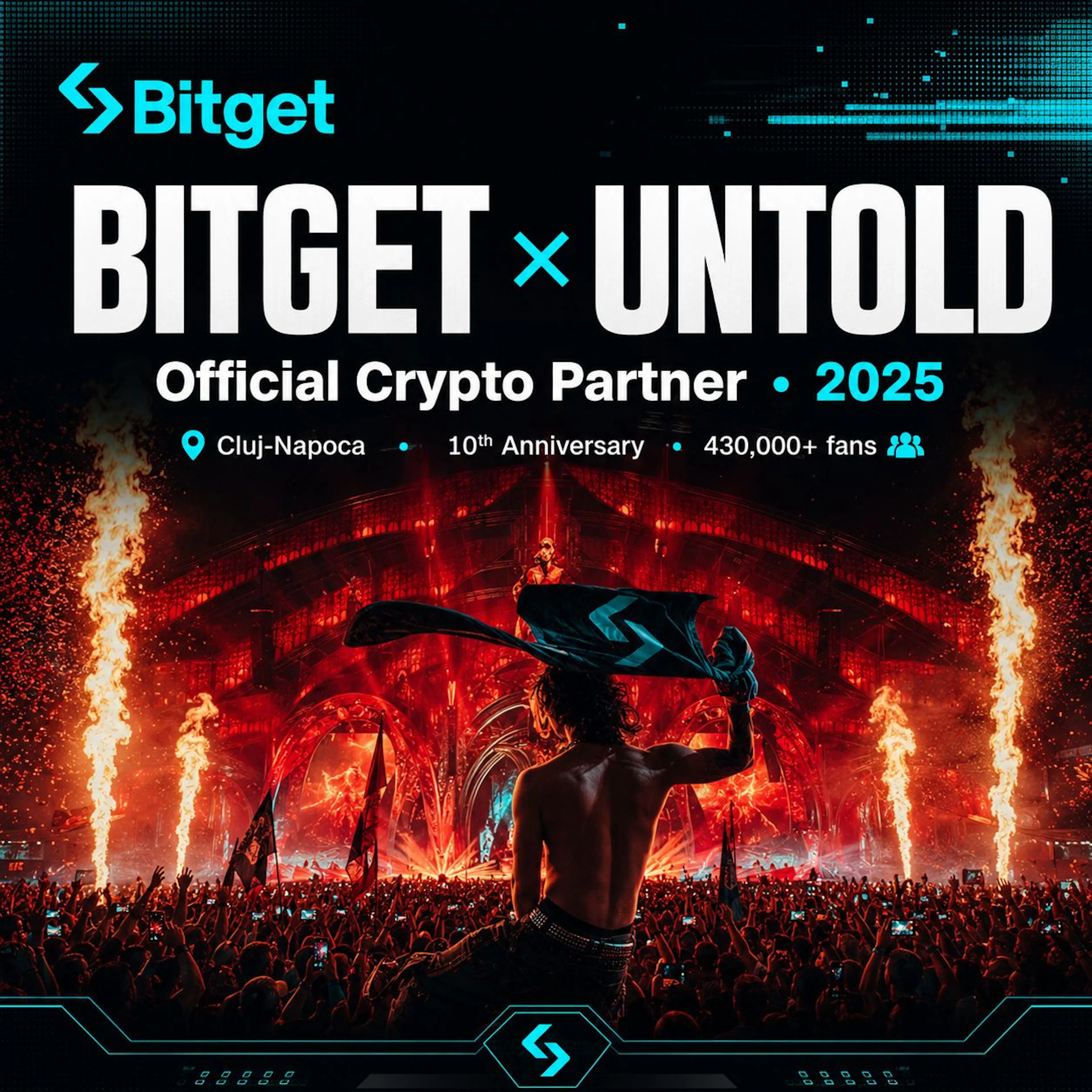
Why it matters: Set the price and the format that KuCoin would match six months later. Bogdan Rădulescu, UNTOLD’s co-founder, called the deal a bridge “between the world of music, culture, and the future of finance.”
The Pattern Beneath the Seven Deals
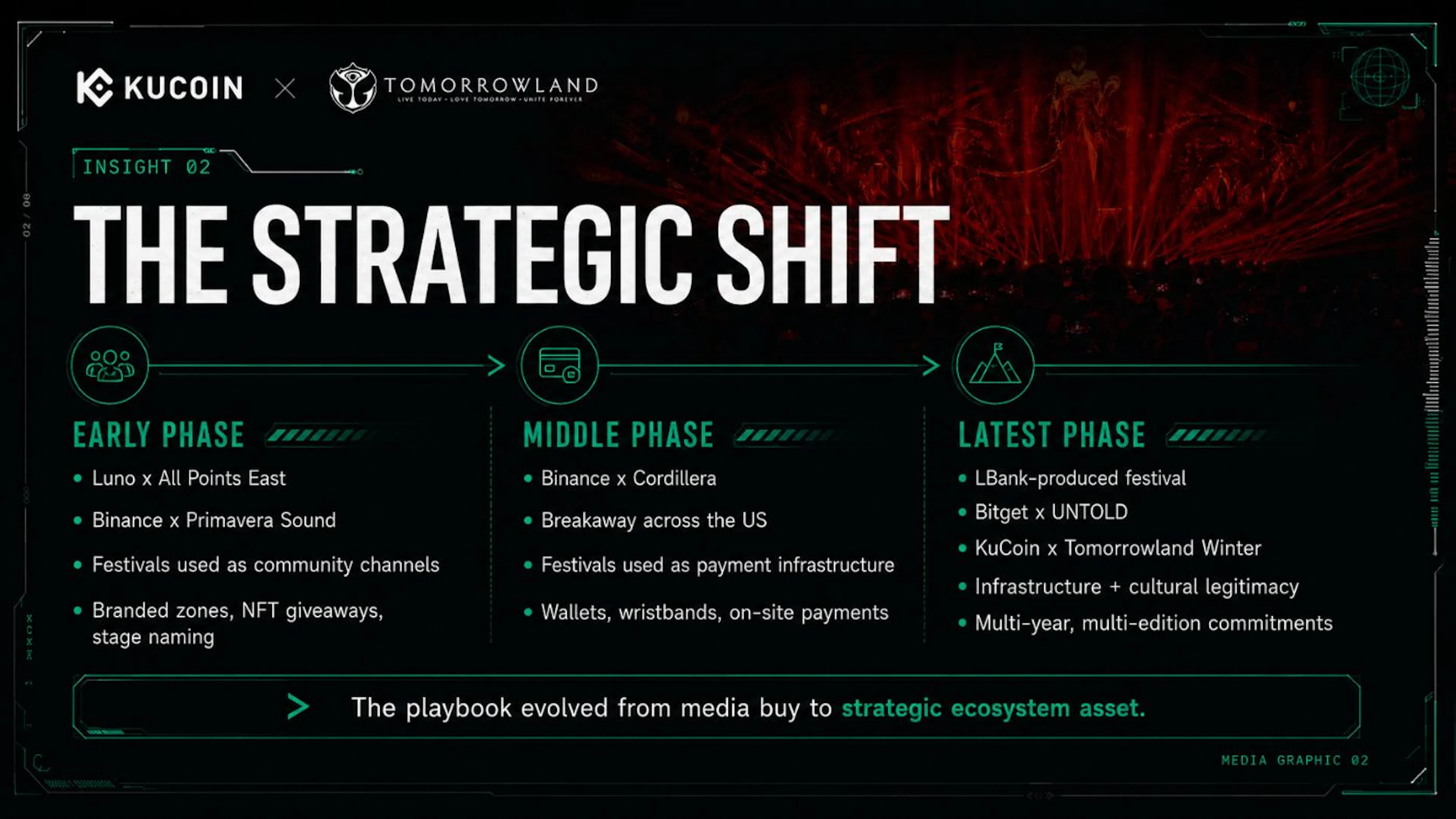
Read the seven cases in sequence and a strategic shift becomes visible. The early entries, Luno at All Points East and Binance at Primavera Sound, treated festivals as community channels. Branded zones, NFT giveaways, stage naming. The middle entries, Binance at Cordillera and Breakaway across the US, started treating festivals as payment infrastructure. The latest entries, LBank’s exchange-produced festival, Bitget at UNTOLD and KuCoin at Tomorrowland Winter, treat festivals as payment infrastructure and cultural-legitimacy plays at the same time, with multi-year, multi-edition commitments replacing the one-off media-buy logic of earlier cycles. The deal got more strategic each year.
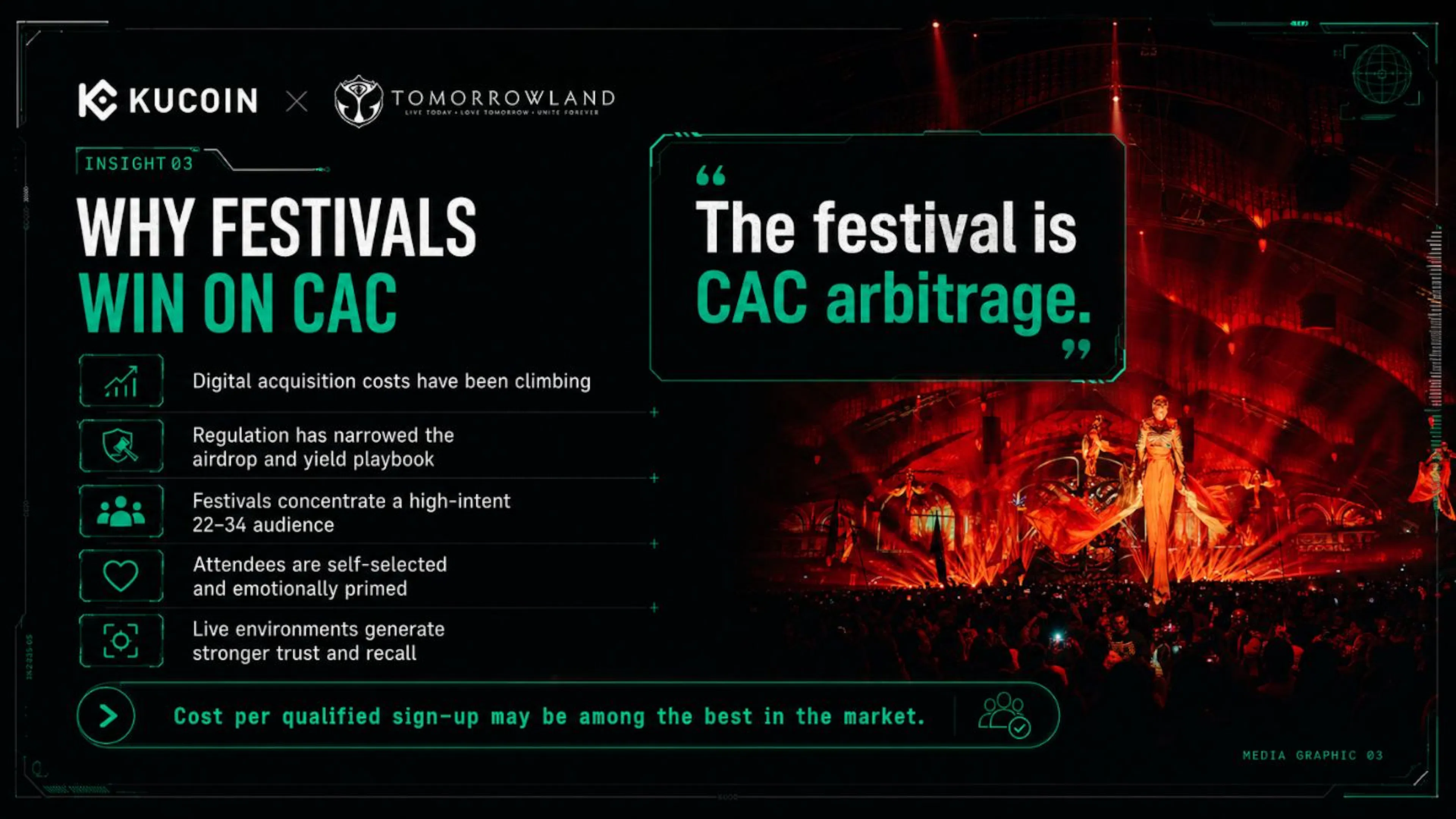
There is a simple reason why. Crypto exchange customer acquisition cost has been climbing for two years as paid digital channels saturate and regulatory scrutiny limits the playbook around airdrops and yield campaigns. The festival is a CAC arbitrage. A single Tomorrowland Belgium weekend pulls roughly 400,000 attendees in the 22 to 34 age band, over-indexed on crypto-curious demographics, self-selected into the venue, and emotionally primed by the journey itself. Cost per qualified sign-up at that frequency, once you factor in the trust and recall a festival environment generates, may be the best in the market.
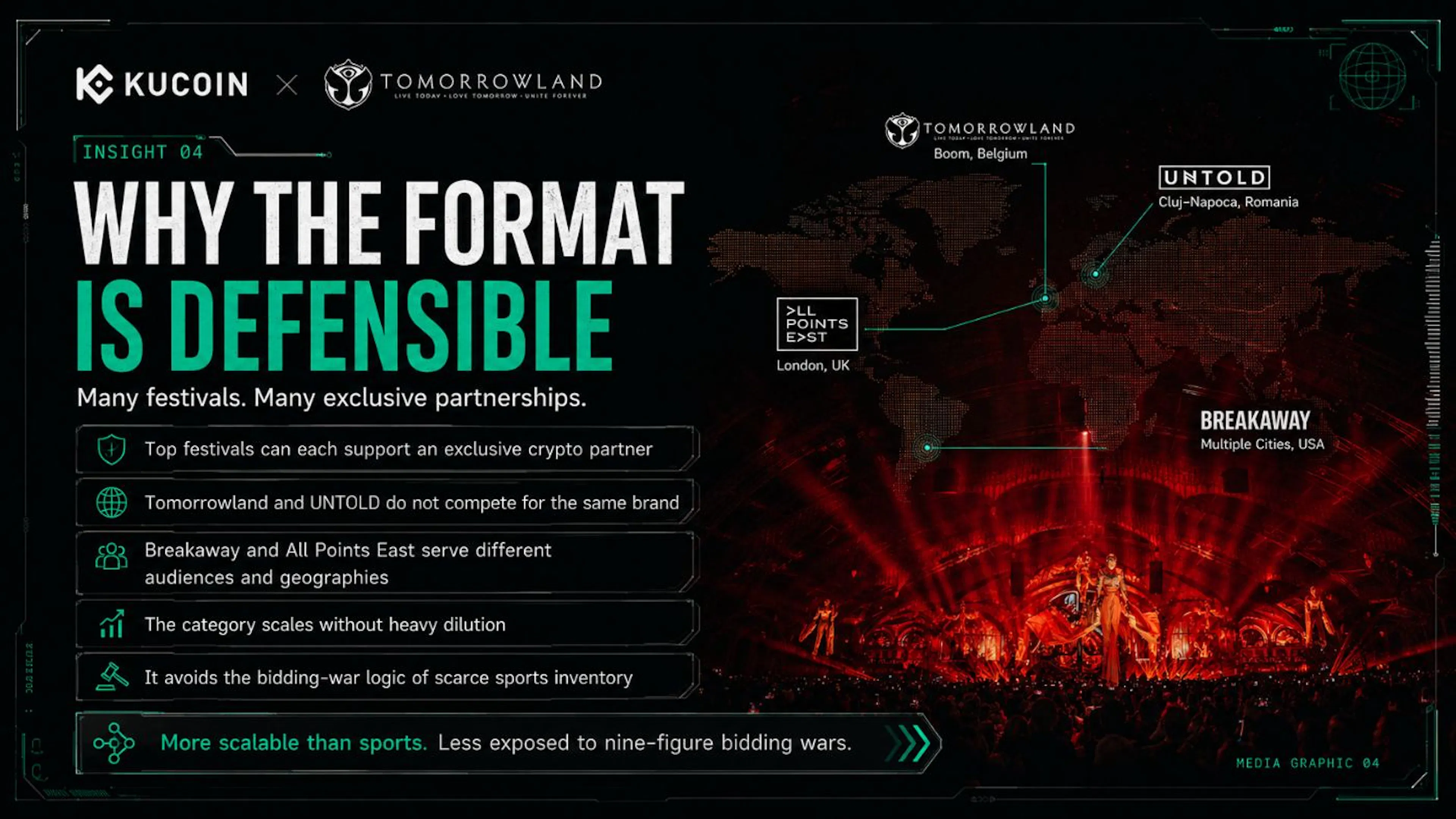
The format is also defensible in a way that sports inventory is not. There is exactly one Crypto.com Arena. There are dozens of top-100 festivals that can each take an exclusive crypto partner without diluting the others. Tomorrowland and UNTOLD are not competing for the same brand. Breakaway and All Points East are not either. The category can support a deep bench of exclusive partnerships without the bidding-war dynamics that drove Premier League and Formula 1 deals into the nine-figure range.
OKX is the cleanest counter-example, because it has kept investing in sports and built genuinely creative case studies around McLaren and Manchester City. Its chief marketing officer told Digiday in 2024 that the team’s “Drive to Survive” effect had outperformed any media buy. The OKX strategy is the exception that proves the rule. Most exchanges that bought sports inventory got brand awareness and very little behavioral conversion. The fan watched the race. They did not download the app. The festival-goer, scanning a KuCard in an Alpe d’Huez queue or topping up a wristband with Binance Pay in Bogotá, already has.
Three Signals to Watch Through the Rest of the 2026 Festival Season
Signal one. Whether the Belgium editions in July scale what the Winter edition demonstrated. Alpe d’Huez handled around 25,000 attendees across a week. Boom will run roughly 400,000 across two weekends. The payment infrastructure, the activation format, the OOH funnel, the KuCard mechanic, all have to work at sixteen times the volume. If they do, the deal becomes the reference case the next twenty Tier-1 festival sponsorships are priced against.
Signal two. Whether exchanges start buying festivals instead of sponsoring them. The capital is there. LBank’s Token2049 beach festival was the first proof-of-concept, exchange-produced rather than exchange-sponsored. The next logical step for an exchange with $50 million in marketing budget and a maturing brand thesis is to acquire a festival outright, the way live-events groups have rolled up the touring industry. Watch for that announcement inside the next two years.
Signal three. Whether regulators treat festival crypto payments as a distinct compliance category. KuCoin received its MiCA license from Austria weeks before the Tomorrowland deal went public, and the Winter activation ran inside that regulatory frame. The sequencing was not accidental. A regulated payment partner inside a regulated venue is a much more defensible position than a trading-app sponsor on an arena facade, and it is the bridge from cultural visibility to actual financial integration.
The last crypto cycle was won by the platforms with the deepest liquidity. The next one is being shaped by which platforms get invited to the party, and which of them know what to do once they are inside.
Don’t forget to like and share the story!
This author is an independent contributor publishing via our



Be the first to comment