



AI agents are signing transactions, moving capital, and executing workflows faster than any compliance team can review. The infrastructure that traditional finance built for human-paced decisions is now being asked to govern machine-paced ones.
W3.io is building the accountability layer for that shift, connecting payments, custody, compliance, and settlement into verifiable workflows that enterprises can audit in real time. We sat down with Porter Stowell, CEO of W3.io, to talk about autonomous finance, the limits of legacy financial rails, and what governance looks like when an AI agent is the one signing off on the wire.
Ishan Pandey: Hi Porter, it’s a pleasure to welcome you to our “Behind the Startup” series. Please tell us about yourself and what inspired you to build W3.io?
Porter Stowell: For nine years, I’ve been waiting for the world to be ready for blockchain and digital assets. Most of those years were spent waiting on the people who actually had to move first: the stablecoins, the regulators, the banks, the enterprise buyers. This year they all finally moved. The rebuild of global financial infrastructure is underway in front of us, and that is the kind of moment every entrepreneur dreams of being inside.
Then Opus 4.6 and OpenClaw shipped, and the question we were answering changed overnight. Agents started moving money in production, faster than any human could supervise, and four things became impossible to ignore. Agents are going to take over execution. Vendor networks are about to explode. Nobody is ever going to fully trust agents with their money. And businesses will always want humans in control.

That’s the company W3 is now. The operating system for autonomous finance. A control layer for money that moves itself, with business leaders still at the helm. Live today, real clients, real workflows, already across five verticals.
Ishan Pandey: You spent two decades across IBM, Coinbase, and Filecoin before W3. Each of those represents a very different model of enterprise infrastructure. What did you take from each, and what did you deliberately leave behind when you started building W3?
Porter Stowell: Two decades, three very different schools. But each one left a mark on W3. IBM showed me why enterprise blockchain failed in 2018: it couldn’t integrate with the systems enterprises actually run on. W3 solved that from day one. Coinbase taught me the importance of product management, working backwards from the customer, which is still treated as “optional” in the world of crypto. And Filecoin taught me why people actually buy decentralized tech: verifiability and economic alignment, not ideology. So if you break it down: IBM told me the blocker, Coinbase told me how to build the solution, and Filecoin taught me how to sell it.
Ishan Pandey: W3 calls itself the operating system for autonomous finance. Walk us through the actual business problem. Why can’t existing financial infrastructure handle AI agents moving money, and where does it break in production?
Porter Stowell: Existing financial infrastructure was designed around an assumption that does not hold anymore: that a human is in the loop at the decision point. Settlement windows assume batch reconciliation overnight. Compliance review queues assume a person opening a ticket in the morning. Vendor APIs assume someone clicked a button. Audit logs assume after-the-fact review by a team that shows up Monday. Every layer of the stack has a slow human governing the pace, baked in. Agents break that assumption inside the first ten minutes of production.
In practice, the breaks happen at the seams. An agent picks a vendor, signs a transaction, and the next system in the chain has no model for what just happened. Compliance teams find out at the end of day. Custody systems run policies designed for treasury staff, not for models. Reconciliation engines expect a small number of large, deliberate transactions and choke on a continuous stream of machine-paced ones. KYT scoring lags settlement. Idempotency falls apart because nobody designed for an agent retrying its own decision three times in a second. Every one of those is a real production bug we have already seen, not a hypothetical from a whitepaper.
The result is an exponentially expanding accountability gap. The agent moves at machine speed, the enterprise responds at human speed, and somewhere in between nobody can tell you who pressed the button or whether they were authorized to. That gap is the opening for the next decade of financial fraud, and it is also the opening for W3. We orchestrate the agent’s decision, the vendor selection, the custody action, the compliance check, and the settlement step as one verifiable workflow. The enterprise sees every move in real time, controls the boundaries that matter, and gets a complete audit trail at the end of every transaction. That is what “operating system for autonomous finance” actually means in production.
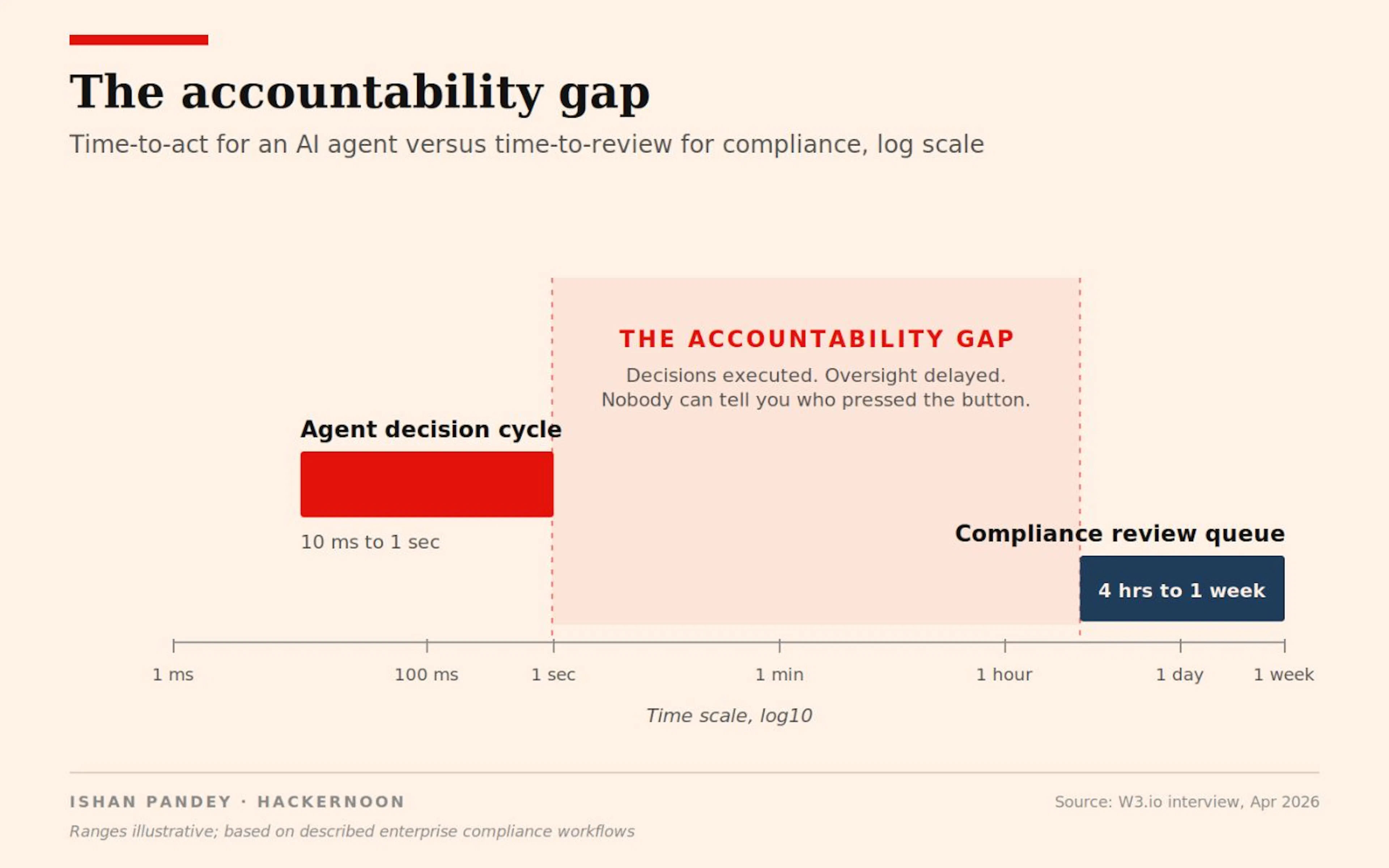 The Accountability Gap : Time-to-act for an AI agent versus time-to-review for compliance, log scale
The accountability gap visualized. An AI agent decides, signs, and settles inside seconds. Most compliance review queues do not surface the transaction until a human opens a ticket the next morning. The shaded zone is where, in Stowell’s words, “nobody can tell you who pressed the button.”
Idempotency falls apart because nobody designed for an agent retrying its own decision three times in a second. Every one of those is a real production bug we have already seen, not a hypothetical from a whitepaper.
Ishan Pandey: Your platform stitches together things like payments, custody, compliance, settlement, and storage into single workflows across vendors like Circle, Paxos, Stripe, and Chainalysis. From an engineering standpoint, how does W3 solve the interop problem that has historically forced enterprises into custom integration work, and what is the architecture that makes a partner connect once and become available across the network?
Porter Stowell: The historical answer to interop has been a custom integration team plus a six-month timeline, repeated every time a partner stack changes. We rejected that model on day one because the math does not work at the speed AI agents are about to demand. You cannot run a six-month integration project against a workflow that exists for ninety seconds.
The architecture decision was to build W3 as a composable coordination layer where every partner connects through a standardized interface, gets containerized, and immediately becomes available to every workflow on the network. We borrowed patterns developers already trust. Containers, because every partner can ship runnable code instead of an integration spec. GitHub Actions semantics, because every developer in finance already knows how to compose them. And what we call MCP, our Model Context Provider system, which lets a workflow pull a capability from any connected partner without bespoke integration code. A partner integrates once. From that moment forward, any enterprise on W3 can use them inside any workflow, in any combination, and we measure that integration in days, not months.
Underneath, every step is progressively verifiable. We get the auditability of on-chain settlement without forcing the entire workflow on-chain, which would be too slow and too expensive for real enterprise volume. Compute lives in containers. Verification lives on-chain when it has to. Settlement lives wherever the partner already settles. Circle, Paxos, Stripe, Chainalysis, and a growing list of others. Our clients get a single contract, a single control plane, and a partner network that grows without their integration team doing any of the work. That last part is the unfair advantage. Every new partner makes every existing customer more powerful, not less.
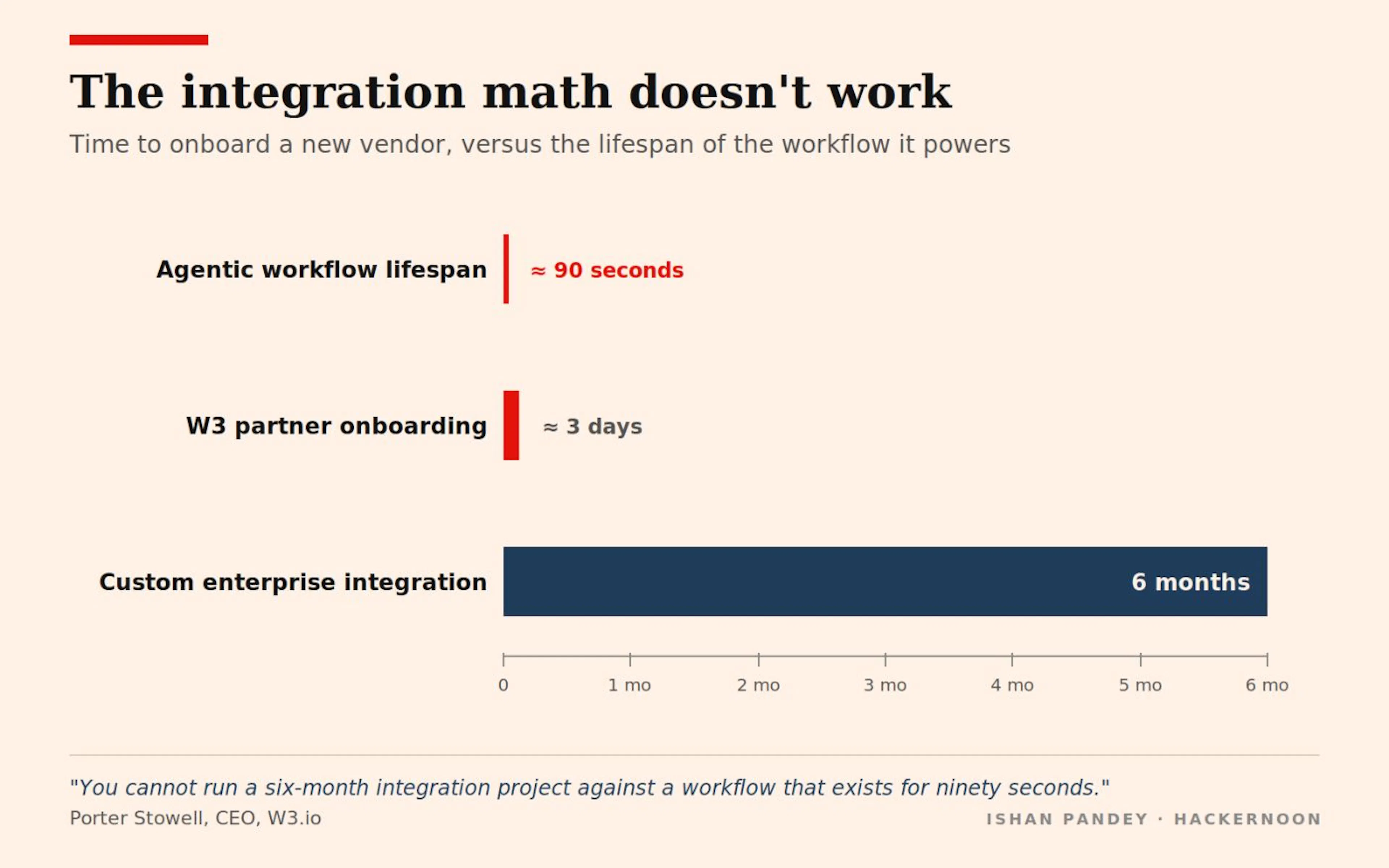 The Integration Math Doesn’t Work : Time to onboard a new vendor, versus the lifespan of the workflow it powers
Stowell’s case for composability in one image. A custom enterprise integration takes six months. An agentic workflow can complete in ninety seconds. The arithmetic is unforgiving, and W3’s containerized partner-onboarding model is built around that constraint.
The W3 architecture, in three layers
- Compute lives in containers. Partners ship runnable code, not integration specs.
- Verification lives on-chain only where it has to. Progressive verifiability, not blanket on-chain execution.
- Settlement lives wherever the partner already settles. Circle, Paxos, Stripe, Chainalysis, and a growing network.
Ishan Pandey: The biggest unanswered question in autonomous finance is governance. When an AI agent executes a transaction at machine speed, who carries the liability, how is the decision audited after the fact, and where does human oversight actually sit in the loop? How does W3 think about that accountability layer?
Porter Stowell: Liability has not changed and is not going to change. It still sits with the company that authorized the workflow. Every general counsel I talk to wants that on the record before anything else, and they should. What has changed is whether a business can actually carry that liability at machine speed, and the honest answer for most of them today is no. They cannot reconstruct who decided what, why, or under what authority once an agent has executed. They have a policy in a wiki and an auditor showing up in six months. What they call a control system is really a hope strategy dressed up in compliance language.
We solve this with control, not with another layer of policy.
Every workflow on W3 has explicit, declarative boundaries set by business leaders. Which agents can act. On which assets. Against which counterparties. Up to which size. Under which conditions. Those boundaries are policy-as-code, enforced at runtime, inside the execution path. Inside the boundary the agent runs at full speed. At the boundary the system stops, escalates, and waits for a human. The audit trail is not bolted on after the fact. It is generated as a side effect of execution: every step timestamped, attributed, cryptographically attested where it matters, and reconstructable end to end.
Human oversight sits in two places that matter. At the design of the boundary, where the business decides what the agent is and is not allowed to do. And at the exception, where the system surfaces anything outside policy for review. Everywhere else, the policy itself is the oversight, executed deterministically, every time. That is what we mean by control without complexity. The humans stay in charge while the work gets done, even when they are asleep.
A policy doc that lives outside the execution path is decoration, not governance, and confusing the two is the biggest mistake I see executive teams make in this space.
Ishan Pandey: Creatorland publicly stated that W3.cloud cut their AI compute costs to under one percent of legacy hyperscaler pricing. Setting aside marketing language, what is the structural reason that gap exists, and what does it tell us about how mispriced enterprise AI infrastructure is right now?
Porter Stowell: Set the marketing language aside. The Creatorland number is not a discount, it is a structural pricing collapse, and it tells you something important about how mispriced enterprise AI infrastructure actually is right now.
Three things are happening at once. First, hyperscaler pricing is built around general-purpose compute and the operational overhead of running every workload type on the planet at the same time. AI workloads do not need most of that. They need GPUs sized for the model, low-latency inference paths, and a cost model that reflects actual utilization, not blanket reserved capacity. Second, hyperscaler pricing carries the enterprise margin stack that comes with selling at scale: sales, support, account management, regional redundancy, contract negotiation, professional services. Useful for some workloads, irrelevant for many. Third, hyperscalers price like there is no alternative, because for most of the last decade there was not.
W3 Cloud is purpose-built for AI workloads on a decentralized provider network. Right-sized hardware, right-sized operating model, no enterprise margin stack, and a pricing model that reflects the actual marginal cost of the compute. The gap between that and a hyperscaler list price stops being surprising once you see the inputs. The lesson for the rest of the industry is uncomfortable.
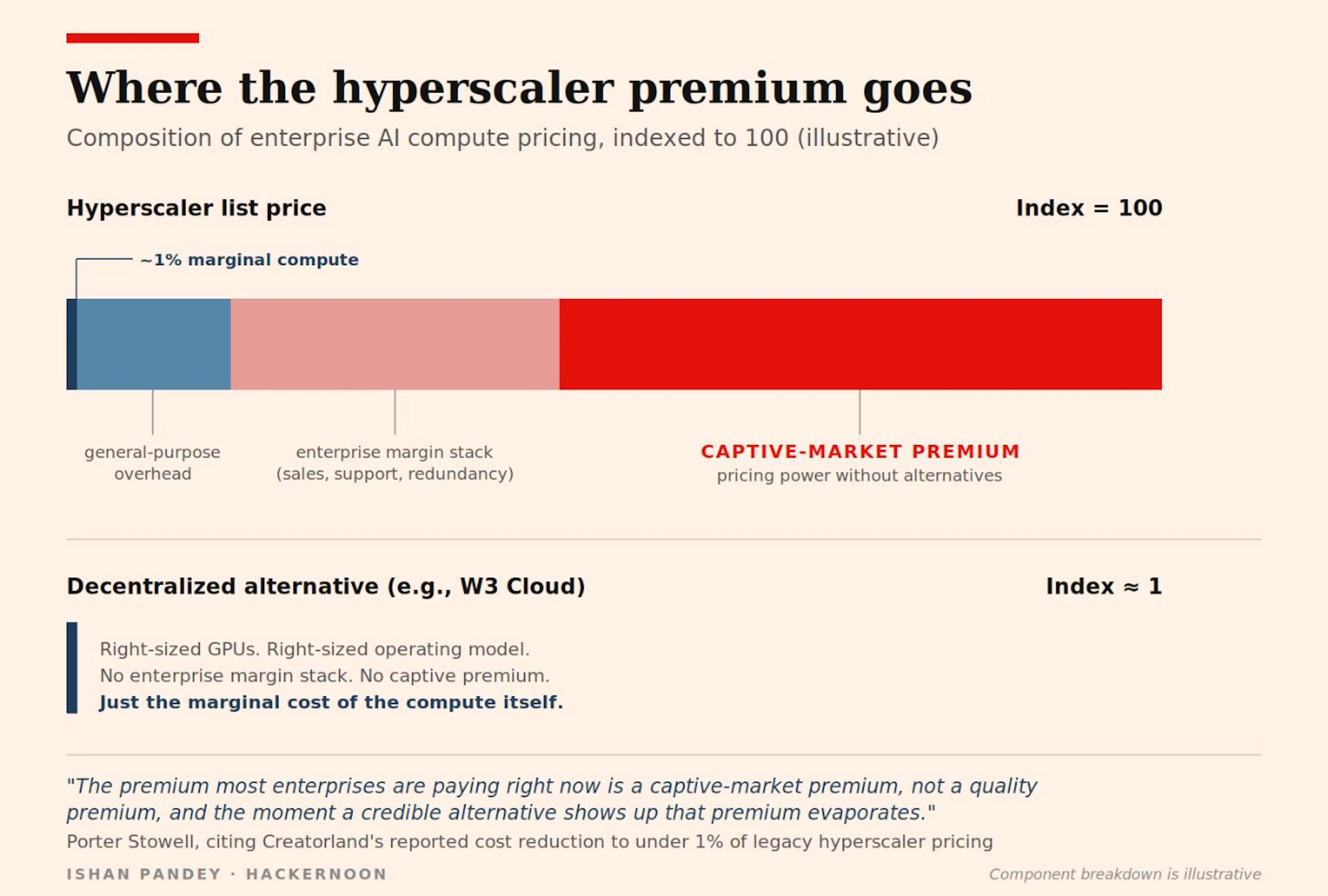 Where the Hyperscaler Premium Goes : Composition of enterprise AI compute pricing, indexed to 100
An illustrative breakdown of where the hyperscaler dollar goes. Marginal compute is a sliver. The rest is operational overhead, enterprise margin stack, and the captive-market premium that disappears once a credible alternative shows up. W3 Cloud, on Stowell’s account, prices to the sliver.
Ishan Pandey: What misconceptions do enterprises bring into early conversations with W3 about deploying AI agents in financial workflows, and where is the gap widest between what they think they need and what they actually need to build?
Porter Stowell: Well, the first is that a stablecoin is a “crypto”, but let’s set that aside for now. After that, the most common misconception by far is that they need a custom integration. They have a stack. They want to add agents to it. Their first instinct is a six-month vendor evaluation followed by a custom build that adds another tightly coupled vertical to the surface area they already cannot manage. What they actually need is coordination. They need a control plane that sits above the existing partners and lets them compose workflows on top, not another point integration that becomes the next thing they regret.
The next misconception is treating governance as a policy document. Most businesses arrive with a beautifully written set of guardrails sitting in Confluence somewhere, and they assume the agent will read and respect it. It will not. Governance only works when it is enforced at runtime, inside the workflow, by the system that is actually moving the money. A policy doc that lives outside the execution path is decoration, not governance, and confusing the two is the biggest mistake I see executive teams make in this space.
The final misconception is timing. A lot of business leaders still believe agent-powered finance is a 2027 or 2028 problem they have time to scope properly. It is a 2026 problem. The agents are already moving money in the wild, often without the enterprise’s full understanding of where, on what authority, or how often. The companies that close that gap first will own the next category of financial services, while the ones that wait will spend the next three years explaining what happened.
The three misconceptions, summarized
- We need a custom integration. ❌ You need coordination, not another point integration.
- Our governance doc covers it. ❌ Governance lives in the execution path, not in Confluence.
- “We have until 2027 or 2028. ❌ Agents are already moving money. It is a 2026 problem.
Ishan Pandey: For founders building at the intersection of AI and financial infrastructure today, what is the part of the problem that looks solvable from the outside but turns out to be the hardest once you are in production, and what advice would you give them on partnerships, regulation, and timing?
Porter Stowell: The thing that looks easiest from the outside is distribution. Every week my feed is full of raise announcements for products and platforms running the same playbook: build it and they will come. Product moats are dead. Platform moats are dead. And yet people are still clinging to them like the next Claude update isn’t coming for them too.
You asked about partnerships, regulation, and timing. For me they all collapse into one answer: distribution first, everything else second.
On partnerships: the only partner worth having is one who shortens your distribution path by a year. Audit trails and regulatory posture matter, but a relationship into a real buyer matters more. What can’t be replicated by AI is a relationship that took years to build. That is the moat now. Pick partners like your funding round depends on it, because it does.
On regulation: treat it as a product input, not a tax. The teams that win read the rule the week it drops and ship against it. The teams that lose wait for the lawyers to come back from vacation. Later doesn’t exist in this category.
On timing: if it looks bad, even better. Two years ago I was talking about revenue in crypto and people thought I was crazy. Now it’s table stakes. If you’re in a room with smart people dismissing your idea, you’re in the right room. A non-consensus view that turns out to be right is the entire game. Everything else is execution.
Don’t forget to like and share the story!
This author is an independent contributor publishing via our



Be the first to comment