


Bitcoin has slipped below $65,000 after Iran rejected renewed prospects for peace talks with the United States, adding fresh pressure to risk assets as military operations continue.
Summary
- Iran rejected U.S. peace talks despite Trump’s claim that Tehran wants a deal.
- Bitcoin fell below $65,000 as renewed U.S.-Iran tensions weighed on markets.
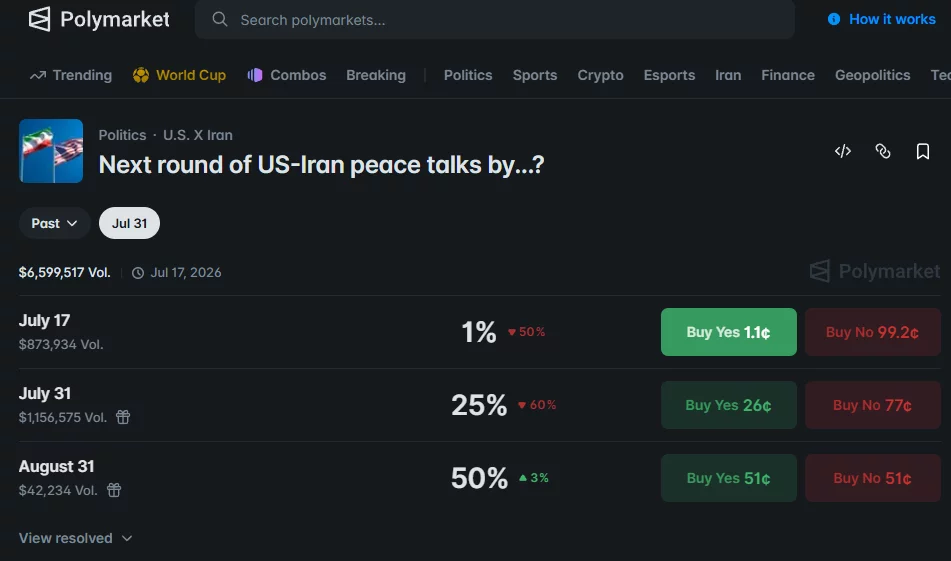
- Polymarket traders see only a 20% chance of peace talks resuming this month.
Iran’s Foreign Ministry said there are currently no plans for negotiations with the United States, with the country’s immediate priority remaining its defense efforts. The statement came after U.S. President Donald Trump claimed during a FOX interview that Iran had reached out earlier and wanted to make a deal, suggesting diplomatic contact could resume.

The conflicting messages have arrived as the U.S.-Iran conflict intensifies once again. Over recent days, both countries have continued exchanging strikes, while Trump has reinstated the Iranian blockade in the Strait of Hormuz and warned that Washington could expand military operations if Tehran does not return to negotiations.
According to data from crypto.news, Bitcoin (BTC) briefly gave up earlier gains and fell below the $65,000 level, changing hands at around $64,800, down less than 1% on the day. The decline interrupted a rally that had followed softer-than-expected U.S. Producer Price Index (PPI) data earlier in the session.
Fresh military operations keep risk appetite under pressure
While inflation data initially supported cryptocurrencies, renewed military developments shifted investors’ attention back to geopolitical risks.
Earlier in the day, the U.S. Central Command (CENTCOM) announced on X that it had completed a 90-minute wave of strikes targeting coastal defense systems and cruise missile storage and launch sites on Greater Tunb Island. According to CENTCOM, the operation was intended to reduce Iran’s ability to threaten commercial shipping through the Strait of Hormuz.
Hours later, CENTCOM announced another escalation. In a separate post on X, the command said U.S. forces launched a second wave of strikes at 3 p.m. ET, targeting Iranian military capabilities used to threaten vessels transiting the Strait of Hormuz. CENTCOM described the waterway as vital to global commerce and said the operation was carried out under the direction of the U.S. Commander in Chief.
CENTCOM stated that the strikes further reduced Iran’s capability to threaten commercial shipping passing through the Strait of Hormuz, one of the world’s most important energy trade routes. The latest operation follows several days of escalating military exchanges between Washington and Tehran, adding another layer of uncertainty for global financial markets.
crypto.news had earlier reported that cryptocurrencies strengthened after U.S. PPI inflation figures came in below economists’ expectations, reinforcing hopes that inflation pressures may continue easing. However, those gains faded as developments surrounding the U.S.-Iran conflict became the dominant market catalyst.
Prediction markets point to limited optimism for diplomacy
Beyond price action, prediction markets continue to indicate low expectations for a diplomatic breakthrough this month.
Data from crypto-based prediction platform Polymarket shows traders currently assign only a 25% probability that another round of U.S.-Iran peace talks will take place before the end of July. Although prediction markets do not guarantee future outcomes, they offer a real-time view of participant expectations based on active trading.
Attention is also turning toward Iran’s senior leadership for additional guidance on the country’s position. Mohammad Qalibaf, identified as Iran’s top negotiator in the referenced reports, is expected to issue a statement later today addressing the ongoing conflict and recent military developments.
For now, financial markets remain caught between improving U.S. inflation data and rising geopolitical uncertainty. While softer inflation initially supported demand for Bitcoin and other digital assets, Iran’s rejection of negotiations, continued U.S. military strikes, and uncertainty surrounding future diplomatic efforts have kept traders focused on geopolitical headlines as the next major driver of market sentiment.



Be the first to comment