



BitMart announced an orderly wind-down of its trading platform on July 26, 2026, becoming the latest crypto exchange to announce closure, just three days after BitMEX said it would shut down after more than 11 years of operations.
The Wind-Down Timeline
BitMart said the decision followed an evaluation of its operating conditions, market environment, and future strategic direction, without citing insolvency, a hack, or an enforcement action.
New user registrations, deposits, and new orders stopped July 26 at 01:30 UTC, with futures accounts moved to reduce-only mode and copy trading, grid trading, and API trading being phased out.
All spot, futures, and other trading services will end August 26 at 01:00 UTC, with any open futures positions settled by the platform at that point based on prevailing market or index prices.

The company plans to officially cease platform operations on January 31, 2027, at 15:59 UTC, though accounts will remain accessible after that date for a period to review history and submit withdrawal requests.
BitMart recommends users complete identity verification and close all positions before August 26 at 01:00 UTC, and submit withdrawal requests before 05:00 UTC that same day, a tighter window than the January 2027 date might suggest.
Withdrawal requests may face manual review covering KYC verification, device and IP checks, withdrawal address screening, source-of-funds review, and Travel Rule or sanctions compliance checks, and submitting a request does not mean assets have been broadcast on-chain.
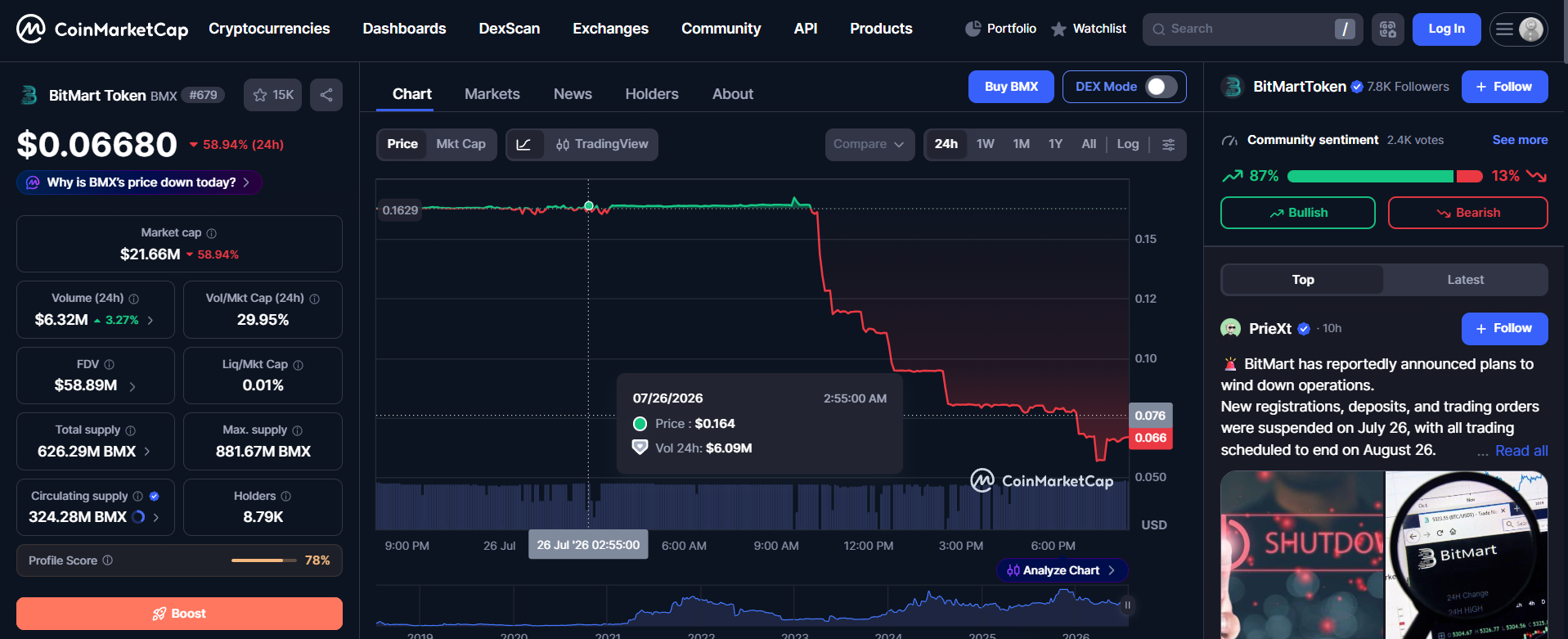
BMX, BitMart’s native token, dropped as much as 60% within 24 hours of the announcement.
Warning Signs Before the Announcement
The full closure notice followed a fast sequence of changes in the days prior, such as a custody fee policy for inactive accounts introduced July 24, then on July 25 a notice restricting services for US users, suspension of the AMM Bot service, and discontinuation of Spot Margin trading with forced liquidation set for July 26 at 02:00 UTC.
That sequence arrived just nine days after BitMart published an upbeat H1 2026 report on July 17 highlighting asset-management AUM up roughly 256%, a new prediction market product, and an expanded regulatory footprint including an Australian financial services license secured in June, a report that also acknowledged Bitcoin was down around 33% for the half, Ethereum down 50%, and spot ETF outflows hitting record levels.
A Pattern Across Exchanges
BitMart is the second major exchange to close in under a week after BitMEX. The latter announced its own closure three days earlier, saying it would shut down September 23, 2026, after 11 years, citing a strategic business review, a story our earlier coverage of the BitMEX exchange closure covered in detail.
Both exchanges independently landed on August 26 as the date active trading effectively ends, both stopped new registrations the same day they announced closure, and both framed the decision as strategic rather than distressed, despite being different types of businesses.
BitMEX built its name as an eleven-year-old derivatives pioneer credited with inventing the perpetual swap, while BitMart operated as an eight-year-old spot and futures exchange with a broad altcoin listings catalog.
The recurring pattern points to structural pressure on tier 2 exchanges specifically due to trading fees having compressed industry-wide, compliance costs having risen with frameworks like MiCA and Travel Rule requirements, liquidity having concentrated into the largest venues, and on-chain perpetual platforms having absorbed derivatives volume that once sat on exchanges like BitMEX.
A mid-tier exchange effectively ends up paying large-exchange compliance costs on small-exchange revenue, a harder equation in a stretch where Bitcoin has fallen roughly a third and Ethereum in half.
Fraud Warning and What Users Should Do
BitMart explicitly warned that impersonation scams tend to increase during exchange wind-downs, stating clearly that no paid priority withdrawal service exists, and that staff will never request a password, 2FA code, private keys, or seed phrase through Telegram, WhatsApp, WeChat, or social media.
Users with BitMart balances should log in to check every account, including Earn, staking, and lending positions, complete or update KYC before the deadline, cancel open orders and close futures positions as soon as possible, and download account and trading history for their own records.
What this means for you: coins on an exchange are a promise from that company, not coins you actually hold, so withdraw well before August 26, 2026, instead of waiting for the January 2027 date to act.



Be the first to comment