



The week of 27 July to 2 August delivered an unusually dense run of catalysts: a hawkish hold from the Federal Reserve, the largest hardware wallet failure in Bitcoin’s history, a month-end ETF redemption wave and a market structure bill running out of legislative runway.
$Bitcoin absorbed all of it and closed the week down roughly 2%, trading at $63,153 as of midday Sunday. That muted reaction is arguably the week’s most informative data point, and it suggests a market that has already discounted a substantial amount of negative news.
The following is a breakdown of what moved, why it matters, and the scheduled events most likely to drive prices over the coming week.
What was the biggest crypto news this week?
Four developments carried material weight:

- The Fed held rates, but three officials voted for a hike, lifting September tightening odds above 60%.
- A firmware flaw in Coldcard hardware wallets was linked to approximately $70 million in stolen Bitcoin.
- US spot Bitcoin ETFs closed the week negative following a heavy month-end redemption day.
- The CLARITY Act reached the Senate recess window with no floor vote scheduled.
Secondary items, including Tether’s quarterly profit and Solana’s tokenized equity volumes, sit beneath those four in terms of market impact.
Why was the Fed’s hold actually hawkish for crypto?
On 29 July the FOMC left the federal funds target range at 3.50% to 3.75%. The decision itself was expected. The vote was not. The committee split 9-3, with three regional presidents dissenting in favour of a 25 basis point hike: Beth Hammack of Cleveland, Neel Kashkari of Minneapolis and Lorie Logan of Dallas. It marks the sharpest FOMC split since September 2016.
Fed Chair Kevin Warsh reinforced the hawkish signal at the press conference, telling reporters there is no soft inflation target and no soft implicit target on this committee’s watch.
Markets repriced immediately. CME FedWatch now assigns a 61.4% probability to a 25 basis point September hike, up from 50.6% a month earlier. Odds of a 50 basis point move have collapsed to zero, and a rate cut carries no probability at all. Prediction markets are aligned but less emphatic: Kalshi prices a hike at 53% against 44% for no change, and Polymarket at 52% versus 46%.
The implication for digital assets is direct. A tightening cycle resuming in September implies higher real yields, a firmer dollar and reduced appetite for long duration risk. Notably, Bitcoin held near $64,000 on the day of the decision while the S&P 500 fell about 1.5%, the Nasdaq 1.7% and the Dow 2.19%. Crypto outperformed equities on the announcement, which is an atypical response and worth monitoring.
How did $70 million in Bitcoin vanish without anyone touching a device?
An attacker drained 1,196 Bitcoin addresses in 41 minutes on 30 July, taking 1,082.65 BTC worth approximately $70.2 million. Galaxy Research attributed the sweep to a firmware flaw in Coldcard, the Bitcoin-only hardware wallet manufactured by Canadian firm Coinkite.
The mechanism distinguishes this incident from a conventional exploit. A March 2021 firmware integration error routed seed generation to a deterministic software pseudorandom number generator rather than the STM32 hardware random number generator. An attacker able to constrain the device UID, timer state and prior RNG-call history could therefore reproduce candidate seeds offline, without ever accessing the physical device. Candidate keys were then validated against public blockchain data and swept remotely.
The transactions carried identical 30 sat/vB fees with no change outputs and clustered across blocks 960,183 to 960,191, indicating full automation rather than manual execution. The proceeds currently sit in four addresses and have not moved.
Coinkite has acknowledged the failure. CEO Rodolfo Novak issued an apology and stated that the company took full accountability for the firmware bug, conceding that its review process had failed to identify it. Emergency firmware has been released for every affected model: version 4.2.0 or later for Mk3, 5.6.0 or later for Mk4 and Mk5, and 1.5.0Q or later for the Coldcard Q.
One detail is critical for affected holders. Updating firmware alone does not secure existing funds, because the private keys derived from a compromised seed remain unchanged. Affected users must generate an entirely new recovery phrase on the corrected firmware and migrate their BTC to it. Galaxy further warned that future attacks remain possible against any Coldcard-generated address, and that such attacks need not match the transaction pattern observed on 30 July.
The incident lands in an already difficult year for security. Blockchain security firm Blockaid reported that crypto projects lost more than $1 billion to hacks in the first half of 2026.
Still storing serious size on a single device? Compare hardware wallets side by side before you migrate your seed. 👉 See our wallet comparison
What are ETF flows telling us about institutional demand?
Institutional positioning remains mixed, with an increasing tilt toward Ethereum.
US spot Bitcoin ETFs recorded a net outflow of $61.53 million for the week ending 31 July, while spot Ethereum ETFs added $27.42 million and Solana ETFs took in approximately $2.82 million. HYPE products saw around $14.75 million in net outflows, consistent with the token’s 11% weekly decline.
The Bitcoin damage concentrated in a single session. Funds shed $265.4 million on 31 July, reversing a $233.1 million inflow the previous day. BlackRock’s IBIT accounted for $122.7 million of the outflow, Fidelity’s FBTC $54.8 million and Grayscale’s GBTC $52.6 million.
The monthly picture is more constructive. July closed with $172.4 million of net inflows for Bitcoin ETFs, ending two consecutive months of outflows after nearly $7 billion left the category across May and June. June alone was the worst month of 2026 at roughly $4.5 billion.
Ethereum products extended their run to four consecutive weeks of net inflows and finished July with $365.2 million, the second positive month of the year. They nonetheless remain approximately $1.1 billion in net outflows for 2026 overall, which frames the move as a recovery rather than a structural reversal.
The aggregate reading: institutions have largely stopped selling, but have not resumed buying with conviction.
Where do Bitcoin and the majors stand right now?
Prices as of midday Sunday 2 August, excluding stablecoins:
| Asset | Price | 24h | 7d | YTD |
|---|---|---|---|---|
| Bitcoin ($BTC) | $63,152.94 | +0.13% | -1.98% | -27.84% |
| Ethereum ($ETH) | $1,867.56 | +0.03% | -0.70% | -37.06% |
| $BNB | $583.35 | -0.43% | +2.16% | -32.42% |
| $XRP | $1.07 | +1.68% | -1.74% | -41.34% |
| Solana ($SOL) | $73.18 | +0.30% | -2.35% | -41.21% |
| TRON ($TRX) | $0.3272 | -0.07% | -1.05% | +15.11% |
| Hyperliquid ($HYPE) | $52.03 | -0.59% | -11.02% | +104.60% |
| Dogecoin ($DOGE) | $0.0700 | +0.26% | -4.59% | -40.31% |
| Zcash ($ZEC) | $473.79 | +1.62% | -3.64% | -7.55% |
| Cardano ($ADA) | $0.1853 | +7.31% | +12.36% | -44.31% |
| Monero ($XMR) | $360.45 | -1.16% | -0.35% | -16.80% |
Cardano is the clear weekly outperformer at 12.36%, with a 7.31% daily gain suggesting the move is still developing. BNB is the only other major in positive weekly territory. Hyperliquid is the week’s largest decliner at 11.02%, though it retains a 104.60% year-to-date gain, and TRON remains the sole large-cap asset positive on the year alongside HYPE.
The year-to-date column is the more significant read. Bitcoin is down 27.84% in 2026 and trades well below the highs above $126,000 recorded earlier this year, while most large-cap altcoins sit 32% to 44% lower.
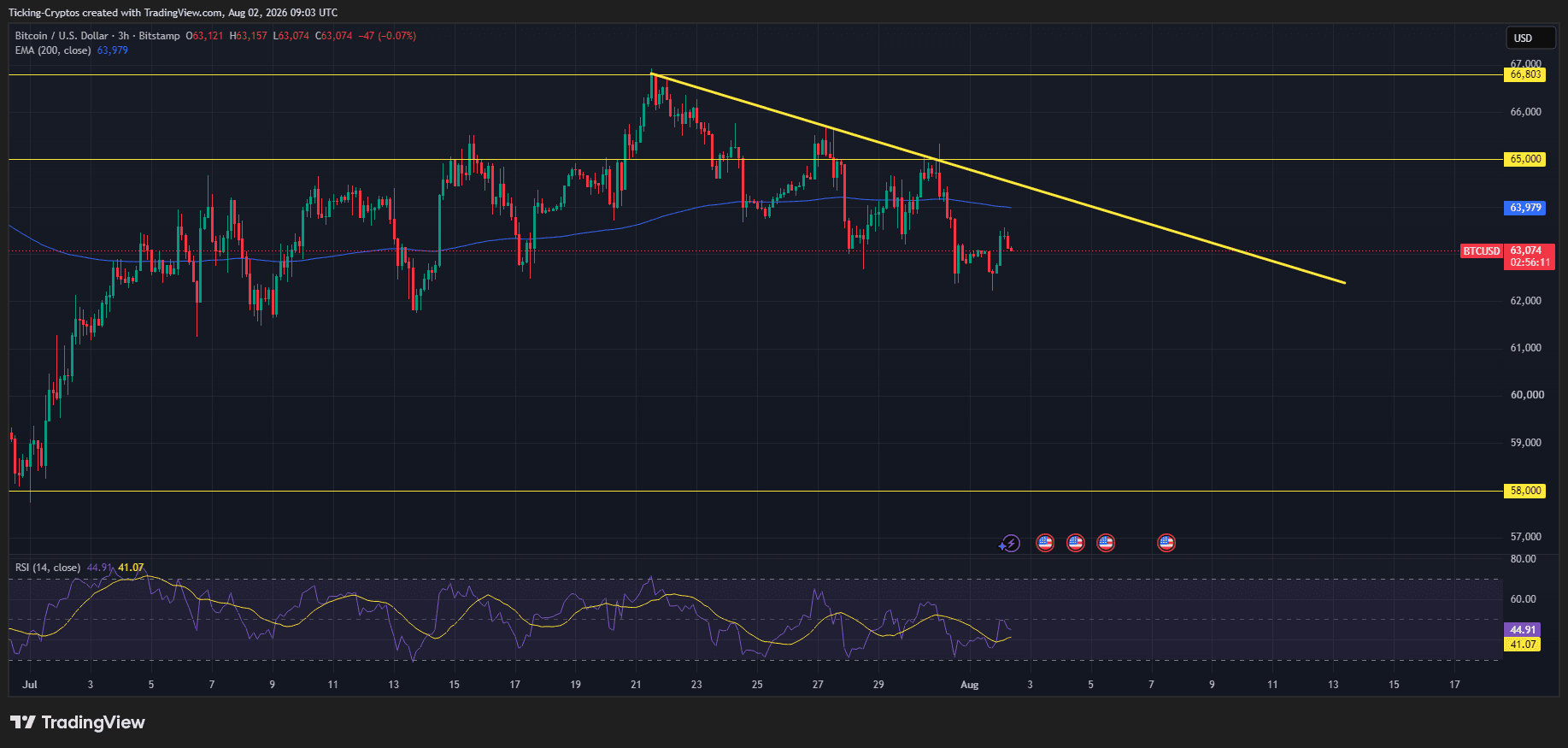
Technically, Bitcoin is now trading just beneath the 200-week moving average near $63,300, a level Marex analysts identified as the pivot for the current range. A sustained loss of $62,500 opens a path toward the $60,000 liquidation target. To the upside, the 20-day EMA near $64,288 and the 50-day EMA near $64,891 form the immediate resistance band, with the 100-day at $67,481 and the 200-day at $73,133 keeping the medium-term trend corrective.
Trading this volatility? Fees and spreads matter more in a chop than in a trend. 👉 Compare crypto exchanges
Is the CLARITY Act finished for 2026?
Not formally, but the timeline is close to exhausted. As of late July, the Digital Asset Market Clarity Act has cleared the House and the Senate Banking Committee, yet there is no floor vote, no cloture motion and no date on the calendar. Senate Majority Leader John Thune has indicated he does not expect the bill to reach the floor before the summer recess begins around 7 August, with the chamber prioritising nominations and subsequently a Russia sanctions bill.
Marex analysts characterised the delay as the removal of the market’s one crypto-specific support, noting that the catalyst intended to unlock institutional buying is now parked. Prediction markets reflect the same assessment. Polymarket odds on 2026 passage fell from above 80% in February to a record low near 24% in mid-July, before settling around 35% as the ethics deadlock hardened.
The legislative groundwork remains in place. The House passed its version on 17 July 2025 by 294 to 134, and the Senate Banking Committee advanced it 15 to 9 on 14 May 2026. Should the bill miss the recess window, most observers treat early August as the practical cutoff, given that a fall vote would compete with appropriations negotiations and the election calendar.
What crypto events are coming next week?
The following dates fall between 3 and 12 August:
- Monday 3 August: ISM survey data. Consensus anticipates a recovery to 54.0 for July, with the prices paid component the relevant line for inflation trajectory.
- Wednesday 5 August: ADP private payrolls and services survey data.
- Friday 7 August, 8:30 AM ET: US non-farm payrolls for July. The week’s primary catalyst, and the Fed’s key labour input ahead of the September meeting. June printed at 57,000 jobs against forecasts of 110,000, following a downwardly revised 129,000 in May. A strong reading raises September hike odds and pressures risk assets; a weak one has the opposite effect.
- Friday 7 August: The Senate summer recess begins around this date, effectively closing the CLARITY Act’s 2026 window absent rapid movement.
- Next week, exact day to be confirmed: The xrpld 3.3.0 release for the XRP Ledger is expected, carrying five proposed amendments, including two features previously withdrawn after researchers identified bugs.
- Tuesday 11 August: Pi Network mainnet upgrade deadline.
- Wednesday 12 August, 8:30 AM ET: US CPI for July. Combined with payrolls, this pair effectively determines the September decision.
- Wednesday 12 August: Aptos unlocks approximately 11.31 million APT, around 0.54% of total supply, at 2 AM UTC.
Further out, the next FOMC decision is scheduled for Wednesday 16 September at 2:00 PM ET.
What should traders watch?
Three variables, in order of significance.
- Friday’s payrolls print. It is the largest single input into the September hike question, which is in turn the dominant driver of crypto direction. A softening labour market strengthens the case against tightening and relieves pressure on risk assets. A resilient one validates the three dissenters.
- The $62,500 level. Bitcoin has spent the week defending the low $60,000s and now sits marginally below the 200-week moving average. Losing $62,500 opens a retest of $60,000, while reclaiming the 50-day EMA near $64,900 would represent the first credible sign of returning momentum.
- ETF flows on Monday and Tuesday. The 31 July outflow was partly attributable to month-end rebalancing. Continued redemptions into the new month would indicate genuine repositioning rather than a calendar effect.
The broader setup is unchanged. Market commentary describes an asset class that absorbed sustained negative news through July but remains cautious into a historically choppy August, with rate hike expectations and labour data the principal risks. Bitcoin’s ability to withstand a hawkish Fed, a $70 million wallet exploit and a stalled regulatory bill within a single week while declining only 2% is the strongest evidence available that current levels reflect substantial existing pessimism.






Be the first to comment