



What to know:
- CFTC warns prediction markets against betting-style odds as regulatory pressure grows.
- New York and 44 states challenge Kalshi over sports contracts and gambling oversight.
- Kalshi faces court setbacks as states move to enforce gambling laws on event markets.
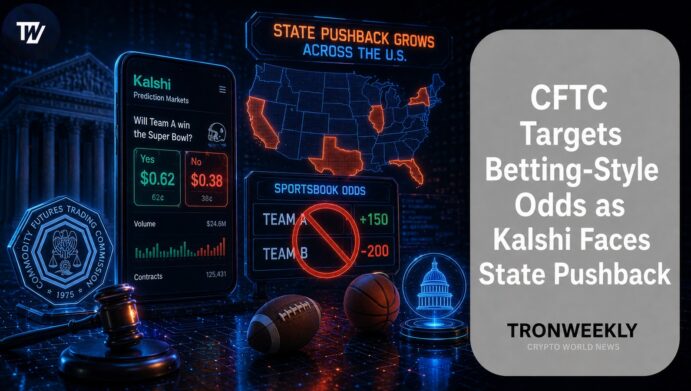
CFTC has warned regulated prediction markets against displaying American-style gambling odds as state authorities increase pressure on sports event contracts. The move comes as federal and state regulators continue to dispute whether these products fall under derivatives or gambling laws.
According to an Aug. 7 Bloomberg report, the Commodity Futures Trading Commission told registered platforms not to present contracts using odds such as +150 or -200. Those formats are commonly used by sportsbooks.
Contracts in prediction markets are usually priced within the $0-$1 range. Such prices are commonly used to indicate the implied probability of the outcome.
CFTC and States Clash Over Prediction Markets
The CFTC reminded the registered entities that event contracts were still covered by U.S. derivatives laws. Platforms are supposed to refrain from engaging in misleading behavior while listing, advertising, and soliciting for trades.
Also Read: Tether Adds 14 Tonnes of Gold as Hadron Expands Into Saudi Arabia
Such a warning comes amid a defense of the agency’s jurisdiction to control the event contracts. The CFTC contends that designated contract markets are within the purview of the CFTC’s jurisdiction via the Commodity Exchange Act.
The issue has been contested by state regulators, which claim that the event contracts related to sports are similar to wagers and should be regulated through the licensing of gambling activities.
On July 31, New York Attorney General Letitia James sued the prediction market company Kalshi. She sought more than $36 billion in civil penalties and damages from the company.
According to the complaint, Kalshi conducts unauthorized gambling operations. More precisely, the company allows the citizens of New York to conduct trades on contracts regarding sports and other events.
However, Kalshi does not agree with such accusations. It claims that the company’s exchange designation makes it exempt from any state gambling regulations.
The problem is not limited to New York State only. Recently, attorneys general of 44 states called for the CFTC to withdraw its proposed rules and to reconsider them.
They claimed that states have traditionally regulated sports betting and that they wanted to continue regulating contracts of sports events.
Courts have also disagreed with the position of the federal agency. A Wisconsin federal court refused to enjoin state authorities to regulate gambling.
Kalshi Faces New Legal and Compliance Pressure
In July, Washington managed to get a preliminary injunction against Kalshi. The court decided that federal derivatives legislation could not bar the state from applying its gambling prohibitions.
A federal court in Utah also made the ruling that allowed the state to apply its anti-gambling legislation to prediction markets. As a result, Kalshi made an urgent request for an injunction during an appeal process.
Gaming lawyer Daniel Wallach reported that Kalshi requested an urgent decision because it was afraid of any possible enforcement during the appeal process. According to Utah Attorney General Derek Brown, the state is going to enforce its gambling regulations.
CFTC’s warning proves that federal registration does not exempt platforms from compliance requirements. Operators have to comply with the legislation about contract marketing, display, and offering to traders.
Additionally, the agency took actions against misconduct on regulated platforms. Former U.S. Representative George Santos returned $17,569.98 as profits and paid a $17,500 fine because of trading the Kalshi contracts.
He also received a three-year trading prohibition. It adds another compliance challenge for the developing market of prediction markets.
Pending appeals in Utah and in other states will influence the regulatory debate. However, now operators should comply with federal derivatives legislation, while several states insist on gambling regulation in prediction markets.
Also Read: Warren Challenges CLARITY Act Over Crypto Market Risks



Be the first to comment