



Disclaimer: The below article is sponsored, and the views in it do not represent those of ZyCrypto. Readers should conduct independent research before taking any actions related to the project mentioned in this piece. This article should not be regarded as investment advice.
QIE Blockchain has introduced a new QIE Reputation Score on its blockchain explorer (https://mainnet.qie.digital), making it easier for users to assess a wallet’s credibility and history before interacting with it.
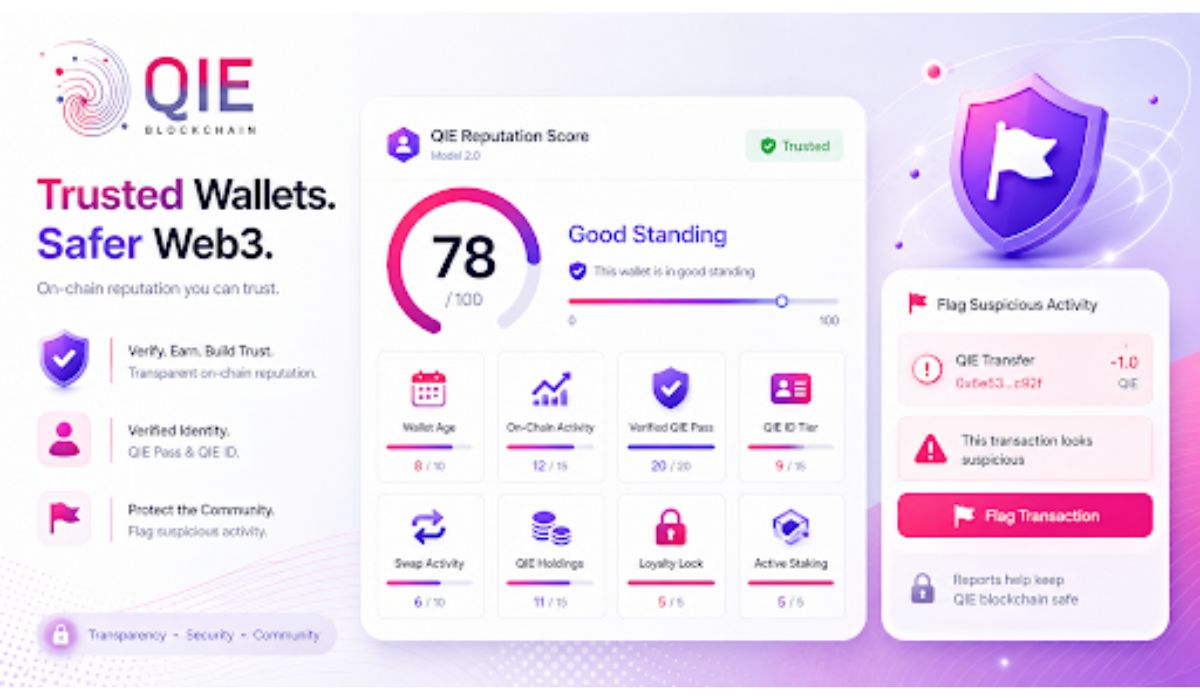
The new system gives wallets a reputation score out of 100 based on a combination of identity, wallet history, genuine network activity, and participation across the QIE ecosystem. It adds a new layer of context to blockchain transactions, where users have traditionally had little more than an anonymous wallet address to assess before sending funds.
Rather than attempting to replace the open and permissionless nature of blockchain, QIE’s approach is designed to make trust more visible.
From Anonymous Addresses to Reputation
Public blockchains provide transparency because transactions can be independently verified, but wallet addresses themselves reveal very little to the average user.

 
A newly created wallet, a long-term ecosystem participant, and an address used repeatedly for suspicious activity can all initially appear as similar strings of characters.
QIE Reputation Scores are intended to change that by allowing users to build an identifiable history over time. Wallet activity, longevity, and participation can contribute to a stronger reputation, while negative behavior can affect it.
This creates a simple distinction between a wallet with an established history and one with little or no track record.
How the QIE Reputation Score Is Calculated
The reputation system evaluates several indicators designed to help distinguish genuine ecosystem users from newly created or potentially higher-risk wallets.
These include QIE Pass verification, QIE ID ownership and tier, wallet age, on-chain transaction activity, swap activity, QIE holdings, Loyalty Lock participation, and active staking.
Each category contributes toward the wallet’s overall score, with the maximum reputation score capped at 100.
Importantly, the model is not simply based on how much cryptocurrency someone owns. A wallet’s history and participation across the ecosystem also contribute to its reputation.
A user who has been active for a longer period, completed QIE Pass verification, regularly transacts, swaps assets or participates in ecosystem services can gradually establish a stronger on-chain reputation.
QIE Pass Adds a Verified Identity Signal
Users who complete QIE Pass KYC verification can add another important trust indicator to their reputation profile while keeping their personal identity information private.
QIE Pass allows a wallet to demonstrate that its owner has voluntarily completed identity verification without displaying the user’s personal KYC information on the blockchain or making those details visible to other users. The reputation system simply confirms the verification status.
Sumsub, QIE’s specialist identity-verification provider, securely stores and manages the underlying KYC information and supporting documents. QIE Blockchain does not publish users’ names, identity documents, addresses, or other private KYC information on-chain as part of the reputation score.
This allows users to prove “I am verified” without revealing “who I am” publicly. Other users, businesses, exchanges or decentralized applications can therefore see that a wallet has completed QIE Pass verification while the wallet owner’s sensitive personal information remains private.
Completing QIE Pass is also optional and does not prevent an unverified wallet from using the QIE Blockchain. Instead, verification acts as an additional reputation signal for users who choose to establish a stronger and more trusted digital identity.
The result is a model that combines privacy, open blockchain access, and verifiable trust — allowing legitimate users to build reputation without placing their personal identity information permanently on-chain.
QIE IDs Are Now Visible on the Blockchain Explorer
QIE IDs are also being integrated directly into the QIE Blockchain Explorer, helping transform difficult-to-read blockchain addresses into recognizable digital identities.
Instead of relying exclusively on a long hexadecimal address, an explorer can associate the wallet with its QIE ID, making addresses easier to identify and remember.
The same infrastructure can also be extended to QIE’s exchange partners. Exchanges can create their own branded top-level identity environments, allowing users to receive identities such as users.lbank or similar exchange-branded naming structures.
This gives exchanges an additional branding layer while making blockchain identities easier for their customers to recognize.
Over time, a branded blockchain identity can therefore become more than a payment alias. It can be associated with a wallet’s transaction history, verification status, and reputation.
Users Can Flag Suspicious Transactions Directly in QIE Wallet
One of the most important additions to the reputation system is community reporting.
Within QIE Wallet, users can open a transaction and flag it if they believe they have been scammed or interacted with a malicious wallet.
The flagged transaction can then be reflected through the QIE ecosystem and visible when examining the relevant wallet’s on-chain reputation.
This introduces an important deterrent for malicious actors. Blockchain transactions are permanent, and a wallet that develops a history of suspicious interactions can carry that reputation.
Instead of seeing only an unfamiliar address, another user may see that the wallet has been flagged before deciding whether to transact.
Reputation Can Go Down as Well as Up
QIE Reputation Scores are not designed simply as reward points.
Negative behaviour can affect a wallet’s reputation as well.
The scoring model allows penalties to be applied where wallets involved in transactions are flagged, with significant deductions possible from the overall reputation score.
This means reputation must be maintained rather than simply accumulated.
A wallet may spend months or years building an established history, while malicious behaviour can negatively affect how that address is viewed by other participants in the ecosystem.
This introduces a concept that has historically been difficult to implement in crypto: consequences attached to an address’s long-term digital reputation.
Loyalty Lock Connects Reputation With Real Utility
The reputation model also incorporates participation in QIE Loyalty Lock.
Loyalty Lock allows users to lock or stake QIE tokens in exchange for ecosystem benefits rather than functioning simply as another staking product.
Depending on the applicable offering, benefits can include discounts on Galaxi stock screening tools, free Qbots trading-bot subscriptions, and other products and services across the QIE ecosystem.
Participation in Loyalty Lock can therefore contribute to reputation because it demonstrates deeper, longer-term engagement with the ecosystem.
Instead of rewarding speculative token ownership alone, QIE can increasingly recognize users who actively use and participate in its products.
Staking and Swapping Help Establish Genuine Activity
Active QIE staking and swap activity provide additional reputation signals.
A wallet that participates consistently across the network can establish a different behavioural profile from an address created minutes before a transaction.
Swap activity through QIE Wallet or QIE Swap, staking activity and broader on-chain transactions can therefore contribute toward a wallet’s reputation over time.
The intention is not to classify every new wallet as dangerous. Every legitimate user starts with a new wallet at some point.
Rather, a lower score indicates that there is simply less historical information available about that address.
As legitimate activity accumulates, its reputation can develop.
A Reputation Score Is a Signal, Not a Guarantee
QIE’s reputation system is not intended to declare that a high-scoring wallet is automatically safe or that a low-scoring wallet is necessarily fraudulent.
Instead, view it as an additional layer of information.
A new legitimate wallet may naturally have a very low reputation score because it has no transaction history, has not yet completed QIE Pass, and has not participated in staking or other ecosystem activities.
Likewise, users should continue following normal crypto security practices regardless of another wallet’s reputation.
The difference is that they now have considerably more information available before making a decision.
Building a Trust Layer for Blockchain
Crypto has solved the problem of verifying transactions remarkably well. What it has not solved nearly as effectively is helping ordinary users understand who or what they are interacting with before a transaction takes place.
QIE Blockchain is attempting to address that gap by combining blockchain activity, wallet age, QIE Pass identity verification, QIE IDs, staking, swapping, Loyalty Lock participation and community reporting into a single reputation layer.
The approach could ultimately extend beyond person-to-person transfers.
Exchanges, marketplaces, decentralized applications and other Web3 services could use reputation data as an additional signal when assessing wallet behaviour, while users gain a more understandable way of evaluating the addresses they encounter.
Making Malicious Wallets Harder to Hide
The long-term objective is straightforward: good actors should be able to build reputation, while malicious actors should find it increasingly difficult to repeatedly operate without their history following them.
A wallet that has been active for years, completed QIE Pass, established a QIE ID, participated in the ecosystem, and maintained a clean transaction history should look very different from a disposable wallet repeatedly associated with suspicious transactions.
Combined with the ability for QIE Wallet users to flag suspicious interactions and make those warnings visible through the blockchain ecosystem, QIE Reputation Scores introduce a new form of community-driven accountability.
Blockchain transactions have always created a permanent financial history. QIE is now working to make the reputation behind that history visible as well.


Be the first to comment