



South Korea’s central bank raised interest rates for a second consecutive meeting on Thursday, extending a sharp policy reversal as persistent inflation, rising property prices and stronger economic growth outweigh concerns about tighter financial conditions.
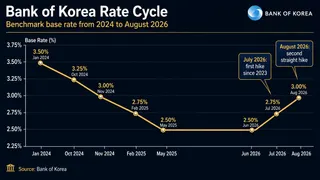
The Bank of Korea increased its benchmark rate by 25 basis points to 3.00%, following July’s move from 2.50% to 2.75%. Six of the seven Monetary Policy Board members backed the latest increase, while Hwang Kunil preferred keeping rates unchanged.
The back-to-back hikes mark a significant shift after the central bank spent much of the previous period easing policy. July’s increase was the BOK’s first rate hike since January 2023, and the latest decision brings borrowing costs back to levels seen before the February 2025 cut. Coinpaper’s earlier look at the first rate hike highlighted the implications for Korea’s heavily retail-driven equity and crypto markets.
Core Inflation and Housing Keep BOK on Alert
Headline consumer inflation eased to 2.8% in July, but underlying price pressure moved in the opposite direction. Core inflation rose to 2.6%, its highest level since December 2023, giving policymakers another reason to maintain a restrictive stance.

Housing is another concern. Seoul apartment transaction prices jumped 2.5% month over month in June, the largest monthly increase since June 2021. That acceleration adds to financial-stability risks at a time when household leverage remains an important consideration for Korean policymakers.

The central bank’s own outlook has also become considerably stronger. It now expects South Korea’s economy to expand 3.3% in 2026 and 2.9% in 2027, up sharply from May forecasts of 2.6% and 2.1%. Strong semiconductor exports and investment tied to global AI demand are supporting the upgrade.
Higher Rates Could Cool Korea’s Risk Appetite
The tighter policy backdrop matters beyond bonds and housing because South Korea remains one of Asia’s most active speculative markets.
Crypto activity has already shown how quickly local capital can return. Upbit recently recorded roughly 1.15 trillion won ($830 million) of trading volume in a single hour as XRP and TRUMP attracted renewed retail demand. Daily volume had climbed to approximately $3.81 billion by the following day.
That makes the BOK’s tightening cycle particularly relevant for digital assets. Higher deposit and borrowing rates can reduce the appeal of speculative positions by increasing the return available on cash while making leveraged trading more expensive.
South Korean investors also have a long history of concentrating activity in individual altcoins. XRP recently generated more than twice Bitcoin’s trading volume on Upbit, illustrating how quickly domestic liquidity can rotate.
The policy shift arrives as South Korea is simultaneously reshaping its digital-asset framework. Authorities are preparing to introduce crypto taxation from 2027, while Korea’s stablecoin market continues developing through projects such as KRW1.
For markets, the next question is whether 3% proves restrictive enough. The BOK said inflation is likely to remain above its 2% target for a considerable period, leaving further tightening on the table if price and housing pressures persist.


Be the first to comment