



Stacks founder Muneeb Ali said on Aug. 27 via X that HashKey Cloud will deploy Bitcoin in Stacks, making the Asian infrastructure provider the second institution announced for the network’s Genesis Bond pilot.
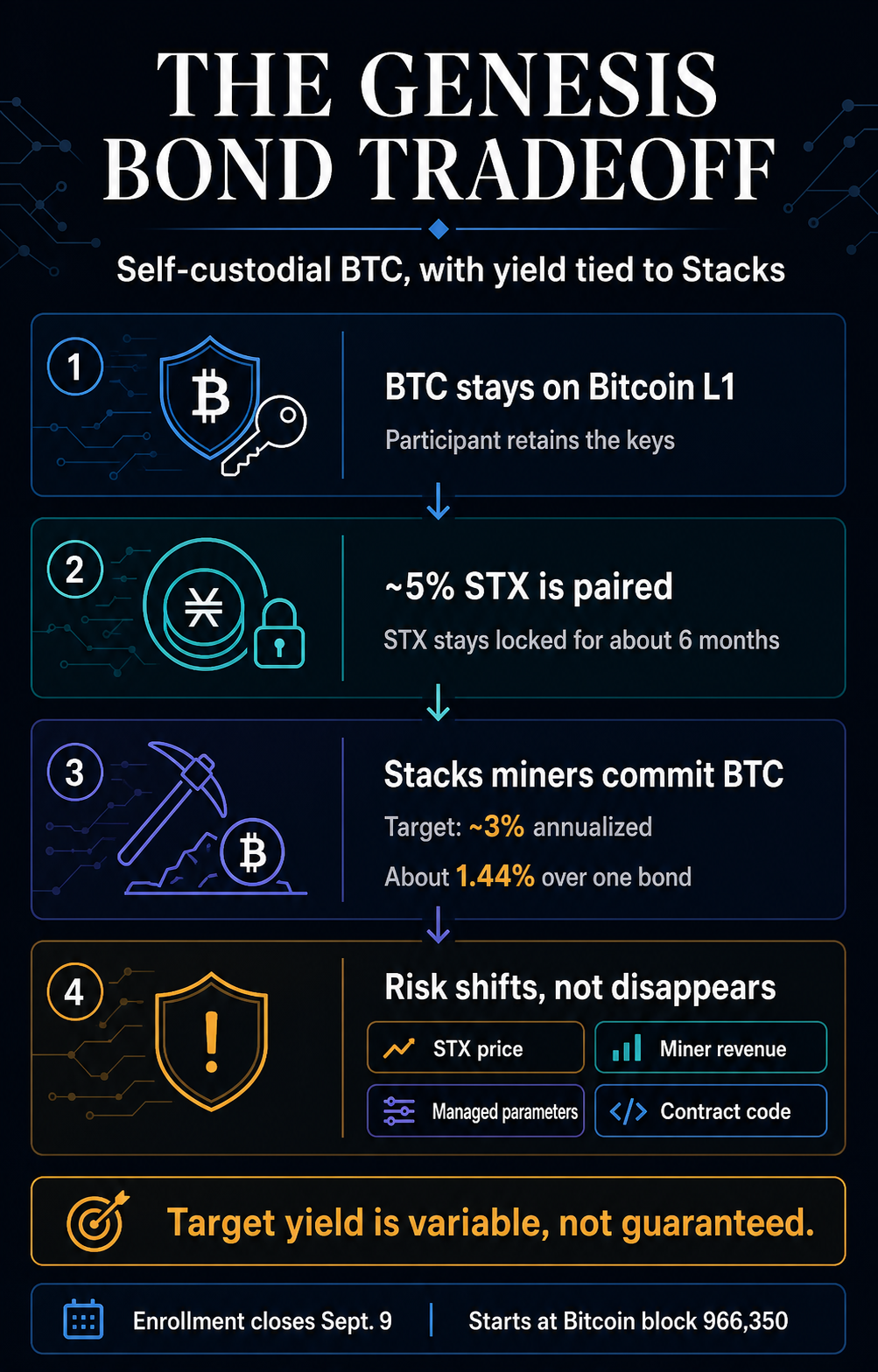
HashKey will time-lock BTC on Bitcoin, retain the keys, and pair the position with STX worth roughly 5% of the committed Bitcoin.
Retaining custody of the principal does not make the yield native to Bitcoin. Stacks targets about 3% annualized from BTC committed by its miners, so payouts depend on STX and Stacks miner economics and are therefore variable.
HashKey’s allocation was not disclosed, while the total BTC committed is expected to become visible on-chain when the bond begins around Sept. 10.

BTC stays on Bitcoin while the return depends on Stacks
Under the native-BTC protocol bond, a participant places Bitcoin in a time-locked output on Bitcoin’s base layer and retains the keys. The asset stays outside a lending agreement, wrapper or third-party custody arrangement. It remains immobile during the bond unless the participant uses the early-exit path.
An early exit returns the BTC principal and ends the remaining yield, and the paired STX stays locked for the full term, so the two asset legs carry different liquidity constraints.
The bond requires STX worth roughly 5% of the BTC position, and that amount determines the participant’s Bitcoin capacity and leaves the position exposed to STX price movements for about six months.
Stacks miners commit BTC as they compete to produce blocks and receive STX block rewards. Protocol-bond holders receive their target return first from that BTC pool.
Across 24 reward cycles, a roughly six-month bond would deliver about 1.44% of locked BTC if the target is realized, and the payouts can vary with miner economics.
The BTC available for rewards depends on the economics of mining Stacks, which in turn depend on STX block rewards, fees and network activity. Excess miner revenue can build a reserve. Under a sustained shortfall that depletes the reserve, Stacks says returns would compress first for STX-only stakers and later for protocol-bond holders.
The design therefore separates principal custody from return generation. Bitcoin keys remain with the participant, while the yield carries STX market exposure and Stacks protocol risk.
The first bond operates inside a managed bootstrap rather than an open auction. During PoX-5, the Stacks Endowment sets each bonding period’s capacity, target yield, BTC-to-STX ratio and allocation.
A future PoX-6 proposal is intended to replace those managed settings with an algorithmic, permissionless auction. Until then, Genesis tests the product within boundaries chosen by the Endowment.
On-chain commitments can show the amount of BTC institutions place in the bond, weekly distributions can show whether miner revenue supports the target, and reserve data can show the buffer available when revenue falls short.
HashKey’s name alone establishes participation. Its disclosed allocation and the bond’s realized payouts will determine how much weight that participation carries as evidence of institutional demand.
Self-custody leaves contract and reward risk
PoX-5 activated at Bitcoin block 960,230 on July 30. Stacks said the codebase was audited by Trail of Bits and Clarity Alliance, with additional review by Asymmetric Research.
An open medium-severity issue in the official stacks-core repository identifies a flaw in the bond rollover path. Near the end of a bond, a participant moving into a later bond can remain credited with old reward shares after withdrawing the collateral behind them. Other participants could then receive a smaller share of the final-cycle reward.
The issue leaves the native Bitcoin under the participant’s keys and does not establish a failure in ordinary Genesis Bond enrollment. The 4.0.1 PoX-5 contract source still contains the affected behavior, making a public fix or mitigation important before that rollover window arrives.
The Genesis Bond reduces reliance on a borrower or custodian, then adds STX exposure, miner-funded payout risk, managed program settings and new contract code. Block 966,350 will begin putting numbers to the test.


Be the first to comment