


Key Insights
- Bitcoin ETF inflows reached $3.8 billion during a three-week buying streak.
- Friday flows slowed sharply after Thursday’s fund demand surge.
- Bitcoin lost $80,000 as rate expectations pressured risk assets.
U.S.-listed spot Bitcoin ETF products attracted about $3.8 billion during the three weeks ending Sept. 4. The stretch marked their strongest three-week inflow period during 2026. Bitcoin traded near $80,000 as demand for the listed funds recovered.
The inflows showed stronger fund demand, but they failed to prevent Friday’s price reversal. Strong U.S. employment data raised interest-rate concerns and pressured risk assets. The move left Bitcoin testing an important weekly technical level.
Bitcoin ETF Inflows Meet Friday Price Reversal
SoSoValue recorded $986.9 million of net inflows during the latest week. Farside Investors published a slightly lower $986.7 million total from its daily figures. The $200,000 difference did not alter the broader three-week trend.
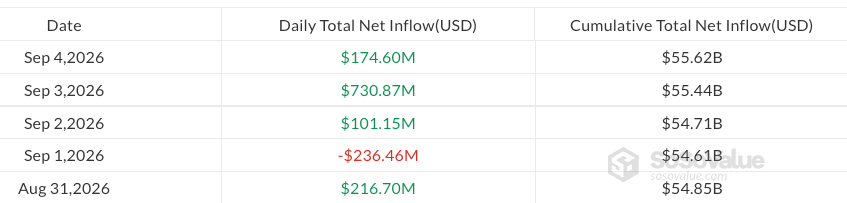
SoSoValue placed combined three-week inflows near $3.8 billion, the strongest such period during 2026. Cumulative net inflows reached $55.6 billion across the U.S. products. However, 2026 flows remained roughly $1 billion negative after earlier withdrawals.

Farside data showed funds attracted $730.8 million on Thursday. Flows then fell sharply to $174.6 million on Friday. BlackRock’s iShares Bitcoin Trust drew $117.4 million, while Fidelity’s fund added $57.2 million.
BlackRock listed IBIT’s net assets at $62.52 billion on Sept. 4. SoSoValue placed combined sector assets at $101.3 billion, giving IBIT about 62% of the market. BlackRock also reported a 2.14% daily decline in the fund’s net asset value.
Bitcoin Price Reverses Despite Institutional Demand
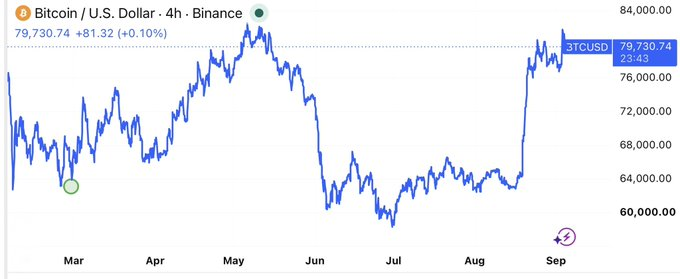
CoinGecko recorded the Bitcoin price at $79,671 for Sept. 4. The asset traded at $81,265 one day earlier, implying a decline near 2%. Daily trading volume increased to $39.84 billion from $26.62 billion on Thursday.

Friday’s trading range extended from roughly $78,700 to $81,300, CoinGecko data showed. However, the BTC price remained 2.6% higher across seven days. The weekly gain reflected the earlier rally rather than strength during Friday’s session.
The reversal showed that fund demand did not fully offset macroeconomic selling. Bitcoin also faced rejection near $82,400 before the U.S. employment release. Market commentator Rain said that rejection created the initial pullback setup.
Rain described the employment report as the trigger, rather than the underlying cause. He said strong hiring reduced the Federal Reserve’s justification for lowering rates. That interpretation tied Friday’s decline to policy expectations instead of weaker crypto fundamentals.
Bitcoin ETF Demand Meets the 50-Week Average Test
Analyst Ted Pillows said Bitcoin price had fallen below its 50-week moving average again. He identified the weekly close as the main technical confirmation. A close above that average would return control to buyers, Pillows wrote.
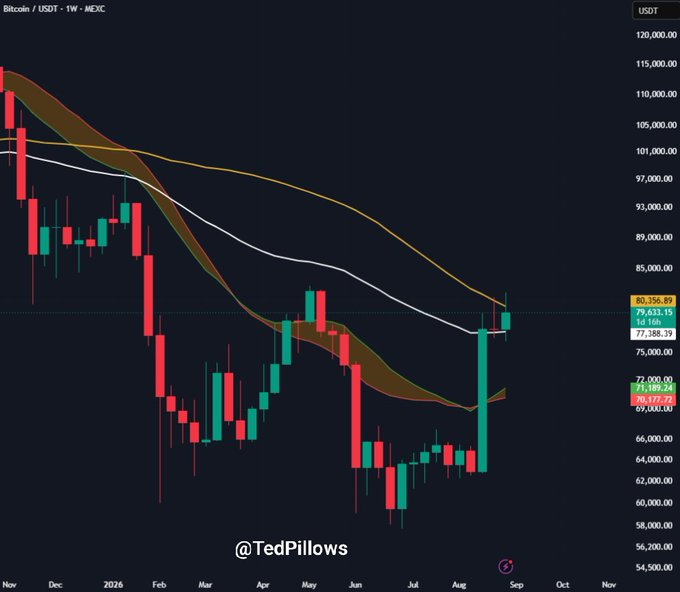
Another close below the average would strengthen the case for a deeper correction. The indicator therefore represents a decision zone rather than a directional guarantee. Price behavior around the level carries more weight than an intraday breach.
CoinGecko’s $78,700 session low provided the nearest observed downside reference from Friday. The $81,300 session high formed the first immediate recovery level. Bitcoin would then face the reported $82,400 rejection zone.
Futures and Macro Data Define the Next Catalyst
CoinGlass displayed Bitcoin futures open interest near $54.42 billion on Sept. 5. The platform also recorded $57.16 billion in 24-hour futures volume. Those totals covered the centralized derivatives venues tracked by CoinGlass.
That derivatives base could amplify volatility around nearby technical boundaries. However, open interest alone does not establish a bullish or bearish direction. Traders still require price and funding confirmation before drawing stronger positioning conclusions.
The Bureau of Labor Statistics said U.S. employers added 162,000 nonfarm jobs during August. The unemployment rate remained at 4.1% during the month. Labor-force participation edged higher to 61.6%, the agency added.
The agency revised June and July payroll growth upward by a combined 55,000 jobs. Average hourly earnings increased 0.3% monthly and 3.1% annually. Rain linked the report’s release to a repricing of interest-rate expectations.
CME FedWatch derives policy probabilities from 30-day federal funds futures prices. The Federal Reserve scheduled its next policy meeting for Sept. 15–16. Inflation data scheduled for Sept. 11 could reshape expectations before that meeting.
Bitcoin now faces an immediate test between Friday’s low and the 50-week moving average. A weekly close above that average could support recovery toward $81,300 and $82,400. Failure would leave the observed $78,700 support exposed during the following trading week.
This article is for informational purposes only and does not constitute financial advice. Cryptocurrency markets can experience sharp price movements.



Be the first to comment