



The India Crypto Exchange ban issue has received more attention recently after the Financial Intelligence Unit of India (FIU-IND) took stronger action against cryptocurrency exchanges allegedly running services from abroad and failing to comply with India’s anti-money laundering requirements.
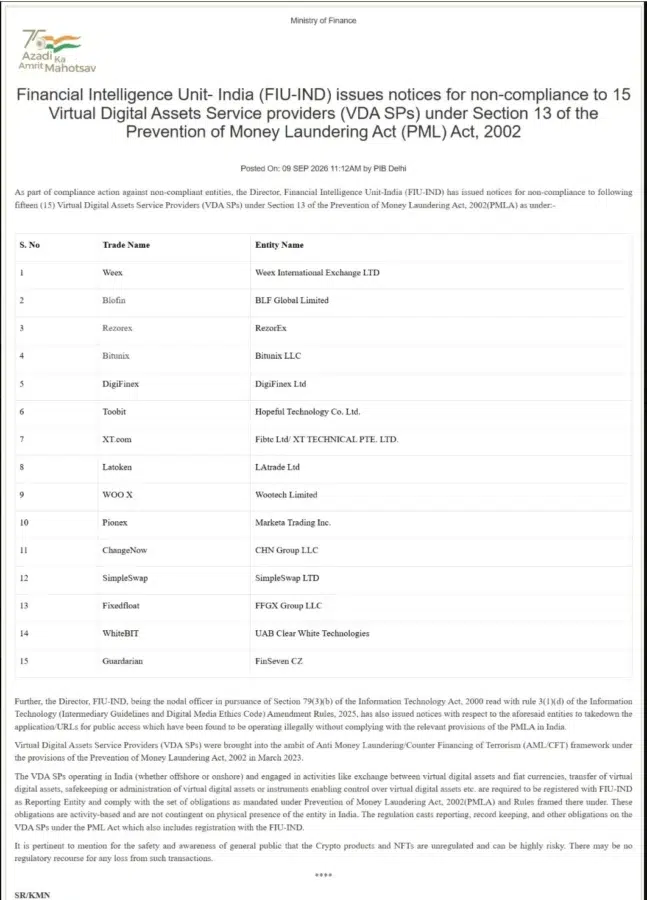
On Tuesday, the FIU-IND served notice of non-compliance under Section 13 of PMLA to 15 VDA service providers. The FIU-IND noted that these were small to medium-sized exchanges targeting the Indian markets.
The companies mentioned in the notice are Weex, Blofin, Rezorex, Bitunix, DigiFinEx, Toobit, XT.com, Latoken, WOO X, Pionex, ChangeNow, SimpleSwap, FixedFloat, WhiteBIT, and Guardarian.
However, the above-stated initiative by SEBI does not constitute a full-scale India Crypto Exchange ban since it specifically emphasizes the regulatory burden on crypto exchanges that operate outside the country and offer their services to Indian citizens without complying with all requirements.

Also Read | Plume Launches FACTOR Vault With $15M to Bring Institutional Private Credit On-Chain
India Crypto Exchange Ban Pressure Grows
Virtual digital asset service providers have been brought within the purview of India’s anti-money laundering regulations as of March 2023. The regulations cover virtual digital asset service providers who provide services to Indian users irrespective of whether the virtual digital asset service provider has a physical existence within the country or not.
As per the guidelines, the virtual digital asset service providers must be registered with the FIU-IND. They must also verify their customers and maintain records of transactions.
These platforms that do not adhere to these criteria may be subjected to punitive actions, thereby raising the question of whether there would ever be any form of restrictions imposed for non-compliance, thus forming part of an India Crypto Exchange ban on certain foreign exchanges.
This latest set of notices is yet another move by India towards integrating foreign cryptocurrency exchanges into its regulatory framework.
FIU Warns Indian Users About Crypto Risks
A public alert was also issued by the FIU-IND regarding the possible risks that come with crypto products and NFTs.
These two products were described as being unregulated and having potential risks. There was also a notification of the lack of regulatory protection for users in case they incur losses as a result of using these crypto assets.
The issuance of this alert was due to the continuous monitoring of the way digital assets are purchased, transferred, and utilized across international borders in India.
It also brings an element of uncertainty for users with regard to offshore platforms.
Stablecoin Transfers Raise Regulatory Concerns
FIU’s latest action follows a number of reports claiming that there are some Indians who have started utilizing other channels for transferring their stablecoins out of the country’s regulated cryptocurrency system.
According to The Economic Times, Indian users are resorting to the process of sending their stablecoins like USDT to exchanges operating in jurisdictions like Sweden, Germany, and Singapore, which later turn those cryptocurrencies into gift cards that are subsequently used for buying groceries, gasoline, and even gold in India.
Such arrangements would make it harder for the Indian government to trace the movements of such assets and identify how the crypto is being used to pay for goods and services in India.
This would bring to light such overseas companies offering their services to Indian consumers without registering with the FIU-IND.
India Previously Targeted Offshore Crypto Platforms
FIU-IND had already issued notices against major offshore crypto exchanges before. In December 2023, it issued notices against nine platforms, such as Binance, Kraken, and KuCoin, and asked for website restrictions on non-compliant platforms.
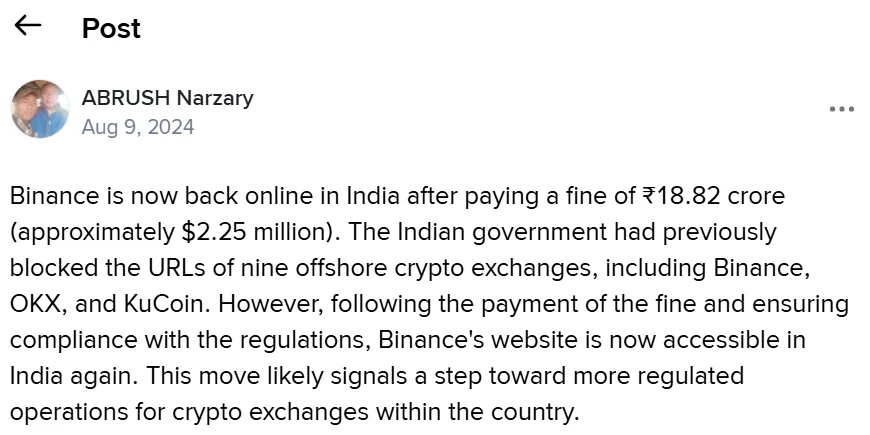
Afterwards, Binance registered itself with the FIU-IND and paid INR 18.82 crore as a penalty due to anti-money laundering violations. It is clear from the recent notices that FIU-IND has started enforcing regulations against smaller offshore crypto platforms.
What the Latest Action Means for Crypto Exchanges
However, the recent FIU-IND regulation is not a nationwide India Crypto Exchange ban but only restrictions on non-compliant offshore platforms.
In view of increased scrutiny of stablecoins and offshore exchanges, the debate on an India Crypto Exchange ban will continue to be relevant for India’s crypto industry.
Also Read | Tether Launches $400M StableFund With Fasanara to Expand USDT Private Credit



Be the first to comment