


Coinbase’s new partnership with payments platform Moov gives community banks and credit unions a route to offer stablecoin services through the financial relationship they already have with businesses. The local institution can remain the customer’s front door, while Coinbase supplies the disclosed custody and transaction infrastructure behind it.
Moov CEO Wade Arnold framed the demand bluntly: business customers asked to accept stablecoins currently go outside their primary financial institution. Moov and Coinbase want that service to appear inside the institution’s existing payments experience. The arrangement could preserve the bank’s customer connection. Control of the economics, data and operational risk remains unresolved until the companies disclose their terms.
How the split stack would work
Under the partnership announced Sept. 10, Moov will integrate Coinbase’s stablecoin payments infrastructure into its existing platform for financial institutions. Coinbase said its CDP Custodial Wallet accounts will provide fund custody and its Payments API will orchestrate stablecoin movement. Moov will connect those functions to the systems used by its bank and credit-union customers.
That division places three parties between a business and the stablecoin rail. The bank or credit union owns the primary customer interaction. Moov supplies the payments-platform connection. Coinbase provides the announced crypto custody and movement components. The customer may experience one bank-facing product even though the underlying service spans multiple providers.

Coinbase’s announcement said Moov has a customer base of more than 1,000 community banks and credit unions. The figure describes Moov’s potential distribution footprint. Live, contracted and pilot institutions remain unquantified, and the companies gave no implementation timetable.
| Disclosed | Undisclosed | Decision it affects |
|---|---|---|
| Coinbase supplies custodial accounts and stablecoin movement tooling | The ownership and settlement configuration for each institution | Where balances sit and who directs key operations |
| Moov embeds the tools in its financial-institution payments platform | The number of live, committed or pilot banks | Whether distribution reach becomes adoption |
| The bank remains the customer-facing institution | Fees, revenue sharing, data rights, compliance duties and liability | Whether the bank retains economics and practical control |
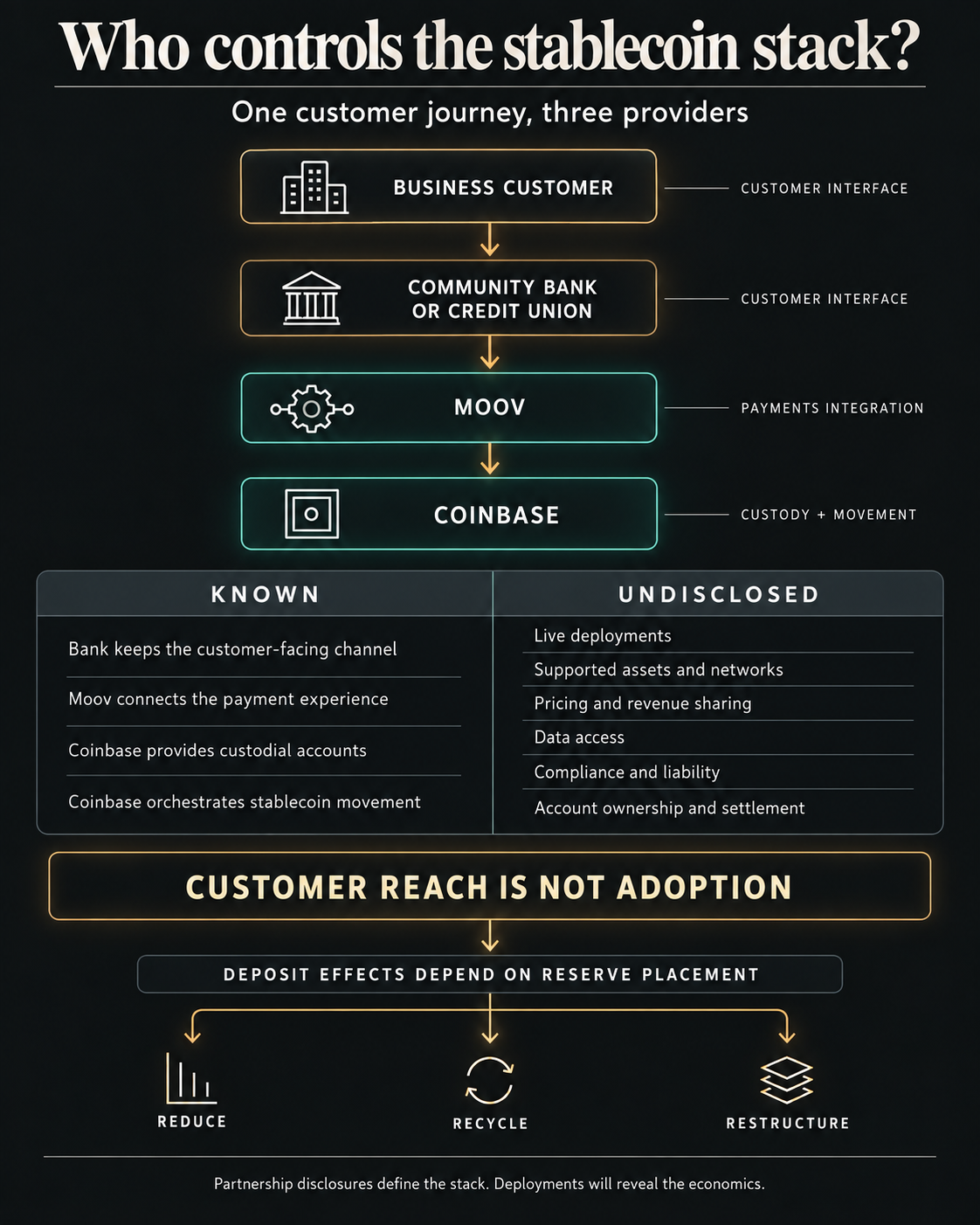
The disclosed architecture gives Coinbase a material role behind the interface. Its standard payments documentation describes a custodial-account stack in which crypto can enter an account, be held and reconciled there, and leave through fiat or crypto transfers. Separate custodial wallet documentation says Coinbase provides custody for assets in those accounts on behalf of the CDP entity.
Those documents cover Coinbase’s standard platform. The partnership record leaves each institution’s supported stablecoins, networks, custodial-balance ownership and fiat-settlement route unspecified. It also leaves fees, revenue sharing, transaction-data access, compliance allocation and liability out of public view.
The result is a split form of control. Community institutions can keep the account relationship and present the service to customers. Coinbase and Moov remain essential to the disclosed technology chain. The bank’s economic and operational leverage will turn on its authority over pricing, settlement destinations, customer data and risk decisions. Coinbase holds a material infrastructure role within a payment chain that also depends on Moov and participating institutions.
Insurance and deposits follow different rules
A bank-facing interface leaves the payment stablecoin’s legal status unchanged. Customer protection and bank balance-sheet exposure follow the legal claim represented by the balance.
In an April 2026 proposed rule, the Federal Deposit Insurance Corporation said deposits held at banks as reserves for a payment stablecoin would be insured as corporate deposits of the stablecoin issuer, subject to applicable limits. Stablecoin holders would receive no pass-through deposit insurance under the proposal.
The same proposal draws a boundary around tokenized deposits. An instrument that meets the statutory definition of a bank deposit remains a deposit regardless of the technology or recordkeeping used. A payment stablecoin and a tokenized deposit can therefore give customers a digital-dollar experience while representing different legal claims.
For a community institution, the distinction reaches beyond consumer disclosure. A qualifying tokenized deposit remains the issuing bank’s liability. Access to a third-party stablecoin can keep the payment experience inside a bank channel while the customer’s converted funds may cease to be a deposit at that bank.
Deposit effects remain conditional rather than following an automatic dollar-for-dollar path. A Federal Reserve analysis published in December 2025 said stablecoins can reduce, recycle or restructure deposits. The outcome depends on who buys them, what assets are converted and where stablecoin issuers place their reserves.
Domestic customers converting transaction-account balances can reduce deposits, especially when issuers hold reserves outside banks. If issuers keep reserves in bank deposits, more funding can stay in the system, though it may move from dispersed retail accounts toward concentrated, uninsured wholesale balances. The effect on any one community bank also depends on whether reserve money returns to that institution or is concentrated with larger custodial and settlement banks.
The Fed identified partnerships, custody services, settlement accounts and white-label infrastructure as possible ways banks can stay connected to digital payment flows. It also described a deeper structural tension: stablecoins may separate the payment relationship from the deposit-funded lending model that banks have historically used to serve households and businesses.
The Moov arrangement puts both possibilities in one product design. A bank may keep the customer conversation and gain a service that would otherwise require its own crypto stack. Coinbase may gain transaction and custody activity while customers access stablecoins through their primary institution. The destination of deposits and revenue remains unsettled.
Deployments will reveal who controls the economics
The first bank deployments will provide the evidence missing from the announcement. Adoption counts will show whether Moov’s network converts into actual demand. Supported assets, account ownership and settlement paths will show whether stablecoin activity returns value to the same institution or routes it elsewhere.
Commercial disclosures will be equally important. Pricing and revenue sharing determine whether the bank earns from the new service or mainly supplies distribution. Data access and compliance responsibilities determine who can deepen the customer relationship and who bears the burden when monitoring or processing fails. Liability terms determine how operational control translates into financial risk.
Coinbase has offered community banks a bridge into stablecoin payments, with its custody and payment infrastructure underneath. That structure may stop the bank from disappearing from the customer’s view. The next test is how much of the payment relationship, balance-sheet value and decision-making power stays with the bank when the customer gains stablecoin access through it.



Be the first to comment