



In a significant move to meet demand for faster, cheaper, and more transparent digital asset infrastructure, the Ripple network continues to expand globally, positioning XRP as a core settlement asset in global finance.
The development follows South Korea’s financial regulator, the Financial Services Commission (FSC), announcing plans to bring equities, bonds, and funds onto the larger blockchain infrastructure, with Ripple’s name taking the lead.

According to the announcement, the regulator wants to widen the market scope of security token offerings on a compliant blockchain infrastructure, with Ripple appearing at the top to benefit from the deal.
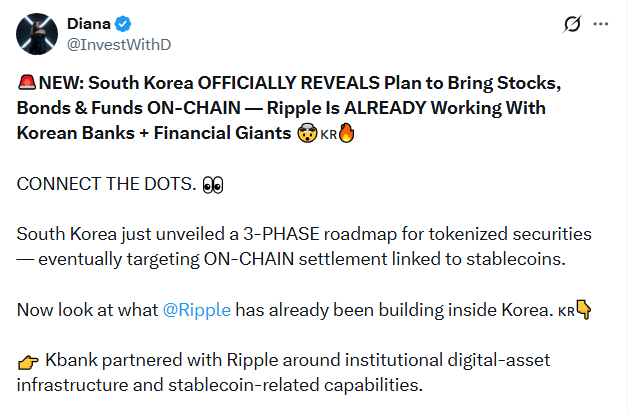
South Korea Opens Traditional Assets on Blockchain
As reported today, the South Korean regulator plans to broaden tokenized securities beyond products (such as real estate and music royalties) to include traditional securities (including stocks, bonds, and funds) on a blockchain network.
The development signals South Korea’s preparation to transition the country’s stock and capital market to 24/7 (around-the-clock) trading. At the center of the spotlight is the Ripple network due to its deep collaborations with Korean banks and financial institutions.

 
According to reports, the South Korean government is preparing to launch its tokenized securities markets starting February 2027. Regulators have already created a phased roadmap to bring traditional capital assets onto a blockchain infrastructure. The first phase will begin with tokenizing privately placed corporate bonds and money market funds, making them available on-chain to institutional investors. The second phase will tokenize all publicly offered securities, and the third phase is scheduled to roll out on-chain settlements by linking tokenized securities with payment assets like stablecoins and DeFi products.
Structural Gaps Lead to Capital Concentration XRP
Blockchains (like Ripple and others) are recognized as long-sought-after networks because of their proven achievements. This success is evident in Ripple’s strong presence in the South Korean market, where it already works with regional banks and financial giants.
Recently, the South Korean government approved integrating the XRP Ledger into the country’s banking system. This was evident when Jeonbuk Bank replaced the traditional SWIFT network with Ripple Blockchain to improve the efficiency of its cross-border transactions. The partnership marked Ripple’s third collaboration in the country since the beginning of the year, indicating its expanding footprint within the Asia-Pacific region.
With the FSC now opening the door to DeFi, Ripple is the biggest potential beneficiary, given its strong presence in Korea. XRP’s remarkable growth in the country stems from institutional gaps and structural flaws. The blockchain’s cost efficiency, high liquidity, and rapid transaction speed have helped Ripple become the preferred network for digital trade. This happens because financial institutions prioritize XRP Ledger for cost-efficient, rapid cross-border payments and on-chain transactions.




Be the first to comment