



AI Summary
- Trump’s conditional $5,000 dividend pledge creates a potential liquidity catalyst, but its funding remains unspecified.
- A large cash distribution could support Bitcoin demand while simultaneously increasing inflation and bond market pressure.
- Higher interest rates and a stronger dollar could create an initial headwind for BTC before any liquidity benefit emerges.
- The proposal is conditional on Republican control of both chambers and should not be treated as approved policy.
- Bitcoin’s response would depend less on the headline amount than on funding, Treasury issuance and the Federal Reserve reaction.
The common market narrative is straightforward: send cash to households and some of it will reach risk assets. The concrete development is narrower and more conditional. Trump pledged a $5,000 payment to every adult US citizen if Republicans win both the House of Representatives and the Senate, but the supplied material provides no enacted legislation, funding mechanism or implementation timetable.
For Bitcoin, the relevant question is therefore not whether trillions of dollars are definitely approaching the market. It is how a possible Trump dividend would affect liquidity, government borrowing, inflation expectations and the dollar if the proposal advanced. That interaction matters more than the headline alone, as our related analysis of Bitcoin’s dollar hedge case and Treasury reality has emphasized.
Our analysis sees a genuine two-sided setup. A broad cash distribution could increase demand across crypto markets, including demand for BTC. Yet financing it through additional debt could lift bond yields, reinforce pressure for higher interest rates and strengthen the very macro headwinds that often constrain speculative liquidity.

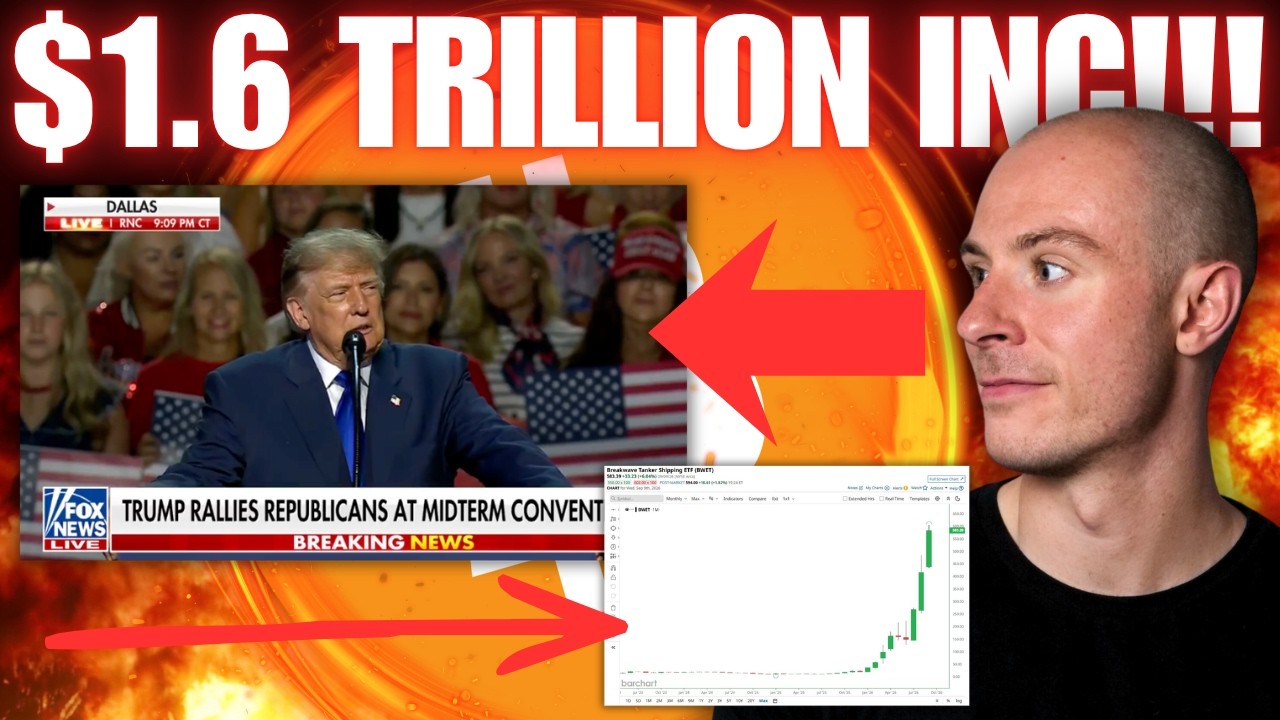
$1.6 Trillion Incoming… What Did Trump Just Say!?!?!? Yields, Inflation And Rates Are Rising……
A conditional payment is not committed liquidity
The proposal was presented as a dividend made possible by US economic performance and compared with a company distributing cash to shareholders. Trump attached an explicit political condition: Republicans would first need to win both chambers of Congress.
I WILL ISSUE A DIVIDEND TO EVERY adult citizen in the United States of America for [cheering] $5,000.
That statement supports reporting the amount and the condition. It does not establish the number of eligible recipients, the total fiscal cost, the source of funds or the likelihood of passage. The transcript offered a broad cost estimate ranging from $1.2 trillion to about $1.7 trillion, but no primary calculation was supplied. We therefore treat that range as an unverified estimate rather than a settled budget figure.
- What is supported: A conditional promise of $5,000 for every adult US citizen.
- What remains unknown: Eligibility rules, timing, legislative structure and funding.
- What markets may price: The probability of implementation rather than the full headline amount.
- What investors should avoid: Treating a campaign pledge as cash already entering the financial system.
This distinction is central to Bitcoin liquidity analysis. Expectations can move markets before policy takes effect, but durable liquidity requires actual transfers, credit creation or an institutional response. Until those channels become visible, the pledge remains a scenario rather than an investable certainty.
Cash transfers could lift demand without guaranteeing Bitcoin inflows
The bullish case rests on household choice. Recipients could spend, save, repay debt or purchase financial assets. The transcript drew a comparison with pandemic-era stimulus and suggested that some previous payments reached markets. It also argued that crypto ownership among Americans could direct part of a new distribution toward digital assets.
That is plausible, but the allocation cannot be known in advance. A $5,000 transfer is not equivalent to a $5,000 Bitcoin purchase. The portion reaching BTC would depend on household finances, market confidence, prevailing prices and the competing appeal of cash, bonds, equities and other crypto assets.
- Direct channel: Recipients use part of the payment to buy Bitcoin or other crypto markets exposure.
- Indirect channel: Consumer spending supports corporate revenues and broader risk appetite.
- Balance-sheet channel: Households repay obligations, limiting immediate market inflows but improving finances.
- Expectation channel: Traders position for future liquidity before payments occur, increasing reversal risk if policy stalls.
In our view, the expectation channel would probably appear first. That makes political probability, legislative progress and funding details more important near-term indicators than assumptions about how every recipient would invest.
Treasury financing could turn the catalyst into a yield shock
The proposal becomes more complicated if the US Treasury must borrow to fund it. Additional issuance could require investors to absorb more government debt. If demand did not expand alongside supply, yields could rise, tightening financial conditions even as households received cash.
The transcript also reported $6 billion of bond buybacks against an earlier reference to $4 billion. Those figures illustrate the tension identified in the source material, but they do not by themselves establish the scale or future direction of Treasury support. The larger analytical point is that fiscal distribution and bond-market management can pull in opposing directions.
remember this hasn’t happened yet and isn’t imminent but certainly is a promise that was made there.
Higher bond yields can raise the return investors receive from lower-volatility assets. That increases the opportunity cost of holding Bitcoin, which produces no contractual cash flow. It can also lift financing costs across markets and reduce the leverage available for speculative positions.
- Shorter maturities: Rising yields can signal expectations for tighter monetary policy.
- Longer maturities: Rising yields can reflect inflation, fiscal risk or greater debt supply.
- TLT sensitivity: The transcript cited TLT as a proxy for long-duration US Treasury exposure.
- Bitcoin consequence: The reason yields rise may matter as much as the direction itself.
A fiscal transfer could therefore be bullish for nominal demand yet bearish through discount rates. Our analysis of Bitcoin volatility against oil, yields and the dollar provides the closest verified context for this mixed transmission mechanism.
Inflation and interest rates define the policy constraint
The source material linked the proposed payment to an already difficult inflation backdrop. It cited rising oil prices, shipping tanker exposure and higher government borrowing costs. It also reported eurozone inflation at 3.3% in August and energy inflation at 14.3%, while presenting an expected ECB rate increase as part of a broader tightening cycle.
Those figures and expectations come from the supplied transcript, without accompanying primary documents, so they require caution. The supported analytical relationship is clearer: if a fiscal payment adds to demand while energy and transport costs are rising, central banks may have less room to tolerate inflation.
For the Federal Reserve, the key issue would be the net effect on prices, employment and financial conditions. The transcript anticipated interest rates rising in the United States and Canada, but that is a market opinion, not a confirmed policy path. A central bank response would depend on subsequent data and the actual design of any fiscal measure.
- Inflationary case: New spending meets constrained supply and rising energy costs.
- Disinflationary offset: Higher yields and tighter credit reduce demand elsewhere.
- Policy risk: Central banks maintain or increase restrictive rates for longer.
- Crypto trade-off: More nominal liquidity arrives alongside a higher cost of capital.
This is why Bitcoin cannot be evaluated only as an inflation hedge. Its price can respond positively to fears of currency dilution while responding negatively to tighter liquidity. We examined the same tension in Bitcoin’s global interest-rate test.
The dollar may decide which force reaches BTC first
The transcript described the dollar as being in a no-man’s-land while allowing for a possible rise alongside yields and volatility. That combination would matter for BTC because a stronger dollar can tighten global financial conditions and make dollar-denominated assets more expensive for non-US buyers.
the irony right now is that crypto is a dollar story.
That claim is best read as a macro framework, not an immutable rule. Bitcoin has its own supply structure and can diverge from traditional assets. Even so, dollar direction, real yields and liquidity conditions remain useful variables when assessing whether a fiscal headline becomes a sustainable crypto catalyst.
Our base interpretation is sequential. Markets could initially focus on debt issuance, inflation and tighter policy, producing volatility or a pullback. A later response involving greater liquidity support could then improve conditions. The transcript went further by forecasting a final crypto shakeout followed by a strong advance, but that remains an attributed market scenario rather than our prediction.
The source also contrasted a technology boom with a speculative bubble, citing a 53% August revenue increase for TSMC and comparing the present AI cycle with earlier technology adoption. This may support broader risk appetite, but it does not remove the rate sensitivity of Bitcoin or prove that crypto valuations will follow semiconductor revenues.
What this means
1. The pledge is an option on liquidity, not liquidity itself. Bitcoin traders can reasonably monitor the proposal, but pricing the full payment before election results, legislation and funding would embed substantial political risk.
2. Funding determines the market transmission. A payment financed without significant new borrowing would have a different bond-market impact from one funded through large-scale Treasury issuance. The route matters for yields, the dollar and BTC.
3. The first reaction may not be the final one. Inflation fears and higher interest rates could produce an initial headwind, while later liquidity measures could become supportive. Investors should distinguish these phases instead of reducing the scenario to a single bullish or bearish label.
Bigger picture
The dividend proposal joins a wider debate over whether Bitcoin functions primarily as a scarce monetary asset, a liquidity-sensitive risk asset or some combination of both. Recent AllinCrypto coverage has examined Bitcoin amid a monetary reordering and dollar-backed stablecoins, highlighting that crypto adoption can coexist with continued dollar demand.
Cross-border policy shocks also remain relevant. Our analysis of Bitcoin, yen intervention and altcoin open interest showed how currency policy and leveraged positioning can intersect. The current proposal adds a US fiscal dimension to that same macro landscape.
We see no contradiction in saying that a $5,000 distribution could support Bitcoin demand and still create difficult conditions for Bitcoin through yields and monetary policy. Both channels can operate, and their timing may differ. The decisive evidence would be concrete legislation, a documented financing plan and observable changes in market liquidity.
Bitcoin liquidity FAQ
Has the $5,000 payment been approved?
No approval is established by the supplied source. Trump presented the payment as a promise conditional on Republicans winning both the House and Senate, while the transcript explicitly said it had not happened and was not imminent.
Would every payment flow into Bitcoin?
No. Recipients could spend, save, repay debt or buy many different assets. Any Bitcoin allocation would be only one possible use of the funds.
Why could a cash distribution raise bond yields?
If additional government borrowing financed the distribution, the US Treasury could need to issue more debt. Greater supply may place upward pressure on yields, although the outcome would also depend on investor demand and policy responses.
Are higher yields always bearish for BTC?
Not necessarily. The cause and policy response matter. Higher yields can tighten financial conditions, but they can also prompt later liquidity measures. Bitcoin’s reaction may change as that sequence develops.
What should investors monitor next?
The key variables are the political condition, any legislative text, the funding method, Treasury issuance, inflation data, Federal Reserve policy, bond yields and dollar direction. Without those details, the dividend remains a conditional scenario.
Sources
This article is for informational purposes only and does not constitute financial advice.


Be the first to comment