



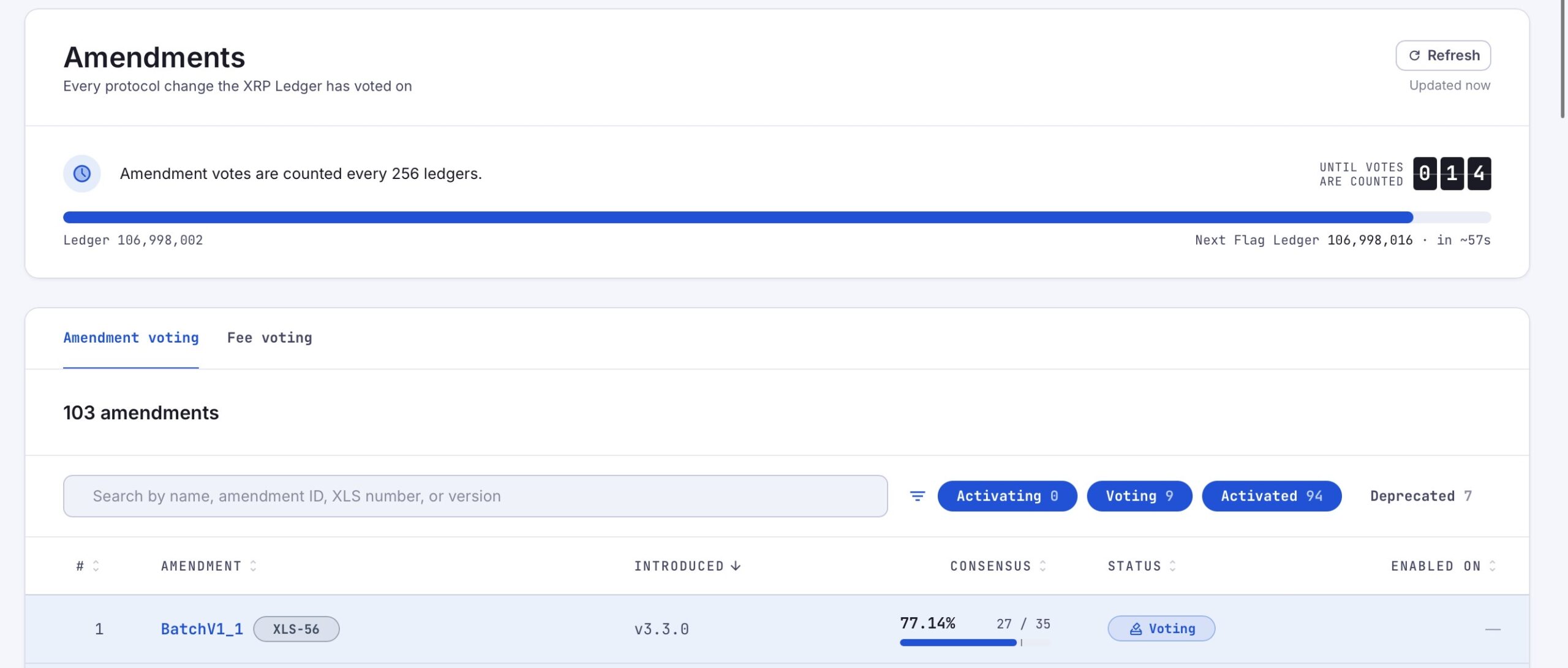
Following today’s Ripple news, XRP Ledger’s Batch V1.1 amendment has secured backing from 27 of the network’s 35 trusted validators, or arounf 77%. That leaves the upgrade one validator vote short of the 80% threshold XRPL requires to begin a 14-day activation countdown.
Batch V1.1 would let users bundle as many as eight linked transactions into a single atomic transaction operation, a change relevant to anyone tracking XRPL payment activity.
This is not simply a vote count creeping toward a number. Clearing 28 votes would only start the countdown clock, not switch the feature on. Support has to stay above 80% for the full two weeks, and validators can change their votes during that window, so the current tally is a trigger point rather than a confirmed outcome.

Amendments XRPSCAN
DISCOVER: Meme coin supercycle: Top performers this week
XRPL Upgrade News: What The Validator Vote Actually Unlocks
The mechanism functions as follows: once 80% of the 35 trusted validators back Batch V1.1, the amendment enters its 14-day majority period. If support holds, the change activates; if it drops below the threshold before the window closes, the countdown resets. The amendment has not yet gone live on the main network, though it shipped in xrpld 3.3.0 and is currently up for validator vote.
In practice, Batch V1.1 would allow up to eight transactions to execute as one bundle: either all succeed, or all fail. A token swap between two parties could ensure both transfers are completed together rather than leaving one side exposed. Wallets and marketplaces could similarly pair a customer payment with a platform fee in a single operation, a detail that’s been picking up attention across ripple news coverage in recent weeks.
RippleX has said commercial projects built around Batch are already under contract or in development, though it has not named the companies involved.
The Batch V1.1 amendment shipped in xrpld 3.3.0 and is now up for voting.
After the v1.0 signature bug was caught in February (pre-Mainnet, no funds at risk), we rebuilt it: root-cause fix, 4 senior reviewers, a Sherlock attackathon, and audits from Halborn and Common Prefix. We…
— Mayukha Vadari (@msvadari) September 14, 2026
Ripple News: The Security Rewrite Behind Batch V1.1
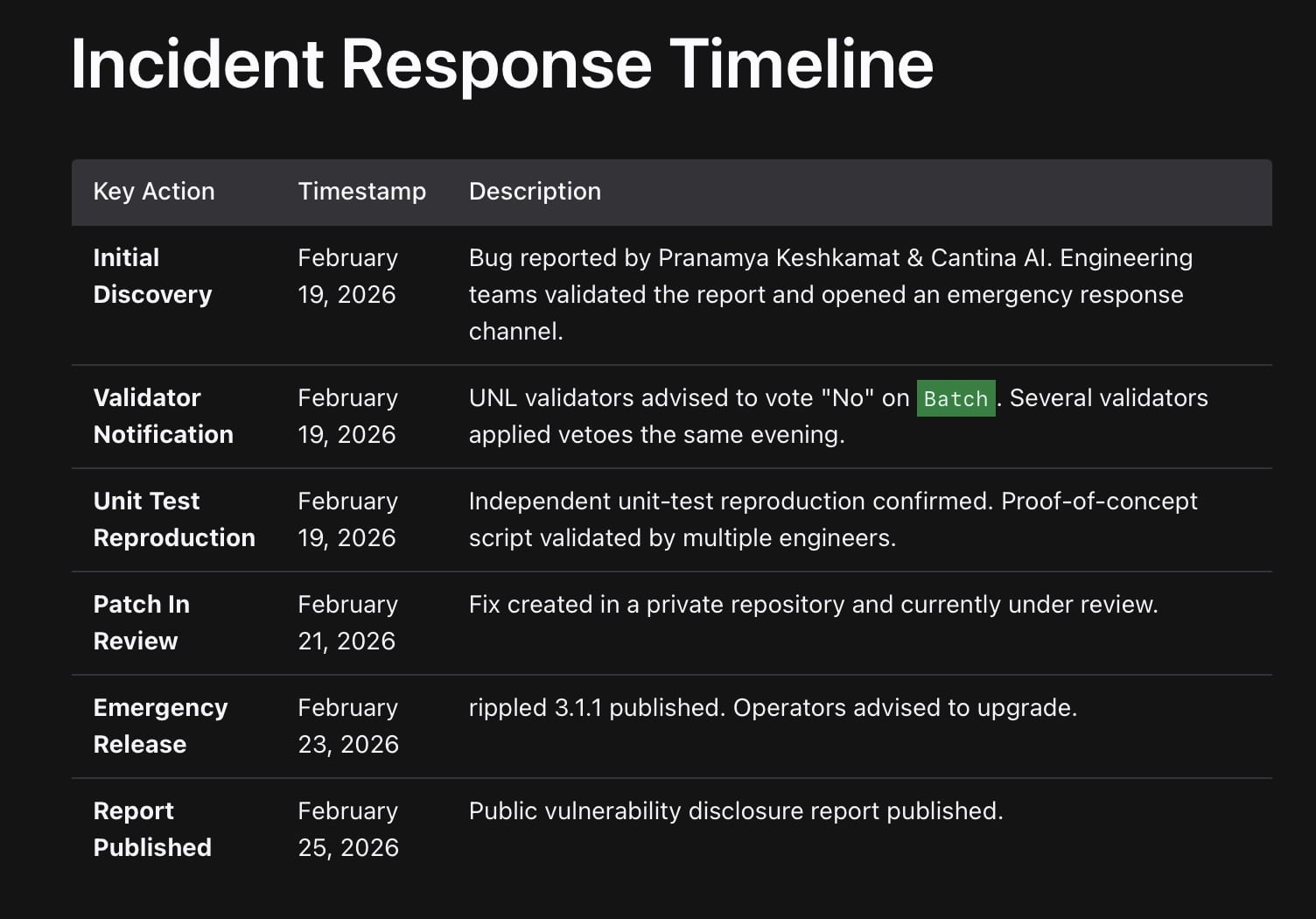
Based on today’s Ripple news, the current version replaces an earlier Batch proposal that never reached Mainnet after researchers found a flaw that could, under certain conditions, let an attacker include another account’s transactions without approval. Because that version was withdrawn before activation, no funds were ever at risk, according to the XRPL vulnerability disclosure report. Developers replaced it in the Aug. 6 release of XRP Ledger’s 3.3.0 software.
Incident Response XRPL.org
RippleX detailed the follow-up review in a technical write-up published on dev.to, describing checks from four senior engineers, audits from Halborn and Common Prefix, a public Sherlock security contest, and automated testing.
That process turned up 11 additional issues involving signatures, authorization checks, and bugs capable of crashing servers, one of which Common Prefix rated critical because it could have let an attacker reuse a signed permission to execute more transactions than intended.
Industry Implication: Payments Infrastructure Still Waiting On A Vote
If Batch V1.1 clears the threshold and holds for 14 days, it would give XRPL a native tool for coordinating multi-step payment flows without relying on smart-contract logic. This is relevant to settlement use cases like agentic transaction rails and stablecoin activity tied to RLUSD settlement volume.
RippleX’s claim of contracted commercial projects remains unverified against named counterparties, and broader forecasts about Batch reshaping XRPL’s competitive position against smart-contract chains are research-only at this stage. For now, the concrete fact is narrower: one validator, one vote, and a 14-day clock that has not yet started.
Market Intelligence: Crypto Analyst Predicts Best New Crypto to Hodl
next
Disclaimer: Coinspeaker is committed to providing unbiased and transparent reporting. This article aims to deliver accurate and timely information but should not be taken as financial or investment advice. Since market conditions can change rapidly, we encourage you to verify information on your own and consult with a professional before making any decisions based on this content.

Daniel Frances is a technical writer and Web3 educator specializing in macroeconomics and DeFi mechanics. A crypto native since 2017, Daniel leverages his background in on-chain analytics to author evidence-based reports and deep-dive guides. He holds certifications from The Blockchain Council, and is dedicated to providing “information gain” that cuts through market hype to find real-world blockchain utility.



Be the first to comment