



AI Summary
- The SEC announcement outlines temporary conditional relief for certain tokenized stock venues and liquidity providers.
- The supplied material does not establish which public blockchains, assets, or operators would qualify for the relief.
- Clearer market structure could support tokenization, but it does not automatically create demand for every underlying network token.
- Bitcoin dominance and the macro environment remain important market variables, not reliable guarantees of an altcoin cycle.
The common market narrative is that regulatory accommodation will immediately unlock a historic rally across altcoins. The concrete development is narrower: remarks attributed to SEC Chair Paul Atkins announce temporary conditional relief intended to facilitate onchain trading of certain tokenized stocks.
This follows the failure of Congress to advance the Clarity Act, according to the supplied material. The proposed innovation exemption addresses the regulatory treatment of certain trading venues and liquidity providers, rather than approving a particular token, network, or public blockchain.
In our view, that distinction is essential. A workable route for tokenized securities could be meaningful for digital market infrastructure, but the source does not identify eligible operators, implementation dates, participating assets, or specific public blockchains. No primary SEC order was supplied, so the exact conditions and legal boundaries cannot be independently assessed from the provided material alone.
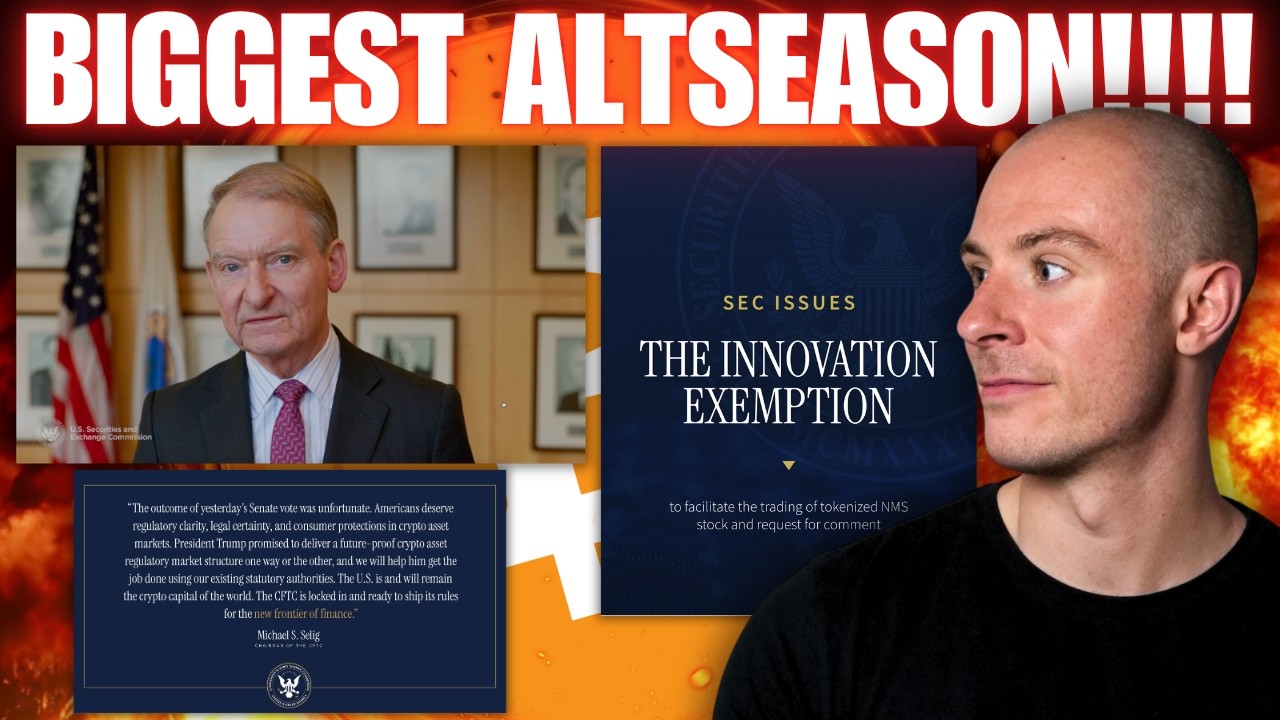
The SEC Just Confirmed The Greatest ALTSEASON Of Out Lifetimes!!! One More DIP Or FULLSEND….
SEC relief changes the regulatory path, not the entire market
The attributed announcement presents the SEC innovation exemption as a use of the agency’s existing statutory authority after the legislative route stalled. That makes it a potentially important administrative response to the continuing market structure dispute, but temporary relief is not equivalent to comprehensive legislation.
Today’s SEC order grants two forms of temporary conditional exemptive relief. First, exempting certain trading venues from the definition of exchange under section 3A1 of the exchange act. and second exempting certain liquidity providers from the definition of dealer under section 3A5 of the exchange act.
The two components described in the remarks are limited and functional:
- Trading venues: Certain venues would receive conditional relief from treatment as an exchange under the cited provision.
- Liquidity providers: Certain providers would receive conditional relief from treatment as a dealer under the cited provision.
- Scope: The stated objective is to facilitate trading in certain tokenized securities, not to exempt the wider crypto market.
The transcript also refers to earlier interpretive work with the CFTC, but it supplies no corresponding CFTC rule or primary document. The development therefore should be read as an SEC initiative whose interaction with broader federal policy still requires documentary detail.
What the temporary exemptions are designed to address
Tokenized securities do not cease to involve securities law simply because ownership or trading records move onchain. The attributed remarks identify uncertainty about whether a venue qualifies as an exchange and whether a liquidity provider qualifies as a dealer. A conditional exchange exemption and dealer exemption could give selected participants a defined route to test the technology while remaining subject to whatever conditions appear in the underlying order.
Onchain trading of tokenized securities could provide vast benefits to investors in markets.
The word “conditional” matters. Without the primary text, investors should not assume that every venue, tokenized instrument, protocol, or service provider is covered. The announcement, as supplied, leaves several practical questions unanswered:
- Eligibility: Which venues and liquidity providers can rely on the relief?
- Asset coverage: Which forms of tokenized stocks or other securities qualify?
- Compliance: What investor protection, custody, reporting, and operational conditions apply?
- Duration: How long does the temporary relief remain available?
- Infrastructure: Which networks and settlement arrangements meet the required standard?
Those details will determine whether the measure supports a small controlled pathway or a broader competitive market. The earlier emergence of narrower SEC relief as an alternative to legislation provides relevant context, but it does not answer the implementation questions.
Tokenization can create network use without guaranteeing token value
The strongest investment thesis attached to the announcement is that institutions must acquire native tokens to use public blockchains. That can be true in architectures where a native asset pays transaction fees, secures the network, or supports other operational functions. It is not a universal conclusion about every token or every tokenization model.
Demand depends on the design of the chosen network and the route through which an institution accesses it. Fees may be abstracted from end users, paid by an intermediary, minimized through batching, or small relative to the value transferred. A growth in tokenized asset volume can therefore coexist with modest native-token expenditure.
- Positive transmission: More settlement activity may increase demand for block space, security, collateral, or network services.
- Weak transmission: Low fees and efficient transaction design may limit the amount of native tokens required.
- Indirect transmission: Institutions may use managed infrastructure without holding the native asset directly.
- Competitive pressure: Activity can move among networks when cost, compliance, or operational requirements change.
Our analysis therefore separates adoption of tokenized securities from valuation of individual crypto assets. Previous coverage of Ethereum and Solana as possible tokenized market rails illustrates that several networks can compete for the same institutional use case.
The altcoin cycle claim remains a speculative leap
The source material couples the regulatory announcement with a highly bullish forecast for altcoins. That forecast is opinion, not an outcome established by the SEC action. It also depends heavily on an anticipated decline in Bitcoin dominance, which measures Bitcoin’s share of the broader crypto market rather than regulatory adoption itself.
Bitcoin dominance is setting up a big continuation pattern to the downside where it will hit 21% eventually.
The 21% projection is the source commentator’s forecast. No supporting chart data, timeframe, or independently verified model was supplied. Even if Bitcoin dominance falls, the move could reflect several different combinations of prices and capital flows. It does not establish that all altcoins will appreciate, that gains will be evenly distributed, or that tokenization will be the cause.
A more defensible framework would look for confirmation across several channels:
- Regulatory confirmation: Publication of the order and its full conditions.
- Institutional participation: Named venues or issuers launching eligible products.
- Onchain evidence: Sustained settlement activity on identified networks.
- Token economics: Demonstrable demand for the relevant native assets.
- Market breadth: Capital participation extending beyond a small group of large assets.
Until those links become visible, the innovation exemption is best treated as a possible enabling condition, not proof of an imminent market-wide altcoin expansion.
Macro pressure still matters for Bitcoin and risk assets
The bullish tokenization thesis exists alongside a less comfortable macro thesis. The supplied commentary refers to rising yields, a strengthening dollar and tighter interest rates as risk-off forces, while acknowledging that crypto had resisted those pressures at the time of the source recording.
This could be the dip. Now I am personally looking for a bit more of a dip.
That is a personal market view, not a confirmed price signal. Regulatory progress can improve the long-term operating environment while financial conditions constrain near-term liquidity. Our prior analysis of Bitcoin under bond-yield and rate pressure reflects why these forces need to be considered together.
For investors, the central tension is straightforward: structural adoption can advance during periods when asset prices remain volatile. A tokenization catalyst does not eliminate leverage, valuation, liquidity, or execution risk. Nor does resilience over a short period prove that macro sensitivity has disappeared.
What this means
-
Regulatory access may be improving. The attributed SEC action targets two specific legal classifications that can obstruct onchain securities trading. If the final conditions are workable, selected firms could gain a clearer operating route.
-
Network winners are not yet identified. The supplied announcement names no blockchain. Any investment thesis must establish which infrastructure is selected and how actual usage affects its token economics.
-
An altcoin boom is not a regulatory conclusion. The relief may support experimentation, but market performance still depends on implementation, capital flows, Bitcoin, liquidity and broader risk conditions.
Bigger picture
The SEC initiative sits within a wider institutional search for compliant tokenization infrastructure. Recent AllinCrypto coverage has followed DTCC’s planned phased rollout on Stellar, a DTCC partnership focused on blockchain settlement controls, and UK Finance work that placed Hedera and Stellar in context.
Other supplied developments include a Hanwha Securities tokenization platform on Avalanche. Together, these examples show that tokenization is being explored across multiple institutional settings and chains. They do not establish that the SEC relief applies to those projects, but they demonstrate why competition over regulated market infrastructure matters.
We see the announcement as a potentially constructive bridge between legislative delay and practical experimentation. Its significance will ultimately be measured through the published legal conditions, eligible products, participating institutions and observable onchain use—not through the size of the initial market reaction.
Sources
This article is for informational purposes only and does not constitute financial advice.


Be the first to comment