



This is our fourth essay in a series about onchain markets. In our first post, we covered application controlled execution (ACE) and how it can create new ways for tokens to capture value. The second essay discussed adverse selection in DeFi and models for protecting against it. And the third essay touched on how various sectors of RWAs are going to come onchain.
Note, in this essay, we use “cryptoassets” to refer to native onchain assets such as BTC, ETH, SOL, and HYPE. We use “RWAs” to refer to assets that originate outside of crypto, including equities, bonds, commodities, currencies, and other traditional financial assets.
The earliest assets on blockchains were native cryptoassets like BTC, ETH, SOL, and now HYPE. And so – generally – all of the early DeFi primitives were built for these assets. These products included AMMs (Uniswap), vAMMs (Perpetual Protocol), CDP stablecoin products (Sky, FKA MakerDAO), synthetic assets (Synthetix), open-term variable-rate borrow/lend pools (Compound/Aave), and perps (dYdX). We believe these products worked relatively well because the underlying market had high volatility, lots of speculative trading, an overabundance of long-tail tokens, and permissionless access. For a bit of history, here’s what the total value locked in DeFi chart used to look like:
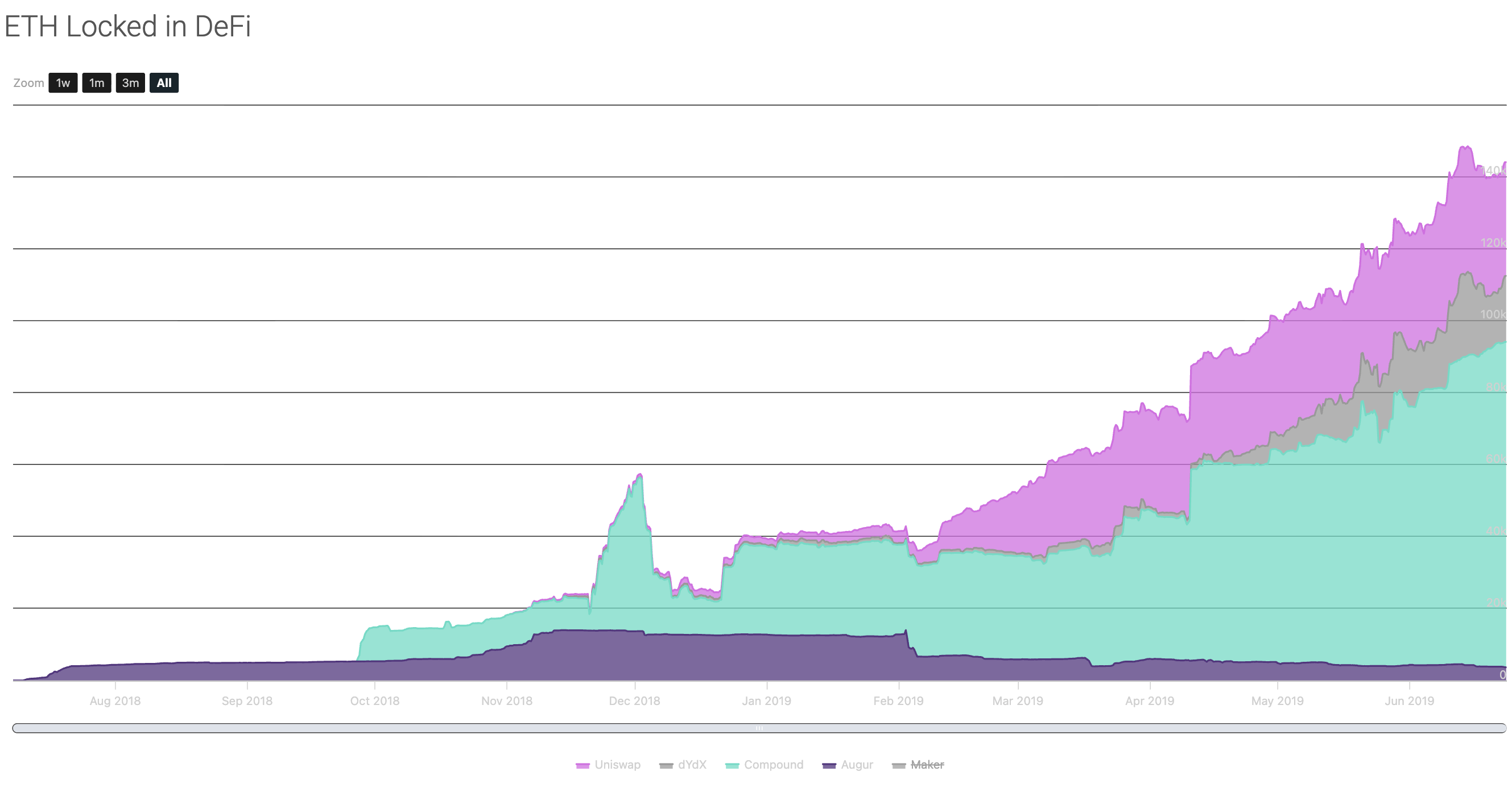

Source: https://mikemcdonald.github.io/eth-defi/
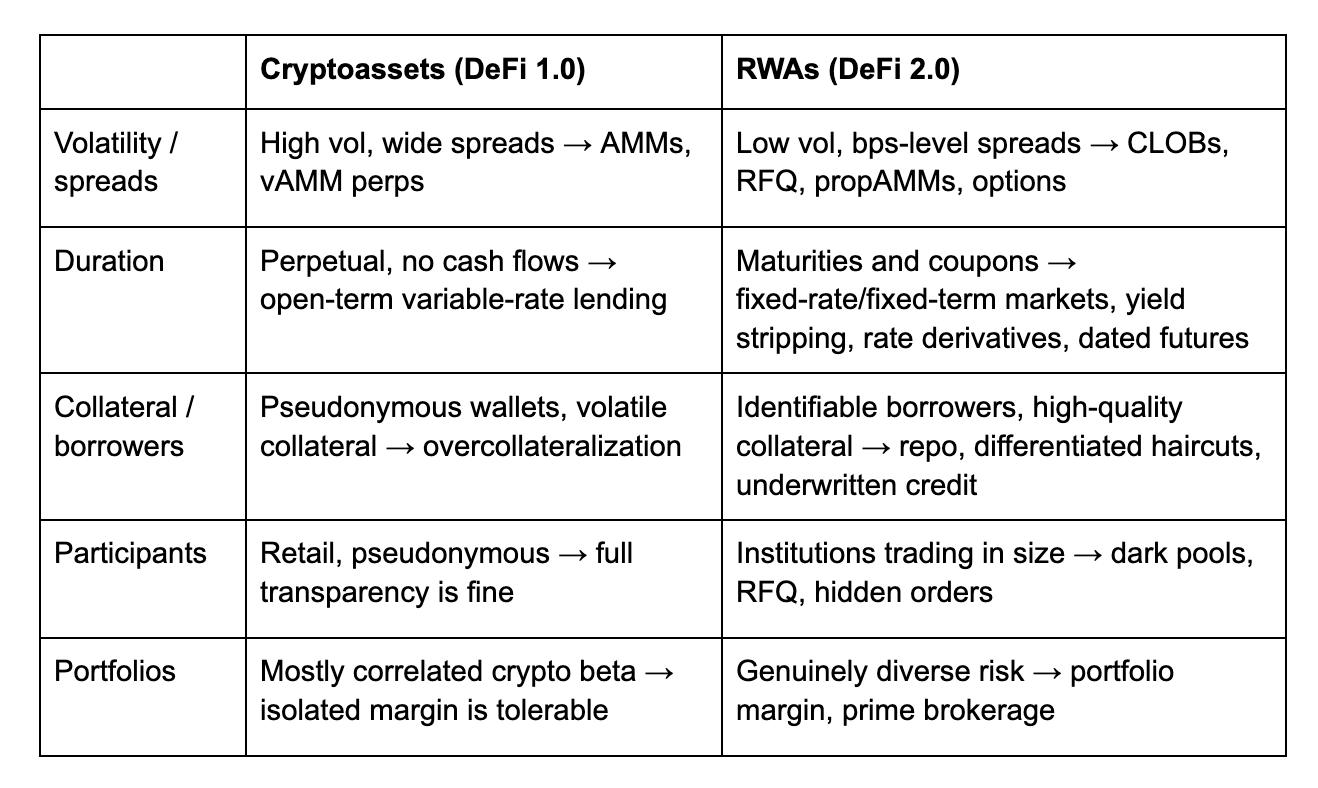
The asset mix and user bases are now changing, though. Treasuries, equities, corporate credit, commodities, FX, and other RWAs are moving onchain. These assets often have lower volatility and tighter spreads, defined maturities and cash flows, make for better collateral, have more identifiable borrowers, and large institutional participants trading them. As a result, a different set of primitives starts to matter: CLOBs, RFQ, propAMMs, fixed-rate borrow/lend, vaults, rate derivatives, repo, dark pools, portfolio margin, options, and dated futures. We call these DeFi 2.0 primitives.
Many of these primitives have existed in DeFi for years. In a lot of cases, DeFi built them before the right assets were even onchain.
The context for this essay is that most RWA discussions have focused on tokenizing assets and moving them onto blockchains, including our recent essay. However, few have addressed how the underlying market structure and primitives will evolve as these new (old) assets arrive.
Building new underlying primitives should create lots of downstream opportunities for investors, in the sense that value will likely be captured up and down the stack (from the general purpose chains themselves, to the core primitives being built out now, to the front ends and order flow engines that own the customer relationship with end users).
Looking backwards at DeFi 1.0
From a tradfi perspective, early DeFi primitives look wildly inefficient. AMMs are less capital-efficient than professional MMs, overcollateralized CDPs are an expensive way to go margin long, and variable-rate lending makes it impossible to project cost of capital while globalizing risk into a few pools. But what’s not talked about enough is that these primitives were built for cryptoassets.
For newly launched cryptoassets, the main challenge was getting any liquidity, not optimizing execution price. The key advantage of AMMs is that anyone can create a market quickly and get some price discovery.
Pseudonymous borrowers on permissionless systems don’t have balance sheets or credit histories, so these protocols relied on overcollateralization instead of the systematic credit checks that would have gotten them materially better terms. In practice, this didn’t matter much since it is widely understood that most users of borrow/lend protocols weren’t borrowing to finance anything; they were borrowing to lever up on volatile cryptoassets or accessing capital without selling a cryptoasset. For these users, variable rates were fine, because a few hundred basis points of extra cost is irrelevant when the underlying asset can move 100% in a month.
Perps followed the same logic. Cryptoassets don’t mature, carry no legal rights, and produce no cash flows, so traders generally just want ongoing leveraged exposure to price movements. Removing expiry and allowing for synthetic derivatives made the product simpler and better matched to the underlying asset. And once again, variable funding rates aren’t a real impediment for someone running 2x long a volatile cryptoasset with a short time horizon.
DeFi 2.0 Features
DeFi 1.0 wasn’t just an early version of tradfi. It was built for a specific set of native cryptoassets and users. As the assets change, the primitives will change too.
There’s a certain set of characteristics that makes RWAs markedly different from the cryptoassets this industry grew up on. Those DeFi 2.0 features (or bugs, depending on who you ask) are:
- Lower volatility and tighter spreads
- Duration and predictable cash flows
- Better collateral and identifiable borrowers
- Larger institutional market participants
- More heterogeneous portfolios and risk exposures
Lower volatility and tighter spreads
AMMs were great for bootstrapping liquidity in long-tail cryptoassets. If you’re launching a new token on Pump.fun or raising through MetaDAO, the first problem is simply getting a market up and running. That’s not really a problem for Treasuries, AAPL stock, or EUR/USD. Those markets already have professional MMs, deep liquidity, lower volatility, and extremely tight spreads. For these assets, execution quality actually moves the needle.
When someone buys a memecoin, all else equal they won’t care about basis points. A trader can pay 2% slippage and flip the token an hour later for a 30% profit or loss without noticing execution costs. But for a Treasury or FX trade, 10 basis points might be the whole economics of the trade.
In these cases, CLOBs, RFQ systems, and propAMMs are a better fit. Professional MMs can price inventory based on outside prices, volatility, order flow, and their own risk limits, instead of just spreading liquidity along an AMM curve. These primitives have been in DeFi for years, but they matter much more for assets where small differences in execution have a big impact.
It’s also a lot easier to bootstrap MMs for these assets for a few reasons. First, there’s already a vast industry of MMs actively trading them, and a bunch of traditional venues where they can hedge and offset risk. Second, more attractive and liquid assets naturally create more demand from retail, which gives MMs more reason to provide liquidity in those names. Third, gap risk is a lot lower than it is for memecoins and high-beta cryptoassets, so in environments where latency is marginally higher on public chains, MMs are less likely to get caught offsides.
Lower-volatility assets also make some derivatives more useful. Ribbon, Katana, Friktion, and others built automated covered-call and put-selling products years ago. Some got a bit of traction, but the assets were often a poor fit. Selling covered calls works for equities that might go up 10% in a year and offer the holder some additional yield. It makes less sense on SOL, which can move 50% in a month, because holders could forgo a ton of upside for probably not enough yield (we understand the market will price this, but crypto options markets have historically been much less liquid than equities).
A big reason crypto options have been somewhat unnecessary, again, is the nature of the assets themselves. If you want a ton of skew and dopamine trading crypto, you can go 3x long a HYPE perp, which is a delta one derivative that’s good enough from a risk/reward and entertainment perspective. You don’t need options, which inherently require taking a view on timing and imbue a risk of total loss of principal.
As equities, indices, commodities, currencies, and other lower-volatility RWAs move onchain, options could actually take off in a meaningful way. A liquid options market opens the door for primitives like covered calls, collars, downside protection, volatility trading, and structured yield. We believe that some DeFi infrastructure built years ago, like options vaults, wasn’t wrong, it was just early for the assets it was meant to serve.
Lastly, volatility has a meaningful impact on credit markets. When the collateral itself can move 10% in a day, lenders need much larger buffers, which is why early crypto lending markets often settled around ~66% LTVs, with extremely harsh liquidation penalties. It can also explain why variable-rate borrowing was sufficient for cryptoasset-focused DeFi. If Alice is borrowing USDC against SOL to lever up, she probably doesn’t care whether her annualized borrowing cost moves from 7% to 10% overnight when the value of her collateral can move more than that in a single day.
Duration and predictable cash flows
Most cryptoassets are perpetual. There is no concept of a maturity date for BTC, ETH, SOL, or HYPE, and this shaped both lending and derivatives markets in DeFi. Aave and Compound primarily offer open-term, variable-rate loans, which work well for traders who may not know how long they will hold a position and for whom borrowing cost is secondary to the volatility of the underlying.
We wrote about the opportunity for fixed rate markets in DeFi all the way back in 2021. Admittedly we were early, and again the primary reason was the nature of the assets themselves.
A company borrowing $100 million for three years to finance an acquisition or capex program needs to know whether its annual interest expense will be $5 million or $10 million. Similarly, an asset manager buying a bond at a 6% yield and financing it at 4% is underwriting a 2% spread; if its funding cost suddenly moves to 6%, the economics of the trade disappear. As such, certainty matters a lot for these groups.
Additionally, open-term lending has a structural inefficiency. Lenders need to be able to withdraw at any time, but borrowers want to keep their loans open for as long as they desire. As a result, protocols’ risk management framework generally need an extra liquidity buffer so lenders can exit. As a note, this is why open-term borrow/lend pools in DeFi have such aggressive utilization curves (they want to protect against an entire pool being borrowed). Some lender capital sits unused, creating a gap between what borrowers pay and what lenders receive, even before the take rates that protocols like Aave and Kamino charge.
Fixed-rate, fixed-term markets are one way to solve this. Instead of letting lenders pull capital whenever they want, borrowers and lenders commit to specific maturities. That means more of the lender’s capital actually stays deployed, while the borrower knows its exact financing cost. The tradeoff is that liquidity gets split across maturities. A three-month loan and a one-year loan are different markets (but that’s also how you start getting real price discovery across time and, eventually, a yield curve).
Morpho Midnight is one example. It creates fixed-term markets where rates are set through bids and offers at specific maturities, and lenders can trade positions before expiry. If you eventually have liquid three-month, six-month, one-year, and multi-year markets, you can start to answer what money costs across points in time. From there, it becomes much easier to price loans, bonds, forwards, swaps, and basically anything else that depends on duration.
Pendle and Exponent are other examples of primitives whose TAM changes as the asset base expands. These products separate a yield-bearing asset into principal and yield, allowing users to trade fixed versus floating returns. Historically, the universe of interesting onchain yields was relatively narrow: staking, borrow/lend rates, perp funding rates, and eventually protocol points. In fact, one of the most compelling uses of yield tokens became levered exposure to points programs run by DeFi protocols.
With RWAs, the set of yields expands to Treasury rates, credit spreads, dividends, floating-rate loans, and other contractual cash flows. Yield stripping goes from being a way to leverage protocol incentives to a generic tool for separating and trading principal and income, and that’s why we’re quite excited about this primitive.
The same idea applies to rate derivatives. Pendle’s Boros lets users trade fixed versus floating perp funding across defined maturities. Today, that underlying rate is still crypto-native. But the structure gets a lot more interesting once the thing being hedged is a Treasury rate, a corporate borrowing cost, or some other real-world benchmark.
The same is true for dated futures and forwards. A company hedging an FX payment six months out doesn’t really want a perpetual instrument. Neither does a producer locking in a commodity price for delivery, or a bond investor hedging duration. Those exposures have a date attached to them, and the hedge should too.
Lastly, we believe vaults should also become much more useful as the set of assets and strategies in DeFi expands. Early DeFi vaults mostly automated crypto-native strategies like yield farming, looping, LP’ing, and selling options on volatile tokens. With RWAs, vaults can package Treasury ladders, covered calls on equities, diversified credit portfolios, basis trades, or different combinations of fixed and floating-rate exposure. The primitive is not new, but the set of strategies that can sit inside it can get much larger.
Better collateral and identifiable borrowers
Crypto lending started from the assumption that the protocol knew almost nothing about the borrower. An Ethereum or Solana wallet has no income statement, credit score, or legal obligation that a smart contract can easily enforce. Overcollateralization solved this by making identity largely irrelevant: if a user wanted to borrow $100 of USDC against ETH, Maker required $150 of ETH, and a keeper would liquidate the user if the position became unsafe.
That has appeared to be sufficient for anonymous borrowers using volatile collateral, but it’s much less efficient for many RWAs. A Treasury bill is not ETH. Its volatility is lower, there is deep external liquidity, and lenders can mark its value with much more confidence. Requiring $150 of Treasuries to borrow $100 just because crypto lending evolved that way throws away much of the benefit of high-quality collateral. For Treasuries and other high-quality collateral, 66% LTVs obviously don’t make any sense.
RWAs, and eventually better identity and legal frameworks, also make the borrower itself underwritable. With a real company or fund, you can look at the balance sheet, cash flows, management team, contracts, and liabilities. If that borrower is identifiable and the collateral is legally enforceable, the lender doesn’t have to rely entirely on the value of the collateral. We’re also starting to see protocols connect repayment behavior to offchain credit profiles and penalize borrowers who default onchain. Maple is already doing a version of this today, underwriting institutional borrowers rather than treating them like anonymous wallets.
Early undercollateralized loan networks in DeFi were fundamentally broken because the only borrowers were the ones who couldn’t get loans on the traditional side. For example, Goldfinch lent capital to SMEs in emerging markets who weren’t creditworthy enough (or well placed geographically) to get good paper. That naturally created a lot of adverse selection. Once regulatory frameworks in the U.S. open up for real businesses to get permissionless credit (accounting for KYC/AML), we imagine this market will open up dramatically and provide retail users all around the world with the opportunity for good risk-adjusted lending returns.
Larger institutional market participants
RWAs also change who is trading and the size of trades. Blockchain transparency is usually a feature, but it gets complicated when traders are executing in size. For a $20k BTC buy, transparency doesn’t really matter. But when an asset manager needs to buy $100 million of an equity or bond, showing the full order can be very expensive.
Tradfi markets have spent decades building ways for institutions to trade size without showing their hand. That’s why block trading, RFQs, hidden orders, crossing networks, and dark pools exist in the first place. DeFi is starting to build versions of the same thing. Renegade uses MPC and ZKPs to match orders privately and settle them onchain, while Silhouette is building a dark pool on Hyperliquid. Our portfolio company Zama is taking a more modular approach, building FHE primitives that applications on general-purpose chains can use to add confidentiality directly.
The key difference is between hiding settlement and hiding trading intent. Certain Institutions may be okay with their trades being shown after the fact, but during execution it is safe to say that most, if not all institutions, will seek confidentiality to prevent market participants from front running their positions.
More heterogeneous portfolios and risk exposures
We spoke about the lack of capital efficiency for DeFi derivatives a few years ago at our summit. The TL;DR was that protocols had isolated margin requirements, so there was room for a DeFi-native prime broker to both extend credit against positions and net a trader’s overall exposure across protocols to reduce their margining requirements.
As asset classes and positions get larger and more diversified, this becomes even more important. If a Treasury position offsets a rate future, the system should recognize the hedge. Or if Alice is long SPY and short BTC in equal size, maybe she should get more favorable margin requirements. We’re starting to see individual protocols adopt portfolio margining, but we haven’t seen a full-scale DeFi prime broker just yet.
Our portfolio company Project 0 is beginning to build this on Solana, allowing collateral across several DeFi venues to sit within a unified margin and credit system. Today that mostly improves capital efficiency across crypto markets. But the primitive becomes far more valuable when users can net Treasury exposure against rate futures, equities against options, commodities against dated futures, and FX exposures against forwards.
We believe this is another example of RWAs dramatically expanding the TAM for an existing DeFi primitive. Portfolio margin is useful when a trader has multiple crypto positions, but most cryptoassets still share a lot of the same underlying beta. The value of portfolio margin gets much larger when portfolios contain genuinely different sources of risk across equities, credit, rates, commodities, FX, and crypto.
As more assets come onchain, we imagine users will maintain one balance sheet across all asset classes. They wouldn’t need to pre-fund every venue independently, and third-party primes will aggregate and net their exposure across every asset class.
Who captures the value?
Most importantly, RWAs should expand the economic surface area of DeFi, by a lot.
The obvious TAM expansion is simply the size of the underlying asset base. Cryptoassets represent a relatively small fraction of global financial assets. Equities, sovereign and corporate debt, commodities, currencies, and other RWAs are orders of magnitude larger. If even a small percentage of those assets and their associated trading activity move onchain, the opportunity set for DeFi protocols expands dramatically.
But there’s another dimension to the TAM expansion that we think is just as important: RWAs generally require more financial infrastructure around each dollar of assets.
A memecoin might need a spot market, a perp market, and maybe a borrow/lend pool (if there’s even any collateral value or shorting interest). A Treasury, on the other hand, can trade in spot markets, finance itself through repo, serve as collateral, sit inside a fixed-income portfolio, be hedged with futures or rate derivatives, and slot into structured products. And a single-name equity can support spot trading, securities lending, options, forwards, covered calls, portfolio margin, and index products.
So the opportunity isn’t just that there will be more assets onchain. There should also be significantly more financial activity around each dollar of assets. And we think value can accrue throughout this stack.
At the bottom are the general-purpose L1s and L2s themselves. More sophisticated financial markets require more transactions: MMs updating quotes, traders placing and cancelling orders, credit positions being financed and refinanced, options settling, collateral moving between venues, and portfolios rebalancing. Eventually, blockchains will be updating large amounts of financial state continuously. If (we would argue when) blockchains become the settlement and execution layer for this activity, L1s and L2s can monetize a much larger and more persistent source of blockspace demand than crypto speculation alone.
The next layer is the core financial primitives. Exchanges monetize trading activity, lending protocols capture a portion of credit spreads, rate markets monetize duration and yield trading, and options and structured-product protocols take fees on risk transfer. In many cases, the protocols already exist and the TAM underneath them is simply getting much larger. Pendle doesn’t need to remain primarily a market for staking yield and points, Boros doesn’t need to remain primarily a market for perp funding, and an options protocol doesn’t need to remain a venue for trading BTC and ETH volatility. They can grow out of that and capture way more value.
There’s also a lot of potential value in aggregation. As more venues and asset classes move onchain, users aren’t going to want to manage financing, collateral, and execution separately across a dozen different protocols. That creates room for DeFi-native prime brokers that can look across a user’s entire portfolio, figure out where capital should sit, how much leverage makes sense, and where trades should execute. That role is already incredibly valuable in tradfi, and it should matter even more onchain as markets become more fragmented and composable.
And finally, there’s the application and order-flow layer. The app that owns the customer ultimately gets to decide where a lot of that activity goes. It chooses where trades get routed, where collateral sits, which credit markets users borrow from, and which products they see in the first place. We wrote about this in our essay on publisher-exchanges. If you control the order flow, you can route it toward the venues and liquidity providers that offer the best economics.
This is why we think the RWA opportunity extends beyond simply putting assets onchain. As more assets move onchain, they create demand for new financial infrastructure around them, including trading, credit, derivatives, and risk management primitives.
DeFi 2.0 – Assets are catching up to the primitives
DeFi has already tried most of the primitives that RWAs need: order books, RFQ, options, structured products, fixed-term lending, yield stripping, rate derivatives, dark pools, and portfolio margin. We believe the problem was that they were built for the wrong type of assets (cryptoassets).
Friktion built a covered-call vault, but the underlyings were just volatile cryptoassets. Pendle separated principal and yield, but the main yield to trade was protocol points. Boros launched rate derivatives, but the underlying rate is still perp funding. And Project 0 unified margin, but most positions are still just different flavors of crypto exposure.
The core primitives that have defined DeFi so far – AMMs, perps, open-term variable-rate lending, vAMMs, and overcollateralized stablecoins – emerged because they fit the characteristics of existing cryptoassets. Importantly, these products are not going away. AMMs will continue to serve long-tail assets, perps will remain the primary tool for crypto speculation, and pooled over-collateralized variable-rate lending will still be the best option for pseudonymous borrowers who just want to get leverage on their existing cryptoassets. But we need new primitives to support where the industry is heading, and it’s likely heading towards RWAs.
The first phase of RWAs has largely been about getting assets onchain and tokenizing them. The next phase will be making them useful once they’re there.
On both the liquid and venture sides of our business, we’re making the bet of a lifetime that there will be meaningful investable opportunities across DeFi 2.0 primitives. We believe these financial building blocks are going to power the next generation of assets that come onchain, assets that people all around the world are desperate to hold.
In this post, we discussed how DeFi primitives are going to evolve to support RWAs. In our next essay on market structure, we’re going to examine why RWAs need DeFi in the first place.



Be the first to comment