



QNT moved above $100 after fresh UK and U.S. banking milestones sharpened an already rising market narrative, though the announcements cannot account for the entire advance.
Key Takeaways
- QNT moved above $100 in a sharp rally.
- Most of the weekly rise came recently.
- UK banks completed transactions using Quant infrastructure.
- The U.S. project adds longer-term potential.
QNT traded above $100 at the time of writing, up about 42% over 24 hours and 63% across seven days, according to CoinMarketCap data. The comparison matters: the larger part of the weekly advance arrived in the latest day, when Quant-related announcements reached the market.
The news may have accelerated the rally. It did not start it from zero.
September 24 brought two meaningful developments: live tokenized-deposit transactions in the UK on a platform built by Quant, and a U.S. selection by The Clearing House. Their timing makes them plausible accelerants for QNT’s sharpest move.
That is not the same as proving they caused the entire surge. QNT had already risen from a $60-$65 base toward the low $70s before those releases, while a wider recovery in crypto risk appetite was also lifting interest in altcoins. The announcements met an existing bid; they may have given it a more concrete reason to accelerate.
In other words, the market can be reacting to the details without every percentage point being attributable to them. No public trading data can split the move precisely between the news, broader market conditions and momentum buying.
What happened in the UK
UK Finance said Barclays, HSBC UK, Lloyds Banking Group, Monzo, Nationwide, NatWest and Santander completed the first retail transactions using tokenized sterling deposits. Quant built the shared platform used by the Great British Tokenised Deposit initiative.
The tests were specific rather than theoretical: two remortgage completions and a consumer marketplace payment between a buyer and a private seller. In the mortgage cases, funds were locked then automatically released when completion conditions were met. In the marketplace example, money moved only after the goods changed hands.
That gives programmable deposits a practical use case. The money remains a deposit at a regulated commercial bank, but its release can follow agreed conditions. For remortgages, that could reduce friction at completion. For a private sale, it could reduce the risk of one party paying or handing over goods first.
The distinction matters: Quant built the platform, while the banks performed the transactions. These are completed live transactions, not a slide-deck demonstration. They do not, however, show that every participating bank has launched a public product or that the system is processing payments at scale.
Why the U.S. announcement adds a second layer
On the same day, The Clearing House selected Quant for its On-Chain Money Initiative. Quant is expected to supply interoperability, orchestration and transaction-management capabilities for a network intended to clear and settle tokenized-deposit transactions.
The proposal is designed to connect with established U.S. payment rails, including RTP and CHIPS. That is why the selection stands out: the project aims to add programmability to commercial-bank money inside existing infrastructure, rather than build a separate crypto payment network.
It is still a future project. The network is expected to be available to participating institutions in the first half of 2027. The Clearing House says its existing networks clear and settle more than $2 trillion a day, but that measures their current overall activity, not expected tokenized-deposit volumes, Quant revenue or demand for QNT.
Quant is part of a broader push by banks to make commercial-bank money usable around the clock. Coindoo recently covered DBS and Citi’s tokenized USD payment test, another example of institutions exploring this direction.
What is being priced in
That gap explains both the enthusiasm and the risk. The UK result supplies evidence of execution; the U.S. initiative adds longer-term optionality. Neither release is a revenue disclosure, and neither says banks will buy QNT as part of their use of the technology.
After the vertical move, the chart has a simple question
The daily chart shows QNT racing from the low $70s to above $100 in a few sessions on its strongest recent volume. Its daily RSI is near 84, a sign of intense momentum and of a move that is stretched in the short term. That does not automatically call a top; it does mean price has less nearby support than it had before the breakout.
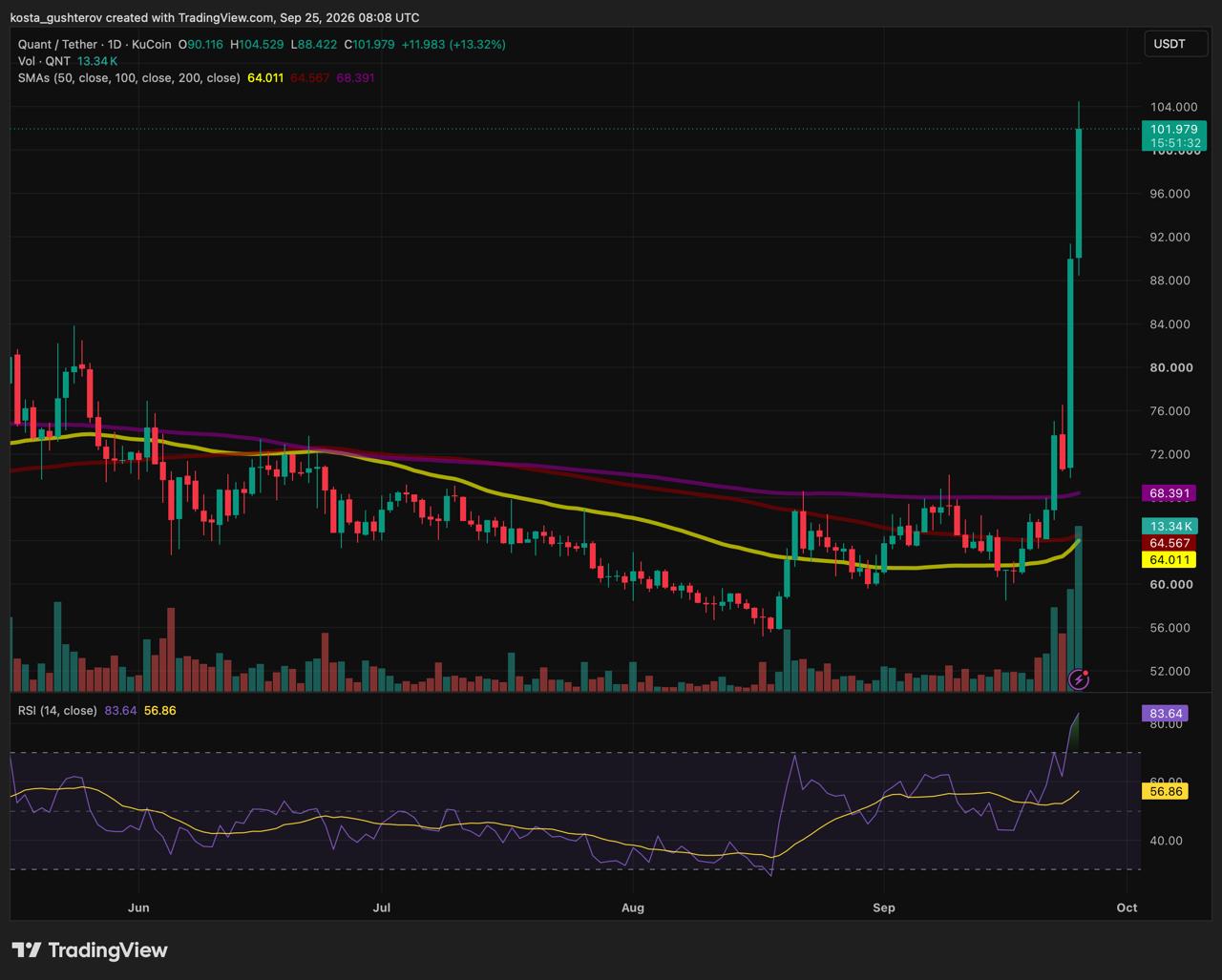
The recent high around $104-$105 is the first resistance area. Above it, the next zone to watch sits near $108-$111, where previous rallies stalled in late 2025.
On a pullback, $88-$90 is the first area to watch. Holding it would show that buyers are willing to defend part of the fast advance. A deeper decline toward $72 – $76 would retest the zone QNT cleared before it turned vertical; losing that range would do more damage to the breakout structure.
Below it sits the 200-day moving average near $68 – $69, now the clearer structural line. The 50-day and 100-day averages converge around $64–$65, but they come into focus only if QNT first gives up the 200-day area.
What would turn a market reaction into a longer story?
UK Finance expects more pilots in coming months, including work connecting tokenized customer money with digital assets for settlement. The Clearing House initiative has a longer timetable, with initial availability planned for 2027.
For now, QNT’s move reflects a mixture of a pre-existing market recovery, strong momentum and news that made Quant’s bank-infrastructure case more tangible. The next test is repeatability: more transactions, broader bank participation and clearer commercial disclosures. Those would say more about the durability of the story than another single-day price spike.
This article is provided for informational purposes only and does not constitute financial or investment advice. Cryptocurrency prices are volatile, and technical levels can change quickly.

Alex is Editor-in-Chief of Coindoo and co-founder of Millennial Media Group, with nearly a decade of experience covering financial markets – crypto first, then everything else.
It started in 2016 with Bitcoin. Like most people at the time, he didn’t fully understand it – so he kept digging. Blockchain, tokenomics, the projects, the cycles. That curiosity never stopped, and eventually pulled him into traditional markets too: equities, commodities, macro. Not because he left crypto behind, but because you can’t properly understand one without the other.
What drives him is straightforward: he wants to know why something is happening, not just that it’s happening. Most market coverage stops at the headline – price up, price down, here’s a chart. Alex finds that kind of reporting actively unhelpful. If you walk away from an article without understanding the mechanism behind the move, what did you actually learn?
He holds a degree in Tourism from New Bulgarian University – not the most obvious path into financial markets, but markets have a way of pulling in people who are simply too curious to stay out. He has authored over 200 in-depth analyses and more than 10,000 articles across crypto and traditional finance. He still thinks every day in markets teaches him something new. That’s probably why he hasn’t stopped.



Be the first to comment