



In his September 27 essay, “The cryptographic world computer”, Vitalik Buterin describes Ethereum’s 2030 endpoint as a hybrid system rather than a larger version of today’s chain. Blockchain consensus would sit alongside cryptographic privacy and verification, while powerful decentralised components operate away from the base chain.
The shift would redefine Ethereum’s “world computer” ambition. Instead of requiring every participant to download and re-execute all computation, specialised computers would perform workloads and produce compact cryptographic proofs for others to check. Data-availability sampling and SNARK verification would support that model, allowing the network to establish that computation was performed correctly without making every verifier perform it again.
Proof systems and data availability are intended to weaken the link between the amount of computation being verified and the cost borne by verifiers. The unresolved issue is whether Ethereum can distribute trust across specialised infrastructure without concentrating operational control there, particularly while current rollups still rely heavily on centralised sequencers.

Proof-based verification over universal execution
In Buterin’s model, Ethereum moves away from requiring every node to download and re-execute transactions. Data-availability sampling and SNARK verification would allow specialized computers to execute workloads and produce compact cryptographic proofs that other participants can check.
The result is a different division of labour, not an abandonment of broad participation. Verification remains accessible without universal duplication of execution because participants need to establish data availability and proof validity, rather than reprocess the full workload. Blockchain consensus, privacy and cryptographic verification remain the architecture’s trust anchor for powerful off-chain components; Ethereum’s base layer settles the conditions under which their claims can be accepted.
That direction is already visible in Ethereum.org’s scaling roadmap: rollups have reduced costs through blob storage, and future data-availability sampling is intended to let validators check small portions of large datasets instead of downloading everything. The 2030 vision extends an architecture Ethereum is already pursuing, though Buterin says efficient, safe proof generation remains difficult and that managing and parallelizing access to very large state may be the more complex system-level problem.
A modular world computer
The technologies Buterin associates with the period after Ethereum’s planned Hegotá upgrade show how expansive this model is meant to be. He identifies recursive STARKs, automated formal verification, optimised proof-of-stake consensus, multi-party block construction and quantum-safe cryptography as defining elements of that post-Hegotá environment.
Recursive STARKs are central to the logic of compact verification. If proofs can themselves be aggregated and verified through further proofs, a verifier can assess a large body of computation through a much smaller object. In practical architectural terms, that creates a path for Ethereum to secure more computation than its individual nodes could feasibly run in full.
The other items on Buterin’s list point to a broader engineering programme rather than a single scaling upgrade. Formal verification concerns confidence in the systems producing and checking these cryptographic claims. Optimised proof-of-stake consensus concerns the network coordinating around them. Multi-party block construction addresses a part of the transaction-production pipeline where control can otherwise be concentrated, while quantum-safe cryptography speaks to the durability of the security assumptions behind the design.
That combination is why the phrase “cryptographic world computer” is more precise than a generic claim that Ethereum will become faster. A monolithic chain makes one execution environment the centre of the system. Buterin’s endpoint envisages a network in which specialised layers and machines can undertake differentiated tasks, provided their outputs can be verified under Ethereum’s security framework.
The modular design also makes data availability a first-order concern. A proof may attest that a computation produced a result correctly, but users and other systems may still need access to the underlying data needed to reconstruct or exit from a system. Ethereum’s roadmap places data-availability sampling at the centre of making that access verifiable at scale, rather than treating it as an auxiliary storage problem.

Privacy enters the verification architecture
Privacy is not presented as a separate application feature in Buterin’s account. He places cryptographic privacy alongside consensus and verification, making it a property Ethereum wants its underlying architecture to support.
The roadmap gives that objective several forms: shielded ETH and ERC-20 transfers, private proving, zkVM-based execution and research into fully homomorphic encryption, which would enable computation over encrypted data. Ethereum’s privacy roadmap therefore points to a system that can establish whether rules were followed without requiring every observer to see the underlying information.
Verification still has to be efficient and credible. Buterin’s framing leaves privacy-preserving systems carrying the added cost and complexity of proof generation, while the same infrastructure is expected to support scalable computation, private activity and decentralised participation. That combination increases the risk of a bottleneck at one layer.
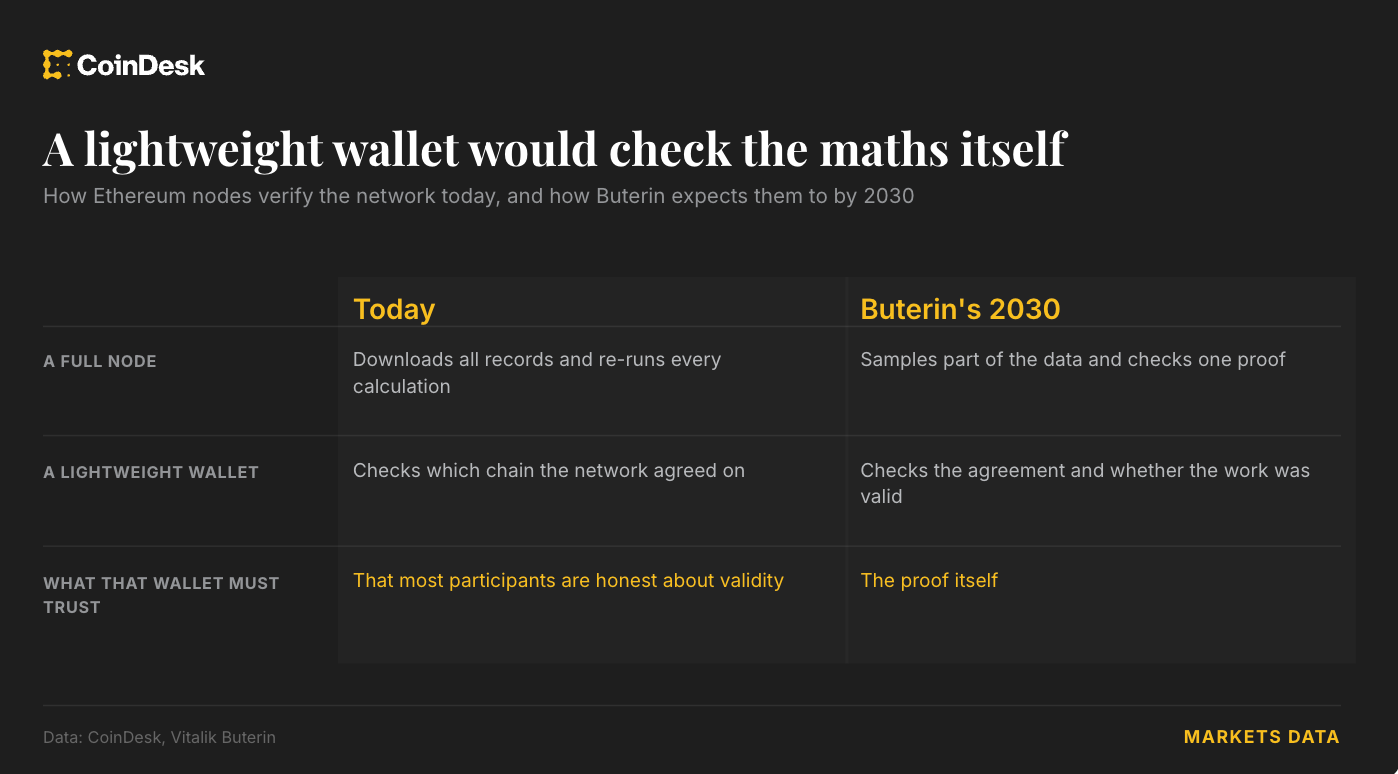
Illustration explaining how a lightweight wallet could verify Ethereum’s cryptographic proofs without repeating all network computations. — Source: CoinDesk
State growth and sequencer control
In Buterin’s account, efficient and safe proofs remain difficult, while managing and parallelising access to very large state may be the more systemically complex challenge. Proof-based verification does not remove the need to maintain and access the state required by computation. As applications and rollups create more activity, safely organising that state and allowing concurrent access without breaking the system’s guarantees becomes a deeper design problem.
Rollups are a major route for Ethereum scaling, and blob storage has reduced their costs. Yet current rollups still rely heavily on centralised sequencers, according to the roadmap materials cited by Buterin.
Ethereum Foundation roadmap materials caution that timelines are targets rather than guarantees. The proposed 2030 architecture would shift Ethereum from universal transaction re-execution towards specialised computation verified through compact proofs.
Disclaimer: This article is provided for informational purposes only. It is not offered or intended to be used as legal, tax, investment, financial, or other advice.




Be the first to comment