



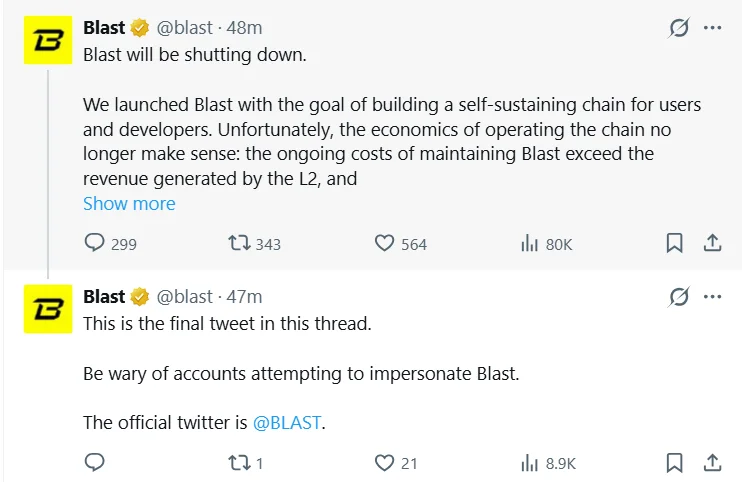
Blast is shutting down its Layer 2 network, ending a project that once pitched unusually high yields and a distinct approach to crypto payments. The reason is blunt: operating costs now exceed L2 revenue, and Blast says it sees no credible path to economic sustainability.
The project is asking users to move their assets back to Ethereum mainnet. Not exactly the ending anyone expected when Blast was promoting ways to earn more than 50% APY on USD by holding BLAST.
Blast Shutdown Puts User Withdrawals First
The shutdown process won’t be instant. It said it will first withdraw its Lido assets, a process expected to take roughly one week.
During that period, withdrawals will temporarily remain unavailable. Once complete, the withdrawal delay will be reduced to 24 hours. After that, users can withdraw through the normal Blast interface.

October 26 Deadline Brings Another Change
There’s a hard date to remember. Users have until October 26, 2026, to withdraw through the standard Blast interface.
After October 26, assets will still be withdrawable, but users will need to interact directly with Blast bridge contracts on Ethereum L1. It said it will publish detailed instructions before that deadline. The project is strongly encouraging users to move funds before then.
Its Economics Finally Become Impossible To Ignore
Blast said its original goal was to build a self-sustaining chain for users and developers. That plan has now run into the basic problem every network eventually has to confront: the bills have to make sense.
According to Blast, ongoing maintenance costs exceed the revenue generated by the L2.
So the network is winding down. For users, the immediate priority is straightforward. Withdraw assets to Ethereum mainnet before October 26. The crypto project’s shutdown is now moving from announcement to execution, and the withdrawal timeline is the part users can’t afford to ignore.
Was this writing helpful?
Story Ends Here
Trust with CoinPedia:
CoinPedia has been delivering accurate and timely cryptocurrency and blockchain updates since 2017. All content is created by our expert panel of analysts and journalists, following strict Editorial Guidelines based on E-E-A-T (Experience, Expertise, Authoritativeness, Trustworthiness). Every article is fact-checked against reputable sources to ensure accuracy, transparency, and reliability. Our review policy guarantees unbiased evaluations when recommending exchanges, platforms, or tools. We strive to provide timely updates about everything crypto & blockchain, right from startups to industry majors.
Investment Disclaimer:
All opinions and insights shared represent the author’s own views on current market conditions. Please do your own research before making investment decisions. Neither the writer nor the publication assumes responsibility for your financial choices.
Sponsored and Advertisements:
Sponsored content and affiliate links may appear on our site. Advertisements are marked clearly, and our editorial content remains entirely independent from our ad partners.
Read the Next News





Be the first to comment