



Key Takeaways
- Polymarket traders still see plenty of room to run, giving bitcoin a 39% chance of touching $100,000 before 2027.
- Kalshi is playing things closer to the vest, with its $86,240 forecast sitting not far above bitcoin’s current price.
- ChatGPT is the more optimistic of the two AI models at $94,000 by Dec. 31, while Claude lands at $91,500.
Bitcoin’s price barely moved Saturday, yet around it, a peculiar forecasting contest was cooking. Prediction-market traders have millions of dollars riding on where the cryptocurrency might travel before 2027, while two artificial intelligence (AI) heavyweights were also asked to forget the ranges and name one exact Dec. 31 bitcoin price.
The answers landed all over the board. Kalshi’s crowd stayed relatively close to home, Polymarket left the door open to another six-figure appearance, and both AI models envisioned a higher finish.
Friday’s Big Swing Goes Nowhere
The quiet followed a Friday session that briefly looked like it might break the week wide open. Bitcoin opened around $84,600 to $84,800, ripped to roughly $87,100 to $87,240, then surrendered the move and closed near $84,300 to $84,500. By midday Saturday, bitcoin’s price was around $84,829, up roughly 0.6% from Friday’s close. The day’s trading band was narrow, especially compared with Friday’s round trip.

The broader picture was equally stubborn. Bitcoin’s price closed near $84,000 on Sept. 26, fell toward $82,550 to $82,600 on Sept. 28, and then steadied around $83,500 to $83,650 into the month-end. An Oct. 1 bounce pushed it back toward the mid-$84,000s before Friday’s failed breakout. After all that commotion, bitcoin was up only about 0.7% across seven days and still remained roughly 30% below its October 2025 peak just above $126,000. A lot of motion. Not much distance.
Polymarket Keeps Six Figures on the Table
That hasn’t stopped Polymarket traders from wagering heavily on where bitcoin goes next. Its “What price will Bitcoin hit in 2026?” market had generated more than $72.6 million in volume, with the reference price around $84,950. The market gave bitcoin a 73% implied probability of touching $90,000 before 2027 and 54% odds of reaching $95,000. The $100,000 threshold stood at 39%, while $110,000 dropped sharply to 17% and $120,000 commanded just 9%.
There was plenty of action in the other direction, too. A drop to $70,000 carried 31% odds, while $65,000 stood at 17% and $60,000 at 13%. One detail matters here. Polymarket isn’t predicting bitcoin’s Dec. 31 closing price. Its contracts ask whether specific highs or lows will be touched before the end of 2026. A violent afternoon counts just as much as a price held for weeks.
That distinction gives the board its bite. Prediction marketplace bettors are effectively saying bitcoin has enough time left on the clock to make another serious run, even if they’re considerably less enthusiastic about the loftier numbers.
Kalshi and the Machines Pick Their Numbers
Kalshi asks the narrower question: “Where will bitcoin actually finish the year?” Its market forecast stood at $86,240 with roughly $39.5 million in volume. The $80,000 to $84,999.99 bracket carried a 13.3% implied probability, the $85,000 to $89,999.99 bracket stood at 13.1%, and $75,000 to $79,999.99 followed at 11.6%. Settlement comes down to a tiny sliver of time.
Kalshi uses the CF Benchmarks Bitcoin Real Time Index and calculates the result from 60 one-second price prints collected during the final minute before midnight. Following a look at prediction marketplace bets, Bitcoin.com News then handed the problem to Claude Opus 5.5 and ChatGPT-6 Astra at high intelligence effort. Both received the same prompt demanding one specific Dec. 31 price.
Claude Opus 5.5 answered:
“Bitcoin sits near $84,850 (roughly a $1.7 trillion market cap), about 30% below its October 2025 peak and pinned between $82,500 support and $87,000 resistance, which favors a grind higher rather than a new cycle run. ETF demand is recovering but uneven: August inflows reached $3.03 billion, on track for the strongest month since October 2025, cutting year-to-date net outflows by more than half to $2.26 billion, while thin post-halving miner margins and a cautious macro backdrop cap upside and a break below $82,500 remains the main downside risk. My Dec. 31, 2026 prediction: $91,500.”
ChatGPT-6 Astra answered:
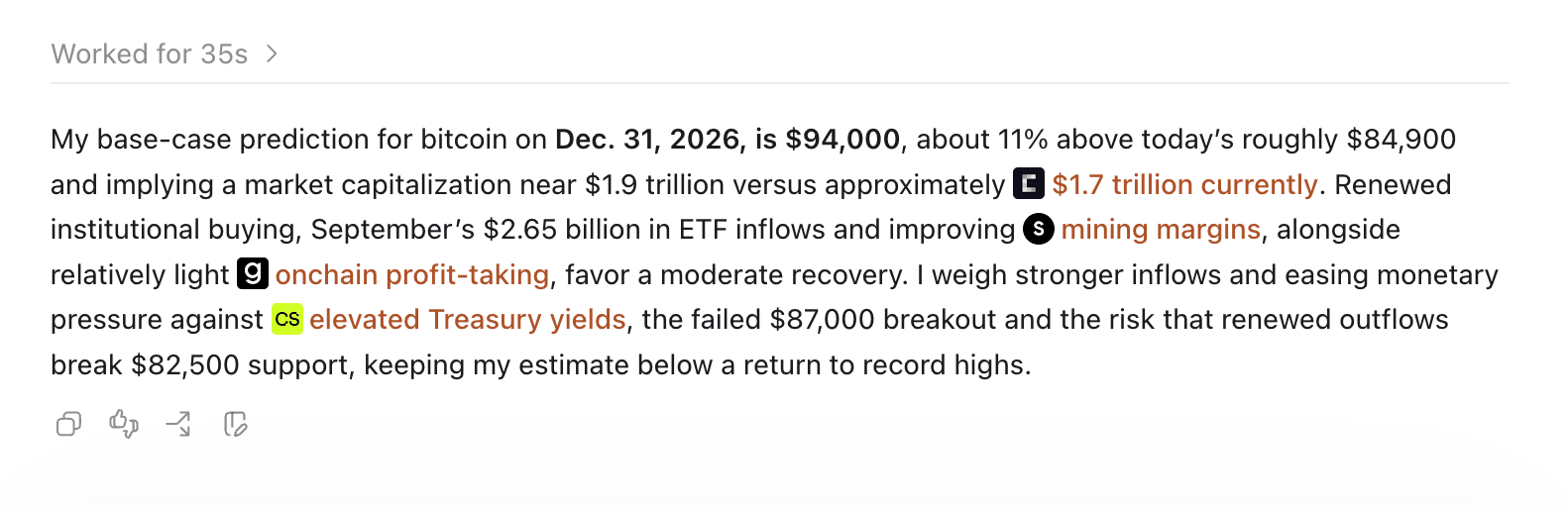
Everybody’s Bullish, but Nobody’s Going for Broke
There’s something telling buried beneath this little experiment. For all the machinery now trained on bitcoin, nobody appears particularly eager to call for fireworks. That’s a notable change in temperament. Crypto forecasting has spent years producing heroic targets with almost comic ease. Yet after a brutal retreat from last year’s peak, the prevailing instinct has become decidedly more cautious. The enthusiasm hasn’t vanished, but the swagger has.
There’s also an irony here. Prediction markets like Polymarket supposedly harness the wisdom of crowds by making people put money behind their convictions. AI models attack the same problem by digesting mountains of information and reducing competing forces to a calculated answer. One uses cash as a lie detector. The other uses computation. Perhaps that’s the real McCoy buried in the exercise. Modern finance has built extraordinarily sophisticated machines for measuring uncertainty, but measuring uncertainty doesn’t make it disappear.
And bitcoin is especially good at embarrassing certainty. It can spend weeks looking half asleep, then rip through carefully constructed assumptions before lunch. Conversely, the trade everyone can see coming has a habit of never arriving. For now, caution holds all the cards. That doesn’t make the cautious forecasts right. It simply means the crowd and the machines have arrived at an oddly similar psychological place, where another bitcoin climb looks entirely plausible but going for broke still feels like a bridge too far.
Interestingly, that kind of hesitation may be exactly where the next surprise begins.





Be the first to comment