



LegalBison is a global boutique legal and business services firm and licensed Corporate Service Provider (CSP) specializing in regulatory structures for FinTech and digital asset projects. Co-Founders and Managing Directors Aaron Glauberman, Viktor Juskin and Sabir Alijev share expert insights on Bitcoin.com News.
Ask a perpetual DEX founder where their company is registered and you’ll often get a shrug, or a foundation’s brass-plate address in the Caymans. That’s the default playbook for a business model regulators are still catching up to. In 2026, three regulators are handling it three completely different ways, and which one a founder ends up dealing with changes almost everything about how the business runs.
Take Hyperliquid. It handles roughly half of all decentralized perpetuals trading and has pushed more than $4 trillion in volume through its books since launch. Decentralized platforms still only make up about a tenth of the total perpetuals market, though. The rest sits on offshore centralized exchanges, which happens to be exactly the liquidity U.S. regulators are now trying to lure back home.
So how does a business like this actually get built, and what happens once regulators start paying attention?

The anatomy of a perp DEX
A perp DEX can involve several legally and technically distinct layers: a user-facing interface, the underlying protocol and validator infrastructure, and, in some cases, a foundation, DAO, or treasury supporting development and governance. Each layer can sit in a different structure, and the foundation or treasury layer, when one exists, is usually parked somewhere with light company law and no perpetuals-specific licensing regime: Cayman, BVI, Seychelles, or these days the UAE.
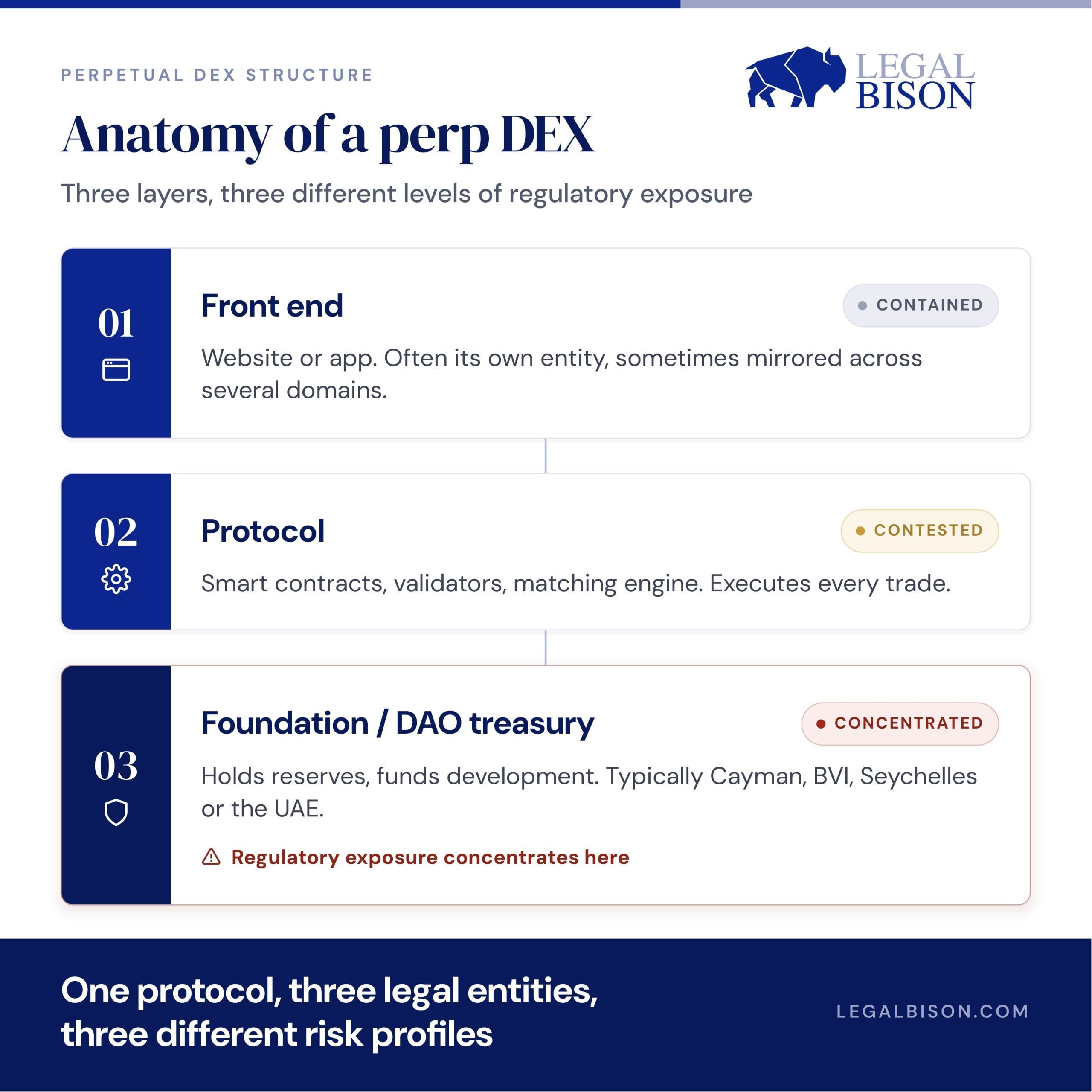
Hyperliquid took this further than most by building its own blockchain instead of renting space on someone else’s. Its HIP-3 feature lets anyone spin up a permissionless market on almost any asset with a price feed, oil, gold, even pre-IPO equity. That design choice matters. Keeping market creation out of any single company’s hands is exactly the test regulators on both sides of the Atlantic now use to decide whether something counts as decentralized at all.
Three roads, three very different rulebooks
Once that structure exists, a founder still has to pick how to deal with regulators, and each option trades speed against long-term safety in its own way.
Go through the CFTC
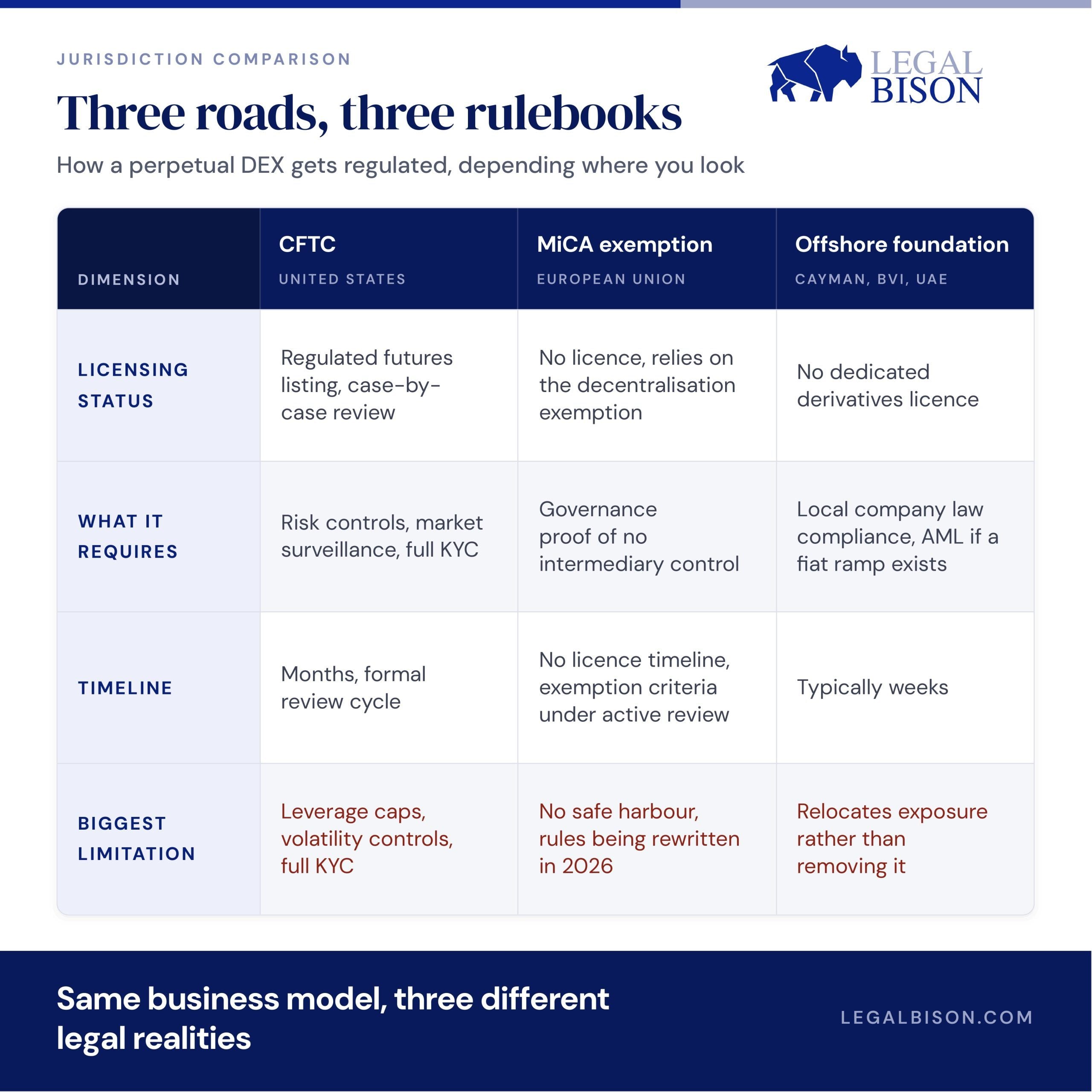
On May 29, 2026, the CFTC let KalshiEX list the first cash-settled Bitcoin perpetual on a regulated U.S. exchange, and it classified perpetuals as futures rather than swaps. Every new listing now gets reviewed case by case and has to prove it has real risk controls and market surveillance in place. That’s a legitimate onshore path, but it comes with everything a regulated derivatives market requires: ID checks on every account, leverage caps, volatility controls, the exact stuff a permissionless DEX was built to skip. It’s also contested. CME Group is suing the CFTC over these approvals, arguing the agency went too far letting Kalshi and Coinbase list crypto perps, and that fight is still playing out in federal court.
Lean on Europe’s decentralization exemption
The EU’s crypto rulebook, MiCA, excludes anything delivered “in a fully decentralised manner without any intermediary.” For perpetual DEXs, though, that exemption only covers part of the picture. Perpetual contracts can still be classified as financial instruments or derivatives under existing EU securities and markets rules, a classification that applies regardless of how the platform is built. What a protocol is actually offering traders can trigger obligations on its own, separate from any decentralization test. Brussels opened a consultation running through August 31, 2026 to pin down the decentralization criteria more precisely, and perpetuals sit squarely inside that review, but the derivatives classification question runs on its own track. No EU regulator has gone after a DEX front end yet, but between the two open questions, that gap won’t stay open forever.
Set up offshore
Still the fastest option, and still the most common. But offshore doesn’t erase regulatory exposure, it just relocates it. The foundation issuing the token, holding the treasury, or running a fiat ramp still has AML and reporting duties wherever it’s registered, and any front end serving a specific country can trigger local licensing questions no matter where the protocol itself lives.
What it actually takes, and how long
Going the CFTC route is the slowest and most paperwork-heavy: disclosures, surveillance systems, a formal review that takes months before a product even goes live, then ongoing compliance after that. The EU route needs no license today for a genuinely fully decentralized protocol, which sounds great until you realize there’s also no safety net, and the rules for keeping that exemption are being rewritten right now. Offshore is fastest, sometimes just weeks, but founders who treat it as a permanent shield rather than a starting point tend to be the ones caught off guard when one jurisdiction changes its mind.
Where the money actually comes from
Funding rates are periodic payments longs and shorts swap with each other to keep the contract price glued to spot; the protocol facilitates that transfer but doesn’t keep it. What the protocol actually earns is trading fees, charged on every open and close, plus, on platforms built around permissionless listings like Hyperliquid’s HIP-3, a second stream: fees for creating new markets in the first place.
Here’s the number that should get a founder’s attention. Hyperliquid crossed $1 billion in cumulative protocol revenue on June 30, 2026, built on roughly $492 billion in trading volume in the first quarter alone, enough to put it just behind Coinbase by volume. That’s money the protocol has already collected, and you can watch the number update in real time on public dashboards like DefiLlama, a level of transparency most venture-backed startups never give an outsider.
Where that revenue goes is the part that actually matters if you’re weighing whether to build here. Roughly 97 to 99% of Hyperliquid’s protocol fees get routed straight into buying HYPE off the open market through what the protocol calls its Assistance Fund. That mechanism has already repurchased and burned more than 41 million tokens, worth over $1 billion. Fee revenue turns directly into reduced token supply on a public, on-chain schedule, functioning like a stock buyback that anyone can verify without waiting on a shareholder vote.
Hyperliquid isn’t the only proof this works. GMX, a much smaller decentralized perpetuals exchange running on Arbitrum and Avalanche, still pulls in roughly $35 million a year in fees on a fraction of Hyperliquid’s volume, with 27% of that paid straight to token stakers every week. That’s steady, recurring cash flow on a protocol carrying around $175 million in total value locked, proof the model throws off real revenue without needing to be the biggest exchange on the planet.
The expansion case is where it gets genuinely interesting for a builder. When HIP-3 let Hyperliquid list an oil perpetual, trading volume on that single market jumped from $25 million to more than $550 million across three weekends during a geopolitical flare-up, according to TD Securities. A new market went live and immediately generated fee revenue, with no fresh infrastructure required to make it happen. Put together, that’s the actual pitch for a founder: a fee model with public, verifiable revenue, proven at more than one scale, that grows every time a new market gets switched on.
The key distinction
“Decentralized enough to be exempt” and “decentralized enough to survive a regulator actually testing it” are two different bars, and the gap between them is closing on both sides of the Atlantic at once. Building a perpetual DEX today means building a structure that can defend itself under whatever definition lands next, not the one that looked safe a year ago.






Be the first to comment