


AI Summary
- The IMF has placed XRP Ledger and Stellar within a broader assessment of tokenized financial infrastructure.
- Their inclusion documents existing activity but does not constitute an IMF endorsement of XRP or XLM.
- Tokenized assets reached about $65 billion, while daily tokenized repo volumes averaged roughly $300 billion to $350 billion.
- Institutional adoption will depend on governance, interoperability, liquidity and financial stability safeguards as much as ledger technology.
The common crypto narrative treats every institutional reference to a public blockchain as an endorsement of its native asset. The more concrete development is narrower but still significant: the IMF has mapped XRP Ledger and Stellar within its analysis of tokenized financial infrastructure.
The IMF’s October 2026 Global Financial Stability Report chapter, presented at the Bank of Korea, examines how financial claims can be issued, transferred, serviced and settled through shared digital infrastructure. Its underlying landscape includes public networks such as Ethereum, Solana, Avalanche, Stellar and XRP Ledger alongside issuers and products using those platforms.
That inclusion should not be confused with a forecast for XRP or XLM. It shows that the two networks are visible in the IMF’s assessment of current tokenization activity. In our view, the material question is whether that visibility develops into durable institutional usage under workable governance and risk controls.

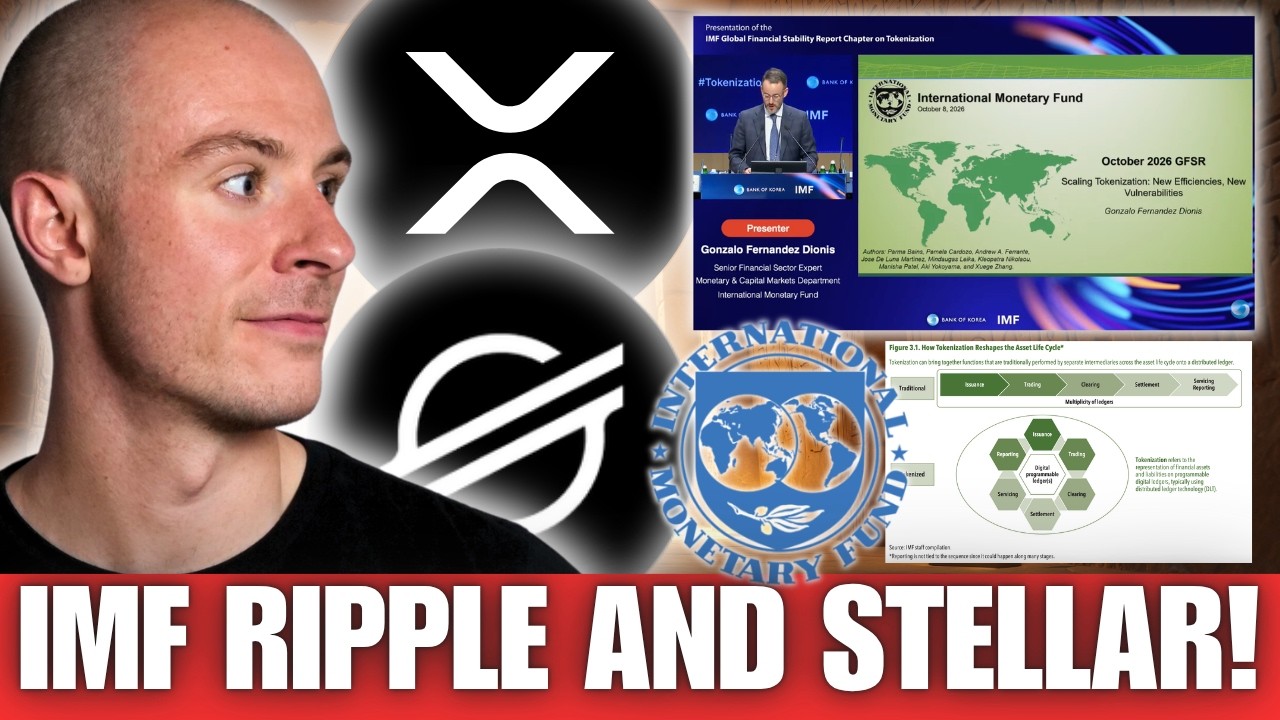
The International Monetary Fund Just Highlighted Stellar Lumens XLM And Ripple XRP!!!
What the IMF actually documented
The chapter defines tokenization as representing financial assets and liabilities on programmable ledgers. Instead of maintaining separate records for issuance, trading, clearing, settlement, servicing and reporting, market participants can place multiple functions on shared infrastructure.
Tokenization the representation of financial assets and liabilities on distributed programmable ledgers has the potential to transform financial markets by placing functions traditionally performed by separate intermediaries onto a distributed ledger.
The immediate proposition is operational. A shared distributed ledger can reduce reconciliation between databases, improve transparency and allow processes to be automated. This is not the same as removing every intermediary. Issuers, custodians, trading venues, settlement operators and regulators may retain distinct responsibilities even when they interact with a common record.
- Issuance: A financial claim can be created and administered on programmable infrastructure.
- Trading: Ownership records and transfer conditions can operate within the same technical environment.
- Settlement: Assets and payment instructions can be coordinated more closely.
- Servicing and reporting: Automation can reduce repeated data entry and support more timely records.
The IMF’s involvement matters because its mandate centers on the international monetary system and financial stability. Its analysis therefore moves the debate beyond whether tokenization is technically possible and toward how it changes market structure, operational concentration and risk transmission. Our previous coverage examined the same distinction in the IMF report’s treatment of XRP Ledger and Stellar.
Tokenization consolidates the asset life cycle
Traditional securities infrastructure relies on multiple ledgers maintained by separate organizations. Each handoff can require matching records, resolving discrepancies and waiting for another participant to complete its part of the process. Tokenization can place more of that workflow on a common programmable foundation.
The strongest near-term case is therefore less dramatic than replacing the global financial system. It is the gradual consolidation of post-trade and back-office functions. Industry participants identified cost efficiency as the most immediate benefit available from that process.
Industry participants consistently identified improved cost efficiency as the most immediate benefit.
- Reconciliation: Shared records can reduce the need to compare several versions of the same transaction.
- Transparency: Authorized participants can obtain a more consistent view of asset status and ownership.
- Programmability: Smart contracts can embed specified conditions into issuance, transfer and servicing.
- Composability: Compatible financial instruments can potentially interact within connected infrastructure.
Potential technical features include nearly instant settlement, atomic settlement and fractionalization. Each feature also raises practical questions. Faster settlement changes liquidity needs, automated conditions must be legally enforceable, and smaller units do not automatically produce deep or orderly markets.
Adoption data shows activity, not dominance
The scale reported by the IMF indicates that tokenized finance has moved beyond isolated proofs of concept, although it remains uneven across products. Tokenized real-world assets reached about $65 billion. Tokenized fixed income, including corporate credit, asset-backed credit and money market fund holdings, represented about $48 billion outside repurchase agreements.
Tokenized assets or tokenized real world assets have grown rapidly reaching about 65 billion US as you can see on the chart on the left.
Repurchase agreements form a separate and much larger flow measure. Daily tokenized repo volumes averaged around $300 billion to $350 billion, reflecting the role that blockchain-based records can play in collateral management. Governments, supranational entities and private-sector issuers have also launched tokenized bonds, with the IMF registering $8 billion of issuance since 2022.
Separately, daily repo volumes have averaged around 300 to 350 billion, reflecting the relevance of tokenization for collateral management.
These figures should not be combined into one market-size claim. The $65 billion figure describes an asset stock, while daily repo volume measures transaction flow. The $8 billion figure covers registered onchain bond issuance since 2022. Our analysis treats them as evidence of several different adoption channels, not as interchangeable measures of value.
- Asset stock: About $65 billion in tokenized real-world assets was identified.
- Fixed income: About $48 billion was attributed to specified fixed-income categories outside repos.
- Daily activity: Tokenized repo volume averaged around $300 billion to $350 billion.
- Bond issuance: The IMF registered $8 billion in onchain issuance since 2022.
Why XRP Ledger and Stellar matter in this dataset
XRP Ledger and Stellar appear in the IMF’s mapping of tokenized value by blockchain platform. The dataset also shows that activity is distributed unevenly: Ethereum has the broadest position described in the source, while particular networks have stronger representation in specific areas. Stellar was identified as a leading platform for non-US government debt, while XRP Ledger was included among the networks supporting tokenized value.
This gives both chains institutional relevance without proving that their native assets capture equivalent economic value. A financial instrument can use a network while settling fees, payments or obligations in another asset. The IMF material supplied here does not establish how much demand tokenization creates for XRP or XLM, nor does it forecast their prices.
The more defensible thesis is infrastructure-based. Public ledgers can provide accessible settlement environments while regulated institutions apply controls such as whitelisting to determine who may hold or transact in particular tokens. The IMF describes this combination of permissionless infrastructure and controlled access as a hybrid governance model.
The source also identifies banks’ interest in issuing stablecoins on permissionless networks. A euro-denominated stablecoin from Societe Generale was cited as being issued across Ethereum, Solana, Stellar and XRP Ledger. That multi-network approach indicates that institutions may value distribution and interoperability rather than exclusive commitment to one chain.
Efficiency arrives with new vulnerabilities
The report’s title pairs new efficiencies with new vulnerabilities, and that balance is essential. Concentrating issuance, transfer and settlement functions on shared infrastructure can remove duplicated processes, but it can also concentrate technical and operational dependencies.
- Infrastructure concentration: Heavy reliance on a small number of networks or service providers can create common points of disruption.
- Governance: Institutions must define who can issue, hold, transfer, pause or recover tokenized claims.
- Interoperability: Assets distributed across several platforms need reliable ways to exchange information and value.
- Liquidity: Technical availability does not guarantee active markets or efficient exits.
- Automation risk: Programmable execution can propagate errors quickly when rules or inputs are defective.
Reduced barriers to capital movement could improve collateral mobility and cross-border payments. They could also make stress move more quickly between markets and jurisdictions. We think institutional adoption will be determined as much by legal certainty, governance and resilience as by transaction speed.
This is why an IMF reference is meaningful but not conclusive. XRP Ledger and Stellar have entered the institutional mapping of tokenized infrastructure; they have not been declared winners. Their longer-term position depends on whether real deployments remain reliable and whether market participants choose them when moving from pilots to recurring financial activity.
What this means
-
Recognition is not endorsement. The IMF has documented XRP Ledger and Stellar within the tokenization landscape, but the supplied material does not recommend XRP, XLM or any other crypto asset.
-
Specialization may matter more than aggregate rank. Ethereum leads broadly, while Stellar’s position in non-US government debt shows how a network can gain relevance within a narrower market segment. XRP Ledger’s inclusion establishes visibility but does not quantify future adoption.
-
Execution will decide the infrastructure thesis. Cost efficiency, transparency, collateral mobility and programmable settlement are credible objectives. Their value depends on governance, liquidity, interoperability and controls that address new vulnerabilities.
For investors, the distinction between network usage and token value capture remains critical. Institutional issuance on a chain may improve its relevance, but the economic effect on a native asset depends on how transactions are funded, how fees work and whether liquidity develops. Those outcomes are not established by the IMF’s platform map.
Bigger picture
The IMF assessment fits a wider shift from experimental blockchain projects toward identifiable financial infrastructure. Our analysis of the blockchain adoption choice facing financial market rails reached a similar conclusion: institutions must decide how public and controlled systems can coexist rather than treating the debate as a simple choice between them.
Verified deployments provide chain-specific context. State Street and Galaxy placed an onchain liquidity fund on Stellar, while an Amundi fund used Stellar. On XRP Ledger, CSD BR mirrored BTG Pactual fund records. These developments are more useful for assessing adoption than treating a mention in an institutional chart as a standalone investment signal.
Policy development is advancing alongside implementation. The SEC tokenization push has tested the XRP infrastructure thesis, underscoring that regulatory design and market plumbing are converging. We see the IMF’s work as further evidence that tokenization is becoming a financial-architecture issue. It does not settle which networks will scale, but it clarifies the standards by which they are likely to be judged.
Sources
This article is for informational purposes only and does not constitute financial advice.



Be the first to comment