



AI Summary
- Central banks are examining how tokenized deposits, stablecoins and central bank reserves could coexist in onchain markets.
- BlackRock emphasized that faster settlement introduces tradeoffs and that collateral quality remains more important than mobility alone.
- Interoperability between new platforms and existing financial infrastructure emerged as the central scaling requirement.
- The supplied source connects South Korea’s tokenized securities plans to Avalanche, but that chain-specific claim lacks an accompanying primary document.
The familiar crypto narrative treats tokenization as a race to move every asset onto a blockchain as quickly as possible. The more concrete development is narrower and more consequential: the International Monetary Fund, BlackRock, the Bank of Japan and the Bank of Korea are examining how tokenized money, collateral and existing financial infrastructure could work together.
The central institutional question is therefore not whether a ledger can represent an asset. It is whether tokenized deposits, stablecoins and central bank reserves can settle reliably across different systems while preserving legal certainty, market integrity and investor protection. That distinction places interoperability and collateral design ahead of broad claims about blockchain adoption.
Avalanche enters this analysis through a separate South Korean infrastructure claim. The supplied source reports that the Korean Securities Depository is building connectivity using AVAX infrastructure as South Korea develops rules for tokenized securities. This is directionally consistent with other institutional activity placing Avalanche rails in focus, but no South Korean primary document accompanied the transcript. We therefore treat the specific chain connection as a sourced thesis requiring independent confirmation.
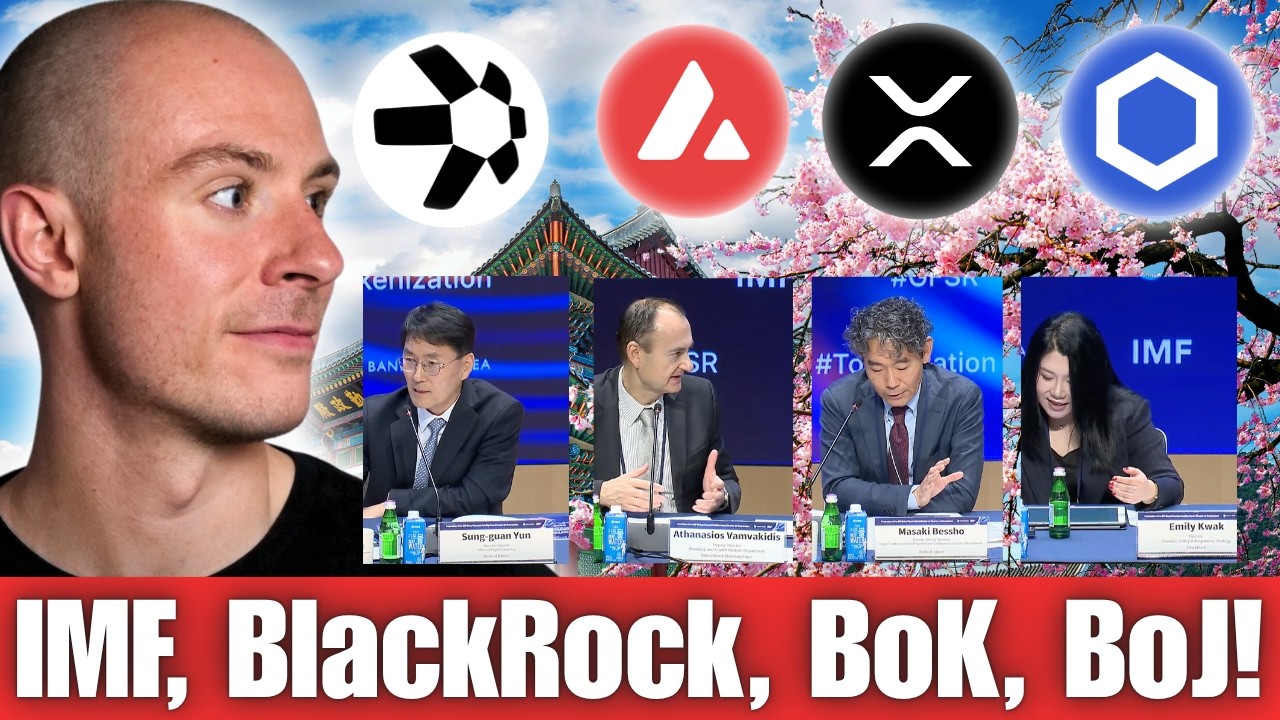
IMF, BlackRock, Bank Of Japan And Bank Of Korea Just Said This About Crypto…..
Central banks are testing the architecture of tokenized money
The Bank of Japan contribution described a future onchain financial ecosystem containing several forms of money rather than one universal settlement asset. That model includes commercial bank liabilities, privately issued digital instruments and potentially tokenized claims on central bank money.
Vision in the future where multiple forms of tokenized money coexist within onchain financial ecosystem and this would include tokenized deposits, stable coins and potentially tokenized forms of central bank reserves.
The institution also described its participation in Project Agora alongside other central banks, including the Bank of Korea, with attention to cross-border payments. A domestic distributed ledger technology sandbox was mentioned in parallel. These are concrete experiments in system design, but they do not establish that any public cryptoasset has been selected as an official settlement layer.
- Forms of money: The proposed environment could contain bank deposits, stablecoins and tokenized central bank reserves.
- Settlement scope: Cross-border payments are one stated area of exploration.
- Design objective: Trust and efficiency must survive when transactions move into onchain financial systems.
That separation matters for crypto research. Previous AllinCrypto analysis of the IMF’s tokenized finance mapping identified XRP Ledger and Stellar within a wider landscape. Inclusion in research, however, is not the same as procurement, deployment or endorsement by a central bank.
BlackRock places settlement speed behind market resilience
BlackRock’s contribution resisted the assumption that immediate settlement is automatically superior. Faster movement can reduce some counterparty and settlement exposure, yet it can also weaken netting efficiency and funding flexibility. Market infrastructure must balance those effects rather than optimize one metric in isolation.
faster settlement may reduce certain counterparty and settlement exposure but it can also reduce netting efficiency and funding flexibility the market participant rely on.
This is an important constraint on tokenization narratives. Legacy processes sometimes appear slow because institutions combine transactions, manage liquidity and reduce the amount of funding required at any one moment. Moving every transaction independently and immediately could change those economics even when the underlying technology performs as intended.
- Potential benefit: Faster settlement may reduce selected exposures between market participants.
- Potential cost: Less netting can increase funding pressure or reduce flexibility.
- Policy test: Resilience and market integrity matter more than whether an asset uses a tokenized format.
Our analysis is that institutional adoption will depend on demonstrable improvements across the full transaction lifecycle. A blockchain can accelerate one step while creating new liquidity, governance or integration burdens elsewhere.
Collateral mobility does not replace collateral quality
BlackRock also identified collateral mobility as a pressure valve during stressed conditions. The ability to transfer high-quality assets to where they are needed could reduce forced sales and help institutions meet obligations. Yet mobility cannot improve the underlying asset or compensate for weak surrounding infrastructure.
Better collateral mobility acts as a critical pressure valve especially during the period of uh period of stress by allowing uh highquality assets move where they are needed and potentially reducing unnecessary fire sales.
This distinction creates a more rigorous framework for evaluating tokenized collateral. Analysts should ask what the token represents, how ownership is recognized and whether the market can continue functioning under pressure. The token wrapper alone does not answer those questions.
- Asset quality: The economic strength of the underlying collateral remains decisive.
- Mobility: Transferability can help direct assets toward immediate funding needs.
- Infrastructure: Operational and market arrangements determine whether mobility produces resilience.
This institutional emphasis also helps explain why the XRP Ledger collateral thesis must be tested against broader tokenization requirements. A protocol’s technical capabilities are relevant, but they are only one part of the institutional case.
Interoperability is the binding constraint
Multiple platforms are not inherently a failure. Banks, asset managers, central banks and market operators can adopt different systems for different purposes. Fragmentation becomes a problem when cash, collateral or assets cannot move between them and instead remain trapped in isolated pools.
True scale require interoperability between new and existing market infrastructure.
That requirement gives technologies associated with cross-system communication a credible area of relevance. Chainlink and Quant are frequently connected to this thesis, and supplied AllinCrypto context includes both DTCC work on tokenized securities infrastructure and a Quant framework for tokenized deposits beyond individual ledgers. Those developments support studying interoperability; they do not prove that either network will capture a particular central bank or securities project.
The same caution applies to XRP, Stellar and Ethereum. The transcript associates these protocols with earlier institutional research, but the quoted panel comments focus on functions and policy objectives rather than announcing chain selections. Protocol exposure remains conditional on technical integration, governance, legal treatment and the ability to connect with existing infrastructure.
South Korea creates the strongest Avalanche angle
The most specific chain claim in the supplied material concerns South Korea. The source states that the Financial Services Commission published rules allowing stocks, bonds and funds to be issued and circulated onchain beginning in February 2027. It further states that the rules place the Korean Securities Depository within the supporting blockchain infrastructure and that the depository is already building connectivity on AVAX.
These assertions would create a meaningful Avalanche infrastructure case if confirmed by the relevant primary documents. They would connect a named public network to the operational layer supporting security tokens rather than merely placing Avalanche in a general research report. However, the only supplied source for those details is the YouTube material, so we cannot independently verify the rule text, implementation scope or technical meaning of “connectivity.”
- Reported policy action: New rules are said to cover onchain issuance and circulation of stocks, bonds and funds.
- Reported institutional role: The Korean Securities Depository is described as part of the infrastructure.
- Reported protocol connection: The source links that infrastructure work to AVAX.
- Outstanding evidence: No Financial Services Commission or depository document was supplied for direct review.
Our view is that this is a lead worth monitoring, not yet a basis for concluding that South Korea’s securities market is moving wholesale onto Avalanche. The distinction between a connectivity component, a pilot environment and a production settlement network could materially change the investment interpretation.
Programmable finance expands the governance problem
A further panel contribution projected that tokenization could become programmable infrastructure for automated workflows and AI agents. That possibility broadens the requirement beyond basic asset transfer. Identity, governance and interoperability become more important when software can initiate or coordinate financial actions.
tokenization can become the programmable infrastructure u especially for automated financial workflows and AI agent.
Automation may make tokenized assets more useful, but it also raises the cost of fragmented standards. An automated workflow must know which identity rules apply, whether an asset is eligible and how an instruction moves across systems. Those conditions reinforce the panel’s institutional focus on legal certainty and resilient infrastructure.
The South Korean speaker also anticipated wider use of tokenized deposit services and eventual public participation in security token offerings. These remarks were forecasts rather than completed outcomes. We see them as evidence of policy direction, not a guaranteed adoption schedule.
What this means
-
Institutional tokenization is becoming a systems question. Central banks and asset managers are concentrating on the relationship among money, collateral, settlement and existing infrastructure rather than treating blockchain deployment as an end in itself.
-
Interoperability has a clearer thesis than any single token. The discussion supports demand for cross-system connectivity, but it does not identify XRP, Stellar, Chainlink, Quant, Ethereum or Avalanche as a universal winner.
-
The South Korean AVAX claim needs primary confirmation. A documented role for Avalanche within securities infrastructure would be significant, but the supplied evidence does not establish its production scope or economic value to the asset.
Bigger picture
The broader pattern is a shift from isolated demonstrations toward questions of market structure. AllinCrypto’s recent coverage has tracked this through the choice facing finance as blockchain market rails evolve and through Stellar’s institutional tokenization test. Together with the current institutional comments, those developments suggest that technical eligibility is expanding faster than evidence of durable network capture.
We think the next useful evidence will be operational rather than rhetorical: primary rule documents, clearly defined institutional roles and technical disclosures showing how assets and cash move between systems. Until then, protocol-specific conclusions should remain proportional to the available sourcing.
Sources
This article is for informational purposes only and does not constitute financial advice.



Be the first to comment