



All news is rigorously fact-checked and reviewed by leading blockchain experts and seasoned industry insiders.
- SharpLink has moved part of its existing ETH treasury into Lido and Ether.fi.
- Some of the company’s income now comes from incentives paid by protocols seeking liquidity.
- The exact split between the two protocols has not been confirmed onchain.
- Staking tokens carry write-downs that are not reversed when ETH recovers.
SharpLink ETH reserves worth roughly $400 million are now deployed across the liquid staking protocol Lido and the restaking platform Ether.fi, the Nasdaq-listed Ethereum treasury company chaired by Ethereum co-founder Joseph Lubin said on October 19. The coins come from the treasury SharpLink already holds, so the move changes how its ETH earns without increasing the number of coins it owns, and it pushes a larger share of the company’s reserves into DeFi infrastructure where returns depend on protocol incentives as well as Ethereum’s own staking rewards.
$200M each, at least on paper
The Lido half dates to August 13, when SharpLink said it would stake $200 million of ETH through Lido and receive wstETH, a wrapped token that represents staked ETH and rises in value as staking rewards build up, with Anchorage Digital holding it in custody. The Ether.fi half grew out of a plan announced in October 2025 with EigenCloud and Consensys’s Linea network. SharpLink’s October statement did not itemize the total, and no wallet addresses have been published that would let outsiders confirm the balance held in each protocol.

Restaking adds a second reward
Ordinary ETH staking pays validators for securing the network, and that reward forms the base layer of both positions. Lido adds liquidity on top, giving SharpLink a token it can move, lend or post as collateral while the underlying ETH keeps earning. At the time of the August announcement, about $16.5 billion of ETH was staked through Lido, and roughly $10 billion of its tokens were being used as collateral across more than 100 integrated applications.
Ether.fi works differently. Its weETH token represents restaked ETH, meaning the same stake is pledged a second time to secure additional services, in this case those run by EigenCloud, in exchange for extra rewards. SharpLink bridges that weETH to Linea, the Ethereum layer-2 network developed by Consensys, and collects incentives from Ether.fi, Linea and EigenCloud for keeping the liquidity there. Joseph Chalom, SharpLink’s CEO, said in August that the Lido position would make the company’s ETH “even more productive” through wstETH’s DeFi integrations.
Exchanges now hold 13.6% of ETH
The coins SharpLink has locked into staking add to a steady drain of ETH from trading venues. Glassnode data puts the share of supply held on centralized exchanges at about 13.6%, down from close to 18.7% in mid-2025, and the slide continued even after ETH rallied from around $1,500 in the summer to roughly $2,400.
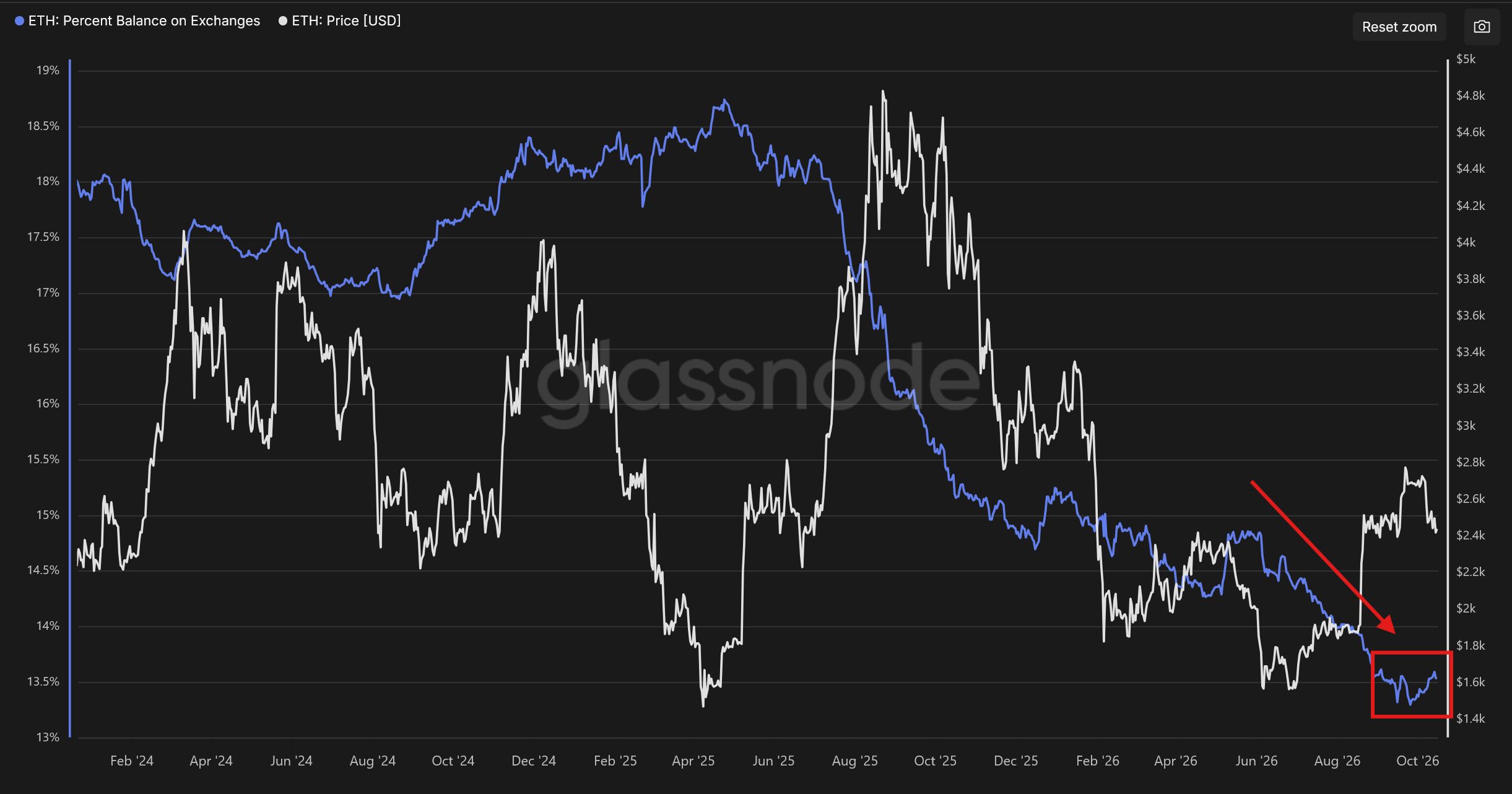
Coins that move into staking contracts, restaking protocols or corporate custody are harder to sell at short notice, which thins the supply readily available to traders, although the same tokens can flow back to exchanges quickly once holders decide to exit. Staking has absorbed a large part of that outflow, with more than a third of all ETH now staked, according to Lido.
Linea pays SharpLink to stay
SharpLink’s quarterly filing explains the economics more plainly than its press releases. A partnership agreement signed on December 18, 2025 commits the company to bridge and maintain at least $200 million of ETH and weETH on Linea over a two-year term, and in return it receives monthly incentives from Ether.fi, Linea and EigenCloud. SharpLink books those payments as compensation for providing and maintaining total value locked on Linea, which places part of its yield closer to a commercial contract than to network rewards, and such payments last only as long as the agreement does.
A $76M write-down on staking tokens
In its second-quarter results, SharpLink reported 888,938 ETH as of August 3, with liquid staking and restaking tokens already making up close to 29% of the total. The quarter closed with a net loss of $394.3 million, against $103.4 million a year earlier, driven by a $321 million unrealized loss on ETH and a $76.1 million impairment on LsETH and weETH. The two charges behave differently, because native ETH is marked to market each quarter and recovers on paper when the price rises, while LsETH and weETH are booked as intangible assets, so an impairment cuts their carrying value and later price gains are not recognized while the tokens remain staked.
| Position | ETH | Share |
|---|---|---|
| Native staked ETH | 634,255 |
71.3% |
| LsETH Liquid Collective | 181,748 |
20.4% |
| weETH Ether.fi | 72,935 |
8.2% |
| Total | 888,938 | 100% |
Holdings as of August 3, 2026, before the Lido allocation.
What Anchorage custody leaves uncovered
A smart contract flaw at Lido or Ether.fi could cause losses that custody at Anchorage would not reverse, since a custodian protects keys and does not insure protocol failures. Restaked ETH can also be slashed, meaning partially confiscated, if operators fail the services it secures, while the bridge to Linea adds a dependency on a separate network. Liquid staking tokens have traded below the value of their underlying ETH during past bouts of market stress, which matters for any holder that needs to exit quickly, because redeeming directly through the protocol runs through a withdrawal queue that can take days. Splitting the money between two providers limits reliance on either one, though both remain tied to the same Ethereum market.
ETH per share is the scorecard
SharpLink publishes its ETH holdings and staking rewards on its ETH dashboard, but the figure that settles whether the strategy works is ETH concentration, the number of ETH held per 1,000 diluted shares, which shows whether yield is outpacing dilution from new share sales. If the Lido and Ether.fi positions perform as intended, concentration should edge higher even in quarters without fresh ETH purchases. Investors are also waiting for an exact split between the two protocols and for any disclosure on whether the wstETH feeds further strategies, including the Galaxy SharpLink Onchain Yield Fund, which launched on August 7 with $125 million in commitments, $100 million of it backed by SharpLink’s staked ETH. Galaxy, the digital asset firm led by CEO Mike Novogratz, manages that fund, and its $100 million should not be added to the $400 million because the two figures may overlap.
The accounting side may matter as much as the yield. At August prices near $1,890, the Lido tranche equals roughly 106,000 ETH, and if wstETH is booked the same way as LsETH and weETH, the share of SharpLink’s treasury exposed to non-reversible impairments would rise from about 29% to around 40%. The third-quarter report, the first to cover a full period with the Lido position live, will show how the company classifies the new tokens and whether staking income was large enough to offset that exposure.


Be the first to comment