


The Hongkong and Shanghai Banking Corporation Limited (HSBC) launched HSBC RedCoin [RCHKD], a Hong Kong dollar-backed stablecoin, on the 23rd of October.
The bank operates under a Hong Kong Monetary Authority (HKMA) stablecoin issuer licence, following requirements under Hong Kong’s Stablecoins Ordinance.
RedCoin began rolling out through PayMe, which serves more than 3.3 million users and over 100,000 merchants. Users could activate an in-app stablecoin wallet for transfers and merchant payments, giving RedCoin an existing distribution network.
Maggie Ng, HSBC’s Hong Kong CEO and Head of Retail Banking and Wealth, described the launch as supporting changing payment habits.

We have an opportunity to help customers in Hong Kong manage this shift with practical products and services that support the real economy, backed by the trust and security of a global bank.
Can PayMe expand Hong Kong stablecoin adoption?
HSBC received its licence on the 10th of April 2026, alongside Anchorpoint Financial Limited. The regulator granted those first two licences from a pool of 36 applications. hkma.gov.hk
Anchorpoint, a joint venture backed by Standard Chartered, HKT, and Animoca Brands, subsequently introduced its HKDAP stablecoin.
According to the supplied DeFiLlama snapshot, HKDAP’s Market Capitalization stood at $2.03 million, against $300.369 billion across stablecoins.
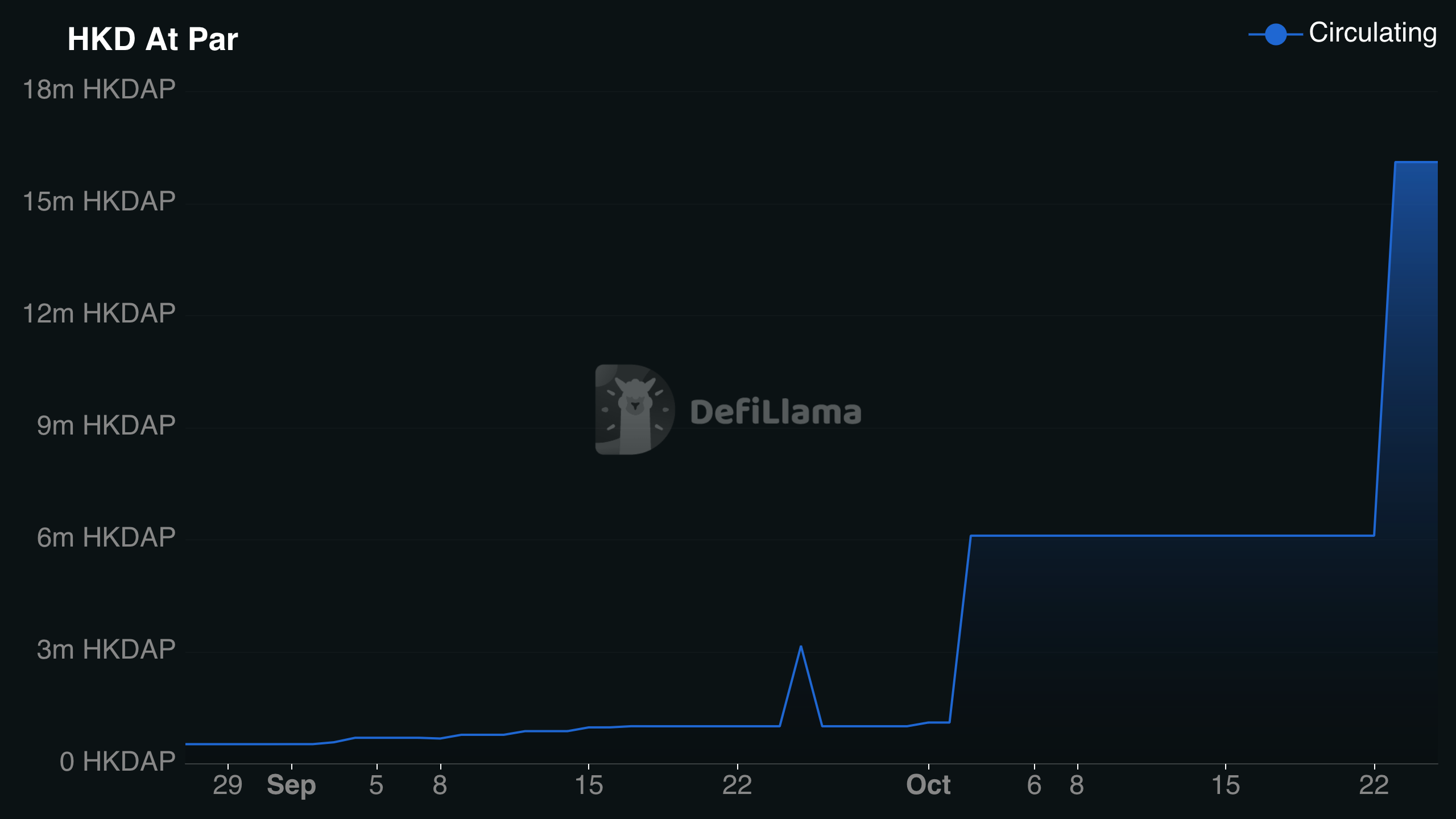
That represented approximately 0.00068% of the total, illustrating HKDAP’s small circulating value relative to the wider market.
However, one token’s Market Capitalization could not establish adoption across all Hong Kong dollar stablecoins.
HSBC’s entry introduced a different distribution opportunity: reaching users through an app they already use. Its survey found that 53% of respondents believed Hong Kong dollar stablecoins could strengthen economic competitiveness.
The bank also reported over US$2.5 billion in Gold Token trading and more than $8.3 billion in digitally native bond issuance. Those figures demonstrated activity across its digital asset offerings, although neither measured demand for RedCoin.
Can local stablecoins challenge dollar dominance?
The U.S. GENIUS Act established a federal framework for payment stablecoins, adding regulatory clarity to the sector.
Elsewhere, issuers have pursued stablecoins linked to local currencies, although their circulating value remained comparatively small.
The supplied DeFiLlama figures put U.S. dollar-linked stablecoins at $298.574 billion, representing approximately 99.4% of the total market.
For HSBC, PayMe could help reduce the friction of accessing a stablecoin wallet. The next test would be whether users had a reason to choose RedCoin for regular payments.
An established user base offers distribution. Sustained adoption would depend on how often those users actually transact with the token.
Final Summary
- HSBC launched RedCoin through PayMe, giving its Hong Kong dollar stablecoin access to an established payments network.
- Dollar-linked tokens dominated stablecoin supply, leaving RedCoin’s payment usage as a key test of demand.



Be the first to comment