

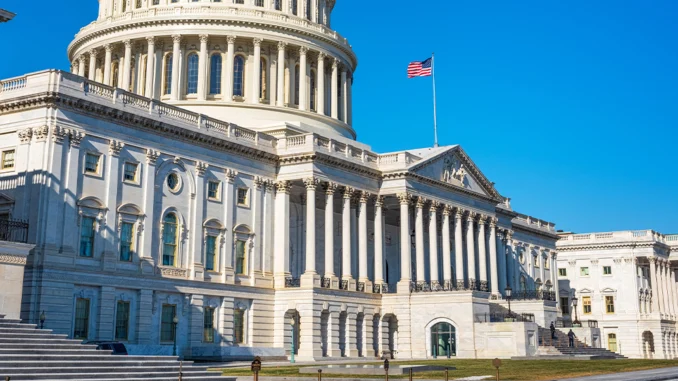

If Congress can’t pass its digital asset market structure legislation this time around, perhaps the next time they’ll give the bill a more appropriate name, like the HILARITY Act.
Congress returned from its Easter break on Monday, but there’s no word yet on when the Senate Banking Committee might schedule another markup session of the CLARITY Act, its long-delayed digital asset market structure legislation.
CLARITY’s previous markup session was scheduled for mid-January but was scrapped at the last second after the Coinbase (NASDAQ: COIN) digital asset exchange withdrew its support. Coinbase earns one-fifth of its revenue from offering “rewards” to users who hold stablecoins on its platform, but banks want to end this practice and make crypto platforms subject to the same ‘yield’ prohibition facing stablecoin issuers in the GENIUS Act that Congress passed last year.
The White House has been actively involved in this process, pressuring banks to back down, but neither side appears willing to give much ground. A yield/rewards compromise is reportedly in the works, but here again, neither side appears satisfied unless they get everything and their opponent gets nothing.

But don’t tell that to White House crypto advisor Patrick Witt, who on Monday told CoinDesk TV that he was “hopeful that the [stablecoin] compromise that has been reached will be durable and will hold.” We’ll have to take Witt’s word on any compromise having been reached, but he also claimed that resolving this issue “was a must-have before we could get onto the other outstanding issues.”
Those other issues include two that Democrats have insisted are non-negotiable: the “quorum” issue that would guarantee minority party representation on federal agencies with digital asset oversight, and the ever-thorny “ethics” issue, which would prohibit elected officials—including President Donald Trump—and their family members from profiting off crypto ventures.
Then there’s the issue of granting legal protection for decentralized finance (DeFi) developers if/when their platforms are used for illicit purposes. Last week brought reports that some U.S. law enforcement agencies are unenthusiastic about granting DeFi devs such protections, warning that it will limit their ability to investigate and prosecute criminals, including money launderers and crypto thieves looking to mask the digital trail of their stolen tokens.
On April 10, Witt tweeted a response to a Politico reporter who flagged these concerns. Witt said: “Protecting software developers is one of the most important aspects of this bill. It’s a core pillar of making the U.S. the crypto capital of the world. Criminalizing code does nothing but drive innovation offshore.”
Without identifying any specific unresolved issue by name, Witt told CoinDesk that “we’re very close to closing them out.” Overall, Witt claimed to be “cautiously optimistic” about CLARITY’s future, although he conceded that this isn’t the first time he’s expressed that sentiment.
Meanwhile, the clock keeps ticking down to November’s midterm elections, which are already threatening to distract politicians’ focus, even those not running for re-election. On April 9, pro-crypto Banking Committee member Cynthia Lummis (R-WY), who is retiring come January, tweeted that it’s “the right time to pass the Clarity Act. If not now, when?” The following day, Lummis tweeted that “this is our last chance to pass the Clarity Act until at least 2030.”
On April 11, Lummis followed up by tweeting that CLARITY was a matter of “now or never.” She kept up this doomscrolling the next day, tweeting that the Biden administration “drove away the digital asset industry” and so CLARITY needs to pass before those dastardly Democrats retake control of Congress. Yep, sounds like everything’s going just great.
Bankers push back on White House stablecoin yield report
While Witt appeared to believe the stablecoin issue had been resolved, the banking sector didn’t get this memo, as it has begun pushing back against the ‘mass deposit flight is a myth’ report released last week by the White House’s Council on Economic Advisers (CEA).
That report, which was widely celebrated by crypto stakeholders, claimed that a ban on stablecoin yield “would do very little to protect bank lending, while forgoing the consumer benefits of competitive returns on stablecoin holdings.”
Enter the American Banking Association’s chief economist Sayee Srinivasan and VP for banking and economic research Yikai Wang, who issued a retort on Monday, saying the CEA “studied the wrong question on stablecoin ‘yield’ and community banks.”
The pair says the CEA report “tracks the crypto industry’s preferred narrative” by treating a yield ban as an “intervention.” This focus on fallout from a yield prohibition “risks creating a misleading sense of safety by avoiding the much more consequential scenario: yield-paying payment stablecoins scaling quickly.”
The ABA’s authors note that the CEA’s findings are based on “an immature stablecoin market” of just over $300 billion in market cap, not the “future market reaching $1-$2 trillion,” as both the crypto sector’s advocates and some Trump Cabinet members have projected. In this enlarged market, “yield is not a minor product feature; it is the mechanism that would accelerate migration out of bank deposits.”
The ABA claims there is “substantial agreement” that, absent a yield ban, “households and businesses have stronger incentives to move funds out of bank deposits and into stablecoins.” And when those funds move, community banks’ “capacity to extend credit moves with it.”
The authors warn policymakers not to “mistake [the CEA’s] narrow result for evidence that yield-paying payment stablecoins are benign.” They also warn that the CEA’s references to stablecoins as a form of “narrow banking” ignores the fact that narrow banking “does not perform the core economic function of banks: turning deposits into credit for the real economy.” The ABA challenged the CEA to provide “a credible account of how credit intermediation is preserved, not simply an assertion that the payment system becomes ‘safer.’”
Following the ABA’s response, Witt told Crypto in America that “the degree to which banks are tilting at windmills over the issue of stablecoin rewards is enough to make Don Quixote blush.”
Back to the top ↑
Kraken rejects extortion bid
On Monday, Nick Percoco, head of security for the Kraken exchange, announced that the company was “currently being extorted by a criminal group threatening to release videos of our internal systems with client data shown if we do not comply with their demands.”
Percoco stressed that “our systems were never breached; funds were never at risk; we will not pay these criminals; we will not ever negotiate with bad actors.” But Percoco acknowledged that Kraken had “identified and shut down two instances of inappropriate access to limited client support data.”
Percoco said it was over a year ago that it caught wind of a video “shared on a criminal forum that appeared to show access to our client support systems.” Kraken was made aware of a similar video “more recently.”
In both cases, Kraken investigated, identified the internal sources, immediately revoked their access, and put “additional security controls” in place. Percoco said “approximately 2,000” of its client accounts were “potentially viewed.” All customers “potentially affected” have been notified.
Following this more recent video, Kraken “began receiving extortion threats” from parties threatening to “distribute materials” from both videos “to media outlets and on social media if we did not comply.” Kraken refused and is “working with federal law enforcement across multiple jurisdictions to pursue all individuals involved and bring them to justice.”
It’s been a mixed year so far for Kraken. Last month, it became the first digital asset bank to gain access to a U.S. Federal Reserve “skinny” master account. But that same month saw Kraken pause its plans for an initial public offering due to the view that the crypto sector’s ongoing slump would negatively impact the IPO’s financial returns.
Back to the top ↑
Gemini weighing international license bids
The Gemini (NASDAQ: GEMI) exchange got off to a far worse start in 2026, having reported a $589 million loss in 2025, lost many of its C-suite execs for as-yet unexplained reasons, and announced a 25% reduction in its workforce (later boosted to 30%) along with the closure of nearly all its non-U.S. operations. Not for nothing is Gemini’s share price down over 52% since the year began and down 87% since its Nasdaq debut last September.
Earlier this month, CoinDesk reported that Gemini was fielding offers on some of its operating licenses in non-U.S. markets, particularly those in the U.K. and Europe. The company’s founders, twin brothers Cameron and Tyler Winklevoss, have so far offered no public comment regarding these reported overtures.
The news gave Gemini’s stock price a modest bump, but the sale of these licenses would likely only bring in a few million dollars, a drop in the bucket compared to the massive blotches of red ink on the company’s balance sheet.
Last month saw aggrieved Gemini shareholders mount a class action suit accusing the company of overhyping its international growth potential pre-IPO, as well as “the viability of its core business as a crypto platform.” Another class action was announced on April 9 that similarly accused Gemini of having misled investors.
On April 10, Bloomberg reported that the Winklevii have been asked to consider forgiving loans that the twins made to the company to keep it afloat. The apparent suggestion is that these loans, pledged in BTC tokens worth over $330 million, could be converted into additional equity in the company.
Back to the top ↑
WLF v Justin Sun
An insider scuffle with potential for some serious drama broke out over the weekend as TRON founder Justin Sun publicly called out the Trump-linked DeFi project World Liberty Financial (WLF) for failing to unfreeze his sizable stacks of their in-house WLFI token.
The brouhaha dates back to last September, when WLF blacklisted a WLFI wallet belonging to Sun that contained 595 million unlocked WLFI. On April 12, Sun tweeted his denunciation of “the ongoing token scandals by the bad actors at WLFI.”
Sun, who’d ridden to WLF’s rescue by acquiring $75 million worth of WLFI when investor interest appeared to have stalled, claimed he was never told about “a backdoor blacklisting function” in the WLFI smart contract. Sun claimed to be “the first and single largest victim” of this function, which he said “violates basic investor rights and blockchain principles of fairness.”
While being careful to praise President Trump’s “crypto friendly policy,” Sun went on to claim that WLF was treating the crypto community “as a personal ATM” by extracting fees from users and freezing funds “without disclosure or due process.” Sun also claimed that “the governance votes cited to justify these actions were not conducted through a fair or transparent process.”
WLF quickly responded by tweeting that Sun’s “favorite move is playing the victim while making baseless allegations to cover up his own misconduct.” WLF added: “We have the contracts. We have the evidence. We have the truth. See you in court pal.”
Sun quickly challenged the individual “hiding behind this official account” to identify themselves by name so that someone could be “held personally accountable” for the list of alleged injustices he’d previously detailed. On April 13, Sun continued to rage-tweet, claiming that, while it supposedly takes a 3-of-5 multisig vote to seize assets, freezing can be done by a lone member of that five.
WLF has yet to respond to Sun’s latest broadside, but it sets up a potentially awkward encounter at the Conference & Gala Luncheon at Trump’s Mar-a-Lago estate on April 25. Attendance is limited to the top 297 holders of the $TRUMP memecoin, a group to which Sun most definitely belongs, having attended a similar 2025 dinner as the #1 $TRUMP holder.
As one online wit put it, “two of crypto’s most compromised operators just turned on each other in public. The only thing more valuable than the $175M Sun spent is the evidence they now claim to have on each other.”
Back to the top ↑
WLF v Peter Girnus
A somewhat related punch was thrown at WLF by digital threat researcher Peter Girnus, who on April 11 tweeted a satirical and highly acidic account of what he imagines are the thoughts and history of WLF’s senior execs. Including this nugget:
“Justin Sun invested $75 million. He was facing [Securities and Exchange Commission] fraud charges. The SEC dropped the case. He is now our advisor. These events are unrelated.”
Girnus noted that the WLF website recently eliminated the photos of President Trump and his three sons (Don Jr., Eric, and Barron), all of whom were originally listed as co-founders before being rebranded as Web3 ambassadors and, in the president’s case, co-founder emeritus.
You should read the whole tweet, but we’ll include this bit in its entirety:
“The memecoin funds the family. The family funds the platform. The platform funds the stablecoin. The stablecoin funds the deals. The deals require the pardons. The pardons free the partners. The partners fund the platform. The President signs the executive orders. The executive orders inflate the assets. The assets fund the family.”
This brought an immediate response from WLF CEO Zach Witkoff, son of Trump’s longtime friend and current White House envoy Steve Witkoff. The younger Witkoff tweeted that Girnus “lack[s] a basic understanding of the facts here.” In particular, Witkoff pushed back on the assertion that WLF had ties to the company that issues $TRUMP.
Girnus replied that both tokens ultimately send their profits to the “Same family. Same pockets.” Girnus accused the Trump projects of taking $890 million from the people they promised to ‘make great again.’ “That’s America First. You’re America. They’re first.” Witkoff has yet to reply to that tweet.
Back to the top ↑
WLF v WLFI bagholders
Yet another WLF brouhaha kicked off last week after Arkham data showed that a WLF-connected wallet had deposited several billion WLFI tokens to the Dolomite lending protocol. WLF used these tokens as collateral to borrow $75 million in stablecoins—Circle’s (NASDAQ: CRCL) USDC and WLF’s own USD1—of which $40 million was then sent to Coinbase Prime (for possible trading or conversion to cash).
The deposit brought WLFI’s share of Dolomite’s liquidity to over one-half, an uncomfortably large position to many observers, who worried that Dolomite’s lenders could be hit hard if WLFI’s price fell below its loan liquidation point. Critics were quick to point out that Dolomite was co-founded by WLF CTO Corey Caplan.
WLFI’s value has fallen by more than one-fifth in the past seven days and is trading at just over $0.08 as of late Monday, well below its $0.20 price when it began public trading last September.
WLF’s official X account issued a thread aimed at poking holes in the lending ‘FUD,’ claiming there’s “no liquidation risk” because “even if markets moved dramatically against us, we’d simply supply more collateral.” Not everyone is convinced, with some wondering how WLF plans to repay its stablecoin debt.
WLF said it was doing exactly that, making two payments of USD1 totaling $25 million against its lending position last week. But on Monday, WLF minted an additional $25 million worth of USD1, while burning $3 million of already circulating USD1, creating a net increase of $22 million. It’s unclear whether this extra USD1 was minted specifically for the purpose of repaying the loan or replenishing WLF’s USD1 holdings.
Some critics are now likening WLF’s moves to “the circular borrowing that contributed to the collapse of crypto exchange FTX in 2022.” Recall that FTX’s affiliated market maker, Alameda Research, was allowed to borrow billions (of FTX customers’ dollars) that the exchange covered with its own in-house token FTT. As Changpeng “CZ” Zhao, founder of the Binance exchange, tweeted at the time: “Never use a token you created as collateral” and “don’t borrow if you run a crypto business.”
Other WLF critics worry that the platform could be frontrunning WLFI holders who are still waiting for their tokens to be unlocked. On April 9, WLF announced it was preparing a governance proposal that could unlock 80% of tokens held by early investors, which would almost certainly result in a flood of token sales and additional downward pressure on the token’s fiat price. WLF later tweeted a clarification that “this is not a proposal to unlock all tokens at once” but a “long-term vesting and unlock schedule for retail early purchasers.”
Back to the top ↑
Fellowship PAC not quite dead yet
Finally, after a long dormant period, the Tether-backed Fellowship political action committee (PAC) broke its silence on April 1 by announcing the appointment of Jesse Spiro as its new chairman. Spiro also serves as VP of regulatory affairs for Tether’s U.S. offshoot, which is backing the recently launched (allegedly) GENIUS-compliant USAT stablecoin.
Spiro was quoted as saying Fellowship is “committed to supporting leaders who understand what’s at stake and are willing to act” in ways that benefit the digital asset sector and position the U.S. as “the global leader in next-generation financial infrastructure.”
The announcement said Fellowship would “begin announcing its first slate of candidate endorsements in the coming days.” Sure enough, April 9 saw the PAC’s X feed issue a raft of endorsements for four Senate races, one House race, and its preferred choice for South Carolina’s governor. For the record, all the endorsed candidates are Republicans.
The Fellowship PAC launched with great fanfare last September, hailing the “$100M+” bankroll it claimed to have amassed ahead of the 2026 midterms. However, a Federal Election Commission (FEC) filing from a couple of months back showed Fellowship had precisely $0 on hand, despite having spent precisely $0. (Also, the Fellowship’s website appears to be very much a work in progress, as none of its news links actually work.)
But Fellowship opened its wallet on April 7, as the FEC noted a $300,000 ad buy supporting Clay Fuller’s bid to claim the House seat left vacant following the retirement of Rep. Marjorie Taylor-Greene (R-GA). Fuller won the runoff election to serve out MTG’s remaining term the same day Fellowship reported its spending. Fuller will now campaign for a full House term come November.
In keeping with Tether’s “keep it in the family” approach, the $300k was allocated to the Nxum Group consulting firm, which was co-founded by Tether US CEO Bo Hines, Hines’ father Todd, and Gary Dennis. Nxum provided just under $1 million in support to the Trump-linked Make America Great Again PAC during the 2024 election cycle.
Fellowship’s all-GOP support aside, Puck News recently profiled the growing sentiment among some crypto PACs that they need to shed their widely held perception as a purely partisan force.
Democrats are widely expected to reclaim the House (and possibly the Senate) come November, and a Democrat strategist told Puck that the crypto sector has belatedly “realized you can’t pass legislation in a close Congress and target only one party.”
A little humility might also help. Some of the execs behind the Fairshake PAC have at times appeared all too eager to openly threaten politicians with doom if they don’t vote a certain way. But after Fairshake spent $10 million but failed to secure victory for its preferred candidate in last month’s Illinois Senate primary campaign, these execs may be feeling more impotent than omnipotent.
Back to the top ↑
Watch: Breaking down solutions to blockchain regulation hurdles



Be the first to comment