

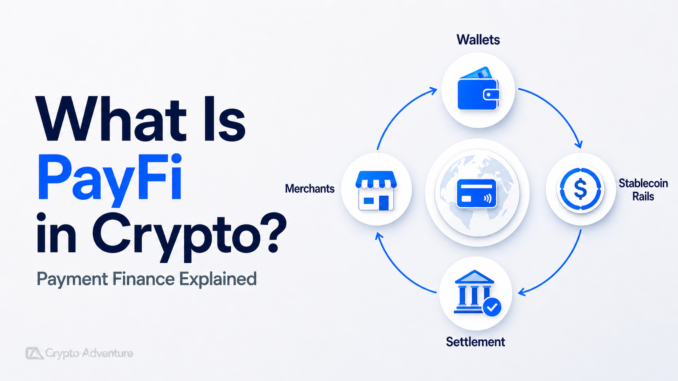
PayFi means Payment Finance or Payment Financing. It combines payment rails with on-chain financing, stablecoins, real-world assets, and liquidity markets. The goal is not only to send money faster. The goal is to finance payment flows more efficiently.
A simple crypto payment moves value from one wallet to another. PayFi goes deeper. It asks who provides liquidity before the payment settles, how merchants get paid faster, how cross-border payment providers avoid heavy prefunding, how receivables become financeable assets, and how stablecoins can reduce settlement delays.

Stellar’s PayFi explainer defines the category around payments, on-chain financing, and blockchain technology. Huma’s PayFi network applies the same idea to real-world payment financing, connecting capital to payment assets such as cross-border settlements, card payments, and payroll advances.
Why Payments Need Financing
Traditional payments are not only slow because messages move slowly. They are slow because money must be prefunded, reconciled, settled, and managed across banks, payment processors, liquidity providers, and local rails.
A payment company may need capital sitting in several countries before transactions happen. A cross-border remittance business may need liquidity on both sides of a corridor. A card-settlement provider may need to bridge the time between user payment and merchant payout. A payroll or invoice platform may need to advance funds before incoming payments arrive.
This is where PayFi becomes different from normal crypto payments. It focuses on the time value of money inside payment flows. If settlement can happen faster and liquidity can be provided on demand, less capital sits idle and more businesses can operate with better working capital efficiency.
How PayFi Works
A PayFi system usually starts with a real payment flow. That flow may come from remittances, merchant settlement, card processing, payroll, invoices, supply-chain finance, or cross-border B2B payments.
The payment provider needs liquidity before final settlement arrives. Instead of relying only on bank credit lines or trapped prefunding, it can access stablecoin liquidity through an on-chain financing network. Liquidity providers fund payment assets, borrowers receive faster settlement, and repayments come from the underlying payment flow.
PayFi can be seen as a modular system spanning high-speed chains, stablecoins, custody, compliance, financing, and applications. Payments cannot work with liquidity alone. They also need identity checks, custody controls, risk underwriting, reliable settlement rails, and compliant counterparties.
The Role Of Stablecoins
Stablecoins are the main settlement asset for PayFi because payment businesses need predictable value. Bitcoin and volatile tokens are usually not suitable for short-term working capital because price swings can erase the benefit of faster settlement.
USDC, PYUSD, USDT, and other stablecoins can move across blockchain rails while staying close to a fiat reference value. That makes them useful for liquidity providers, payment companies, and settlement partners that need speed without taking large crypto-market exposure.
The stablecoin layer also helps global availability. A payment company can receive liquidity outside normal banking hours, settle across borders, and reduce idle balances. The trade-off is stablecoin issuer risk, chain risk, compliance requirements, and liquidity fragmentation across networks.
Where RWAs Fit
PayFi is closely connected to RWAs because many payment flows create real-world receivables. A card settlement, invoice, payroll advance, or cross-border payment obligation can become a financeable asset if the repayment path is clear.
Tokenization can turn those payment claims into on-chain assets or structured financing opportunities. Liquidity providers can fund short-duration payment receivables, while payment companies get faster access to cash. This makes PayFi one of the more practical RWA use cases because the asset is tied to real payment activity rather than a purely speculative token.
The risk is underwriting. A receivable is only valuable if the payer, processor, or counterparty repays as expected. PayFi protocols must understand default risk, settlement timing, fraud, chargebacks, jurisdiction, and compliance. The blockchain can improve transparency and settlement, but it cannot remove credit risk.
PayFi vs DeFi
PayFi and DeFi overlap, but they are not the same. DeFi usually focuses on open lending, trading, staking, collateral, and automated market structure. PayFi focuses on payment flows and the financing needs attached to those flows.
A DeFi lending pool may let users borrow against crypto collateral. A PayFi network may provide liquidity to a payment company so it can settle transactions faster. DeFi can be speculative and open-ended. PayFi is more tied to payment operations, working capital, and real-world cash flows.
The strongest PayFi systems will likely borrow parts of DeFi, such as liquidity pools, smart contracts, transparent accounting, and programmable settlement. They also need more compliance and underwriting than many open DeFi systems because real payment institutions and real counterparties are involved.
PayFi Use Cases
The first major use case is cross-border payments. Payment companies can access liquidity without keeping large prefunded balances in every corridor.
The second use case is card settlement. Merchants and payment processors can receive faster access to funds while settlement completes in the background.
The third use case is payroll and earned wage access. Workers can receive funds earlier when a PayFi system finances the time gap between work performed and payroll settlement.
The fourth use case is invoice and receivables financing. Businesses can turn future payments into short-duration financing when the receivable is verifiable.
The fifth use case is treasury movement. Stablecoin rails can reduce settlement delay for companies moving funds between jurisdictions, platforms, or counterparties.
Main Risks
- The first risk is credit risk. If the borrower or payment counterparty fails, liquidity providers can lose money.
- The second risk is stablecoin risk. PayFi depends on the stability, liquidity, and redemption quality of the settlement asset.
- The third risk is compliance risk. Payments touch KYC, AML, sanctions screening, money transmission, consumer protection, and local licensing.
- The fourth risk is operational risk. Payment providers, custodians, smart contracts, banks, and blockchain networks must all work correctly.
- The fifth risk is liquidity mismatch. PayFi can look safe when repayments arrive on time, but stress appears when payments delay, fraud rises, or liquidity providers rush to exit.
Why PayFi Matters
PayFi matters because payments are one of the largest real-world use cases for stablecoins and blockchain settlement. Speculative DeFi can generate large trading volume, but payment finance connects blockchain rails to business cash flow.
The category also gives crypto a more practical story. Faster settlement, lower prefunding needs, transparent receivables, and programmable liquidity are concrete business problems. If PayFi works, the value is not only cheaper transfers. It is better working capital for payment companies, merchants, workers, and cross-border networks.
PayFi is still early. The strongest projects will need real transaction volume, strong underwriting, compliant counterparties, reliable stablecoin liquidity, and clear risk reporting. The weakest projects may use the PayFi label while offering little more than ordinary lending with payment-themed branding.
Conclusion
PayFi brings payment flows and financing into the same on-chain system. It uses stablecoins, liquidity providers, real-world payment assets, compliance infrastructure, and blockchain settlement to reduce prefunding needs and speed up money movement.
The strongest PayFi use cases are cross-border settlement, card payments, payroll advances, invoice financing, and merchant liquidity. The biggest risks are credit quality, stablecoin reliability, compliance, operational execution, and liquidity mismatch. PayFi is one of the more practical crypto narratives because it connects on-chain finance to real payment needs, but it will only work at scale when risk controls are as strong as the payment speed.



Be the first to comment