

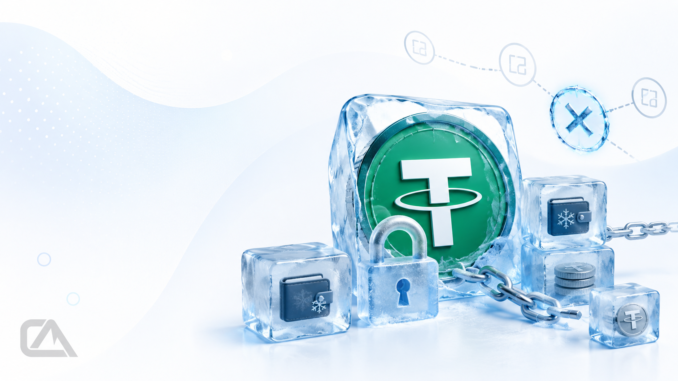
Tether’s latest blacklist activity has frozen about $515 million in USDT across Ethereum and Tron over a 30-day period, sharpening attention on the enforcement controls built into the world’s largest dollar stablecoin.
The latest USDT Freeze Tracker data placed the 30-day total at 371 blacklisted addresses as of May 7, with 329 addresses on Tron and 42 on Ethereum. The frozen value was heavily concentrated on Tron, at roughly $506 million, while Ethereum accounted for about $8.73 million. That updates the circulating claim that Tether froze more than $514 million across 370 wallets. The better current framing is about $515 million across 371 addresses.

The tracker is operated by BlockSec and monitors USDT freeze, unfreeze, and burn activity using public on-chain events from Ethereum and Tron. BlockSec launched the tool earlier this year to make USDT blacklist activity easier to follow, including address-level status, event history, and related multisignature actions.
The latest freeze wave follows a larger enforcement backdrop. On April 23, Tether said it supported the U.S. government in freezing $344 million in USDT across two addresses after information from U.S. authorities linked the wallets to unlawful activity. The company said it works with more than 340 law enforcement agencies in 65 countries and has helped freeze more than $4.4 billion in assets globally.
Tron Carries Most Of The Frozen Value
The Tron concentration is the most important detail in the latest data. Tron has become one of USDT’s main settlement networks because transfers are fast, cheap, and widely supported by exchanges, payment apps, and retail users. That same liquidity footprint also means illicit actors often touch Tron-based USDT when moving dollar-pegged value across platforms.
The freeze mechanics are simple but powerful. USDT moves on public blockchains, but it is not a purely permissionless bearer asset. Tether retains issuer-level controls that can stop listed addresses from transferring tokens. That makes USDT different from Bitcoin or ETH, where no central issuer can blacklist a wallet at the token-contract level.
For users, the latest freeze wave reinforces a core distinction inside the USDT and USDC debate: stablecoins can offer deep liquidity, fast settlement, and low-cost routing, while still carrying issuer controls tied to sanctions, fraud, theft, court orders, and law-enforcement requests.
Stablecoin Liquidity Meets Compliance Pressure
USDT remains crypto’s dominant stablecoin. CoinGecko placed Tether’s market capitalization near $190 billion, making it the third-largest crypto asset by market value behind Bitcoin and Ethereum. That size explains why every major freeze becomes a market-structure story, not only a compliance headline.
The same token that routes global exchange liquidity, offshore dollar demand, and stablecoin payment rails also sits inside a growing enforcement perimeter. Regulators and investigators can follow on-chain flows, identify high-risk wallets, and work with issuers to immobilize funds before they move further through exchanges, bridges, mixers, or payment processors.
The result is a sharper trade-off for stablecoin users. USDT’s liquidity is still the main reason it dominates trading pairs and cross-chain transfers, but the latest 30-day freeze data shows how quickly issuer controls can pull specific balances out of circulation. With roughly $506 million frozen on Tron alone, the enforcement layer around stablecoins is no longer theoretical. It is now a visible part of how dollar tokens move, stop, and get policed across public blockchains.



Be the first to comment