

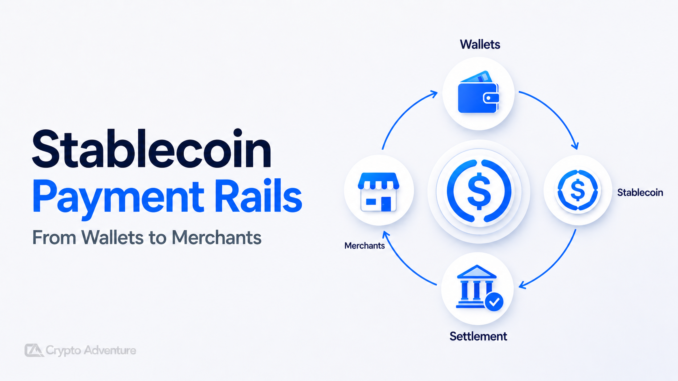

Stablecoin payment rails are the systems that let users, merchants, payment companies, fintechs, banks, and platforms move dollar-like value across blockchain networks. The stablecoin is the payment asset. The rail is the full route that moves it from a wallet to a merchant balance, bank account, treasury system, or another wallet.
A simple transfer can look easy. A customer sends USDC or another stablecoin from a wallet, and the merchant receives value. Real payment rails are more complex. They include wallets, checkout pages, payment processors, stablecoin issuers, blockchains, compliance checks, foreign exchange partners, settlement accounts, refunds, accounting systems, and sometimes card-network settlement.

That complexity is why stablecoin payments are becoming more useful for businesses. Stablecoins can settle across borders, operate outside normal banking hours, reduce prefunding needs, and give merchants access to digital-dollar payments without forcing every customer to use a card.
How A Stablecoin Payment Starts
A stablecoin payment usually starts in a customer wallet. The customer holds a stablecoin such as USDC, PYUSD, USDT, or another supported token on a compatible blockchain. The merchant or payment provider creates a payment request that includes an amount, accepted asset, destination address, chain, and expiration window.
For instance, On Stripe, a business can accept stablecoin payments through familiar flows such as Checkout, Payment Links, Elements, or the Payment Intents API. Customers are redirected to connect a crypto wallet and complete the payment, while funds can settle into the merchant’s Stripe balance in dollars.
This is the key product shift. The user can pay with a wallet, but the merchant does not always need to manage blockchain operations directly. Payment processors can hide wallet complexity, settlement routing, and compliance work from the merchant.
What Happens After The Wallet Payment
After the customer signs the transaction, the blockchain processes the transfer. The payment provider watches the chain, confirms the payment, matches it to the checkout session, and updates the merchant’s system. The merchant may receive stablecoins, fiat settlement, or an internal balance depending on the provider setup.
This creates several possible rails. A crypto-native merchant may want to receive USDC directly into a wallet. A normal online business may prefer fiat settlement in a bank-linked account. A payment company may use stablecoins only behind the scenes for treasury movement while showing ordinary payment interfaces to customers.
Stripe cover the fiat settlement layer for certain markets, which is why payment rails are not only blockchain transfers. They also include regulated settlement services and local payment obligations.
Issuers And Cross-Chain Movement
Stablecoin issuers sit at the center of the rail. Circle issues USDC, PayPal and Paxos issue PYUSD, and Tether issues USDT. Issuers manage minting, redemption, reserves, compliance tools, supported networks, and sometimes enterprise payment products.
Cross-chain movement matters because stablecoins exist on many networks. A user may hold USDC on Solana while a merchant wants settlement on Base or Ethereum. For instance, Circle’s Cross-Chain Transfer Protocol burns native USDC on one chain and mints native USDC on another, reducing reliance on wrapped bridge assets and traditional bridge liquidity pools.
This improves payment routing. A stablecoin rail becomes more useful when the same dollar asset can move across chains without fragmenting into risky wrapped versions. Cross-chain infrastructure helps wallets, exchanges, merchants, and payment providers choose the chain that fits cost, speed, and liquidity needs.
Merchant Settlement
Merchant settlement decides what the business actually receives. A merchant may accept stablecoins but settle in dollars, euros, or another fiat currency. Another merchant may hold stablecoins for treasury use. A platform may split settlement between vendors, creators, workers, and corporate accounts.
Circle Payments Network targets compliant global stablecoin payments with near-instant settlement and partner vetting. Circle also launched CPN Managed Payments so payment service providers, fintechs, banks, and global platforms can use stablecoin settlement without directly managing digital assets.
This is where stablecoin rails become more like payment infrastructure than crypto speculation. The merchant may never think about block explorers, gas fees, or wallet custody. The rail handles conversion, compliance, settlement, and reconciliation behind the scenes.
Card Networks And Stablecoin Settlement
Stablecoins are also entering card-network settlement. Visa’s stablecoin settlement pilot expanded to more blockchains in April 2026 and reached a $7 billion annualized settlement run rate. That matters because stablecoins are no longer only wallet-to-wallet payment tools. They can also support settlement between issuers, acquirers, banks, and payment networks.
This creates a hybrid model. The customer may still use a card, wallet, or app, while stablecoins move in the back-end settlement layer. That can improve availability, reduce weekend delays, and support cross-border flows where traditional settlement is slow or expensive.
The important point is that stablecoin payment rails do not always look like crypto at the user interface. The stablecoin may sit behind a normal checkout, card, remittance app, marketplace payout, or business treasury flow.
Refunds, Chargebacks And Risk
Stablecoin payments change dispute mechanics. A blockchain transfer is normally irreversible after confirmation. That can reduce chargeback-style risk, but it also means refunds need a separate process.
Stripe’s stablecoin payment materials specify stablecoin refunds back to the customer’s original wallet for its supported flow. That kind of design is important because merchants need refund tools, accounting records, and customer support processes. A payment rail is not complete if it only handles the first transfer and ignores refunds.
Fraud risk also changes. A customer must control the wallet sending the funds, but scams, wrong-network transfers, wallet drains, and impersonation remain possible. Merchants and processors need address screening, transaction monitoring, sanctions checks, and clear support paths.
Why Stablecoin Rails Matter
Stablecoin rails matter because they can reduce friction in global payments. A business can accept digital dollars from customers in more markets, settle faster, and reduce dependence on card networks or correspondent banking in certain flows.
They also help payment companies manage liquidity. Instead of prefunding many local accounts, a payment provider can use stablecoins for faster treasury movement, then convert into local currencies when needed. This is especially important for cross-border marketplaces, remittances, freelancers, creator payments, and business-to-business settlement.
The best rails will be invisible to most users. The customer pays, the merchant receives value, and the payment company handles the complexity.
Main Risks
- The first risk is stablecoin issuer risk. If the stablecoin loses its peg, faces redemption stress, or changes network support, payment users can be affected.
- The second risk is chain risk. Congestion, outages, gas spikes, or bridge issues can make payments slower or more expensive.
- The third risk is compliance risk. Stablecoin payments touch KYC, sanctions screening, money transmission, consumer protection, tax reporting, and regional licensing.
- The fourth risk is operational risk. Wallet errors, wrong networks, payment expiration, refund mistakes, and integration bugs can all create losses.
Conclusion
Stablecoin payment rails move value from wallets to merchants through a mix of stablecoins, blockchains, issuers, processors, settlement accounts, compliance tools, and merchant systems. The customer may see a wallet payment, while the merchant may receive fiat, stablecoins, or a processor balance.
The strongest stablecoin rails make payments faster without forcing businesses to manage every blockchain detail. They support checkout, refunds, cross-chain movement, settlement, compliance, and reconciliation. Stablecoins are useful because they move like crypto and settle like digital cash, but serious payment rails only work when the full route from wallet to merchant is reliable.



Be the first to comment