

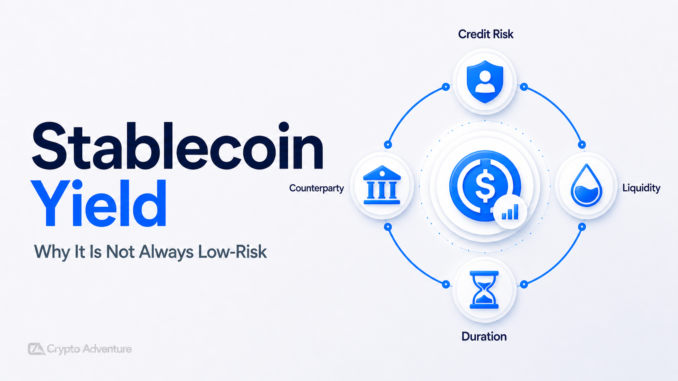

Stablecoin yield can look safer than ordinary crypto yield because the asset is designed to stay near one dollar. That can create a false sense of safety. A stablecoin may be less volatile than ETH or SOL, but the yield strategy behind it can still carry serious risk.
The main risk is misunderstanding the source of yield. A stablecoin itself does not magically produce income. Yield must come from somewhere: borrowers, Treasury bills, DeFi trading fees, lending markets, funding rates, token incentives, market makers, structured credit, or protocol reserves. Each source has a different risk engine.

A low-looking yield can still be risky if the collateral is weak. A high yield can be sustainable for a period if real borrowers or Treasury assets support it. The right question is not only how much yield a stablecoin pays. It is why the yield exists, who pays it, and what breaks if market conditions change.
Where Stablecoin Yield Comes From
Stablecoin yield usually comes from five main sources. The first is lending demand. Users borrow stablecoins from lending protocols and pay interest to suppliers. The second is Treasury or money market income, where the stablecoin or tokenized product holds cash-like assets that generate yield.
The third is liquidity provision. Users provide stablecoins to pools and earn trading fees or incentives. The fourth is derivatives funding. A protocol may use delta-neutral positions and capture funding-rate differences. The fifth is token incentives, where rewards are paid in protocol tokens to attract deposits.
These sources are not equal. Treasury-backed yield has different risk from perp funding. Lending yield has different risk from token incentives. Liquidity pool yield has different risk from a savings-rate token. Users need to identify the engine before judging the APY.
Lending Yield Risk
Lending markets are one of the most common stablecoin yield sources. A user supplies USDC, USDT, DAI, USDS, or another stablecoin into a protocol. Borrowers pay interest. Suppliers earn a portion of that interest.
Aave’s risk documentation shows why this is not risk-free. Collateral values and liquidity can fluctuate, which can create undercollateralization or bad debt. Aave mitigates risk with parameters such as loan-to-value ratios, liquidation thresholds, caps, and risk monitoring, but mitigation is not elimination.
Stablecoin lending can also face depeg risk. If the supplied asset, borrowed asset, or collateral asset moves away from its expected value, liquidations can become messy. High utilization can raise rates but also reduce withdrawal liquidity. Smart contract bugs, oracle failures, and governance mistakes can also affect lenders.
Tokenized Treasury Yield Risk
Tokenized Treasury yield often looks safer because the underlying assets can be short-term U.S. government debt or money market instruments. That can be lower risk than unsecured crypto lending, but it is still not risk-free.
Ondo’s USDY gives a clear example of the warning users should expect. USDY is a yield-bearing token backed by short-term U.S. Treasuries and bank deposits, but holders can still incur losses, including total loss of the purchase price. That warning matters because tokenized Treasury products still depend on issuer structure, custody, legal rights, redemption terms, transfer restrictions, and operational controls.
Tokenized Treasury yield is strongest when the issuer is transparent, the assets are liquid, the custodian is credible, redemptions are clear, and the legal claim is easy to understand. It weakens when access is restricted, redemption is unclear, or the token trades separately from net asset value.
Synthetic Dollar Yield Risk
Synthetic dollar systems can generate yield through derivatives, staking assets, or funding-rate strategies. These systems can be powerful, but they introduce risks that simple reserve-backed stablecoins do not have.
Ethena’s risk documentation covers funding risk, liquidation risk, custodial risk, exchange failure risk, backing asset risk, and stablecoin-related risk. The protocol can earn from funding, but can also be required to pay funding when rates are persistently negative.
That is the important lesson. A high synthetic-dollar yield may depend on market structure staying favorable. If funding rates turn negative, collateral falls, exchanges fail, custody breaks, or hedges malfunction, the yield engine can become a loss engine.
Savings-Rate Token Risk
Savings-rate tokens can make yield look simple. A user deposits a stablecoin, receives a savings version, and the token balance or exchange rate grows over time.
Spark’s Savings USDS documentation shows a clearer version of this model. Savings USDS deposits USDS into the Sky Savings Rate, and sUSDS lets users receive returns while still being able to transfer, stake, lend, or use the token elsewhere.
The risk is not only the vault interface. Users still need to understand the underlying stablecoin, governance controls, savings-rate changes, liquidity intents, withdrawal mechanics, and any protocol dependencies. A savings token can feel cash-like, but it remains tied to smart contracts, governance, and the stability of the underlying asset.
Liquidity Pool Risk
Stablecoin liquidity pools can look low-risk when both assets are dollar-pegged. A USDC/USDT pool may appear safer than a volatile token pair because prices should remain close.
The risk appears when one stablecoin depegs or withdrawals become unbalanced. Liquidity providers can end up holding more of the weaker asset. Pool fees may not compensate for a serious depeg. Incentive rewards can also mask weak organic demand.
Stablecoin LP yield should be reviewed by pool composition, asset quality, depth, withdrawal liquidity, protocol risk, oracle design, and historical behavior during stress. A stable pair is not automatically a safe pair.
Incentive Yield Risk
Some stablecoin yields come mainly from token rewards. A protocol may pay depositors in its own token to attract liquidity. This can create high APYs, but the yield depends on reward-token value.
If the reward token falls, real returns fall. If emissions stop, depositors may leave. If deposits are mercenary, liquidity can disappear quickly. Incentive yield can be useful during bootstrapping, but it is weaker than yield from real borrowers, fees, or Treasury assets.
Users should separate base yield from incentive yield. A 12% APY made of 3% real yield and 9% volatile rewards is not the same as a 12% yield from strong organic demand.
Main Stablecoin Yield Risks
- The first risk is depeg risk. The stablecoin can move away from one dollar.
- The second risk is smart contract risk. The vault, lending market, bridge, or strategy can break.
- The third risk is liquidity risk. Users may not be able to withdraw at the expected time or price.
- The fourth risk is counterparty risk. Issuers, custodians, exchanges, fund managers, or borrowers can fail.
- The fifth risk is strategy risk. Funding rates, collateral values, loan performance, or trading conditions can move against the yield engine.
How Users Should Review Stablecoin Yield
Users should start by identifying the yield source. Borrower interest, Treasury income, funding rates, trading fees, and token rewards carry different risk.
Next comes withdrawal. A yield product is weaker if exits are slow, gated, expensive, or dependent on thin liquidity.
Then comes collateral and backing. Users should check whether assets are on-chain, off-chain, rehypothecated, custodied, lent out, or used in derivatives.
Finally, users should ask who loses first. In a stress event, losses may fall on token holders, liquidity providers, junior tranches, insurance funds, protocol treasuries, or late withdrawers. That loss waterfall matters more than the headline APY.
Conclusion
Stablecoin yield is not automatically low-risk because the word stable only describes the target price of the asset, not the safety of the yield engine. Yield can come from lending, Treasuries, liquidity pools, derivatives, savings-rate systems, or incentives, and each source can fail in a different way.
The strongest stablecoin yield products explain where returns come from, how withdrawals work, what assets back the position, who controls the contracts, and what happens during stress. Users should compare yield by risk source, not by APY alone. A lower yield with clear backing and redemption can be safer than a higher yield built on fragile incentives or complex market exposure.


Be the first to comment