

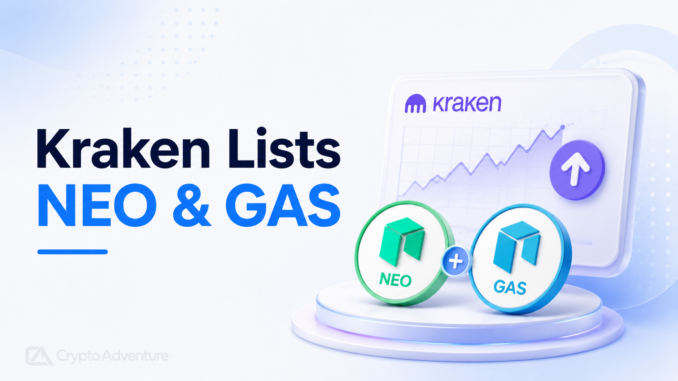
Kraken has added NEO and GAS to its “Tokens launching soon” roadmap, giving Neo’s dual-token ecosystem a fresh visibility boost on a major global crypto exchange.
The listing signal first appeared through the Kraken Listings account on X, which said NEO and GAS were “coming soon.” Kraken’s asset listings roadmap also placed Neo under upcoming chain support, with both NEO and GAS shown in the launch queue. At publication time, Kraken’s NEO market page still indicated roadmap status rather than live spot availability, so the cleaner read is that support is incoming until Kraken activates deposits and trading.

The distinction matters for traders because a roadmap placement is not the same as a fully live market. Exchange listings usually move through stages that can include technical integration, deposit enablement, order-book preparation, regional availability checks, and then live trading. Users should wait for Kraken’s final market notice before sending funds, especially for assets that depend on native-chain deposit routing.
Neo’s Dual-Token Model Gets A Fresh Exchange Catalyst
Neo is one of the older smart contract platforms in crypto, originally launched as Antshares before rebranding to Neo. The network uses a dual-token structure: NEO is the governance asset, while GAS is the utility token used to pay for network fees, smart contract execution, and other on-chain operations.
Neo’s own token materials frame NEO holders as participants in network governance, with GAS distributed through the ecosystem and used as the operational fuel of the blockchain. Kraken’s educational page on Neo also describes Neo as a software network for decentralized products and services, with NEO tied to protocol voting and GAS tied to computation costs.
That split gives the Kraken move more depth than a standard single-token listing. NEO access can appeal to users who want governance exposure to the network, while GAS access can serve users who need the fee asset for activity on Neo-based applications. The listing can also improve price discovery by bringing both sides of the network’s economic model into the same regulated exchange environment.
Market Impact Depends On Real Liquidity
NEO and GAS remain mid-cap assets compared with the largest smart contract networks. CoinGecko showed NEO with a market value around $206 million to $210 million, while GAS was valued near $108 million to $109 million. Those sizes make exchange liquidity more important because new order books can affect spreads, routing, and short-term volatility more visibly than they would for mega-cap assets.
Kraken’s listing roadmap also lands during a broader expansion period for the exchange. Parent company Payward has been pushing deeper into payments, tokenized assets, and institutional infrastructure, including a recent stablecoin payments push. Adding NEO and GAS fits a wider pattern of exchange product growth, where platforms compete not only on major pairs but also on curated access to older networks with established communities.
The near-term test is simple in operational terms: deposits, trading pairs, regional availability, and order-book depth. If Kraken activates both tokens with reliable native-chain support, Neo users gain another centralized liquidity route for governance exposure and transaction-fuel access. If launch details remain limited, the roadmap placement still matters, but the real market impact will come only when users can deposit, trade, and withdraw NEO and GAS without friction.



Be the first to comment